
info@ucallmlabs.com
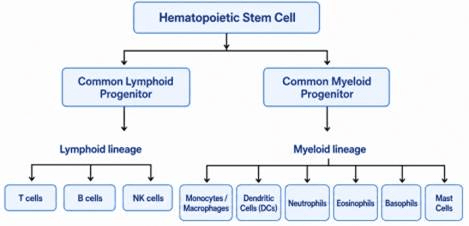
Hematopoietic stem cells (HSCs) are the fundamental cellular source responsible for the generation and maintenance of immune cells. HSCs possess long-term self-renewal capacity and multilineage differentiation potential. Through a series of processes involving hematopoietic progenitor formation and lineage commitment, HSCs give rise to both lymphoid and myeloid lineages, ultimately generating mature immune cells, including T cells, B cells, NK cells, monocytes, macrophages, dendritic cells, and various granulocytes.
Although different immune cell types share a common hematopoietic origin, their development is regulated by distinct transcription factors, cytokine signals, and tissue microenvironments, leading to the acquisition of diverse phenotypes and specialized immune functions.
(Click to explore the Hematopoietic Stem Cell topic)
Major Regulatory Factors
| Cell Type | Key Differentiation / Maintenance Factors |
| HSCs (Hematopoietic Stem Cells) | SCF, TPO, FLT3L |
| T Cells | IL-7, IL-15 |
| B Cells | IL-7, BAFF |
| NK Cells | IL-15, IL-2 |
| Monocytes | M-CSF, GM-CSF |
| Macrophages | M-CSF, GM-CSF |
| Dendritic Cells | FLT3L, GM-CSF |
| Neutrophils | G-CSF, GM-CSF |
| Eosinophils | IL-5, IL-3, GM-CSF |
| Basophils | IL-3 |
| Mast Cells | SCF, IL-3 |