
info@mail.ucallm.com
Bone tissue is regulated not only by bone cells but also by the immune system and inflammatory milieu. Explore our immune cell research portfolio.
Bone tissue is continuously regulated by bone-resident cells including osteoblasts, osteoclasts and osteocytes, as well as immune cells, inflammatory cytokines, bone marrow stromal cells and the local microenvironment. A complex bidirectional regulatory relationship exists between bone and the immune system. Immune cells can modulate osteogenic and osteoclastic processes via cytokines, chemokines and receptor–ligand signaling. In turn, bone cells and the bone marrow microenvironment can regulate the differentiation, migration and function of immune cells. Osteoimmunology is an important interdisciplinary field investigating the crosstalk between the skeletal and immune systems and their mechanisms in health and disease.
Therefore, by establishing monoculture, co-culture and three-dimensional models of immune cells and bone-resident cells, we can study the interactions among immune cells, osteoblasts, osteoclasts and bone marrow stromal cells, and further dissect the relationships among inflammatory microenvironment, immune regulation and bone metabolism.
1 Immune–Bone Cell Crosstalk
The bone marrow serves as a critical site for the generation, maintenance and differentiation of immune cells, and also constitutes the microenvironment where bone formation and resorption take place. T cells, B cells, monocytes/macrophages and other immune cells can regulate the functions of osteoblasts and osteoclasts by secreting cytokines and expressing specific receptors or ligands. For instance, activated T and B cells participate in the regulation of RANKL signaling, thereby affecting osteoclast formation; macrophages are involved in inflammatory responses, tissue repair and bone remodeling.
On the other hand, bone-resident cells can reciprocally modulate the immune microenvironment. Osteoblasts, bone marrow stromal cells and osteocytes produce cytokines, chemokines and growth factors to provide a local niche for immune cells and hematopoietic cells. Therefore, investigating the bidirectional communication between immune cells and bone cells helps us understand normal bone homeostasis as well as pathological processes such as inflammation, osteoporosis and impaired bone repair.
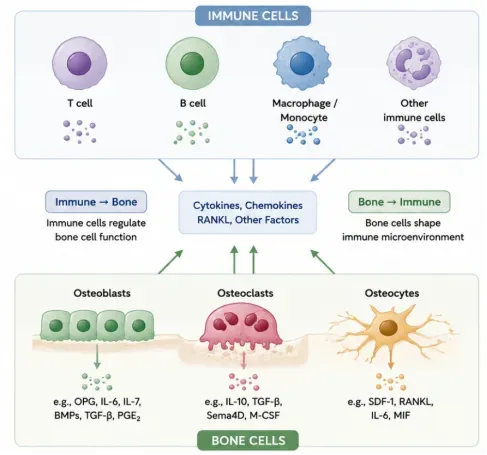
Schematic of immuno-osteology. Immune cells and bone cells communicate bidirectionally through cytokines, chemokines and RANKL; immune cells modulate bone cell function while bone cells remodel immune niche.
2 Inflammation & Bone Metabolism
Inflammatory response represents a critical mechanism linking the immune system and bone metabolism. Transient and moderate inflammation plays an essential role in tissue clearance and repair after bone fracture. However, persistent or aberrant inflammation can enhance osteoclast activity and suppress osteogenic function, ultimately leading to elevated bone resorption and bone destruction. Studies on fracture repair have demonstrated that inflammation participates in multiple phases of bone repair, and dysregulated inflammatory responses may impair subsequent bone formation and tissue remodeling.
In vitro inflammatory bone cell models can be established by stimulation with inflammatory cytokines including TNF-α, IL-1β, IL-6 and IL-17. These models are used to observe functional changes in osteoblasts, osteoclasts and MSCs under inflammatory conditions. Combined with investigations of signaling pathways such as NF-κB, MAPK, JAK-STAT and the NLRP3 inflammasome, we explore inflammation-mediated dysregulation of bone metabolism.
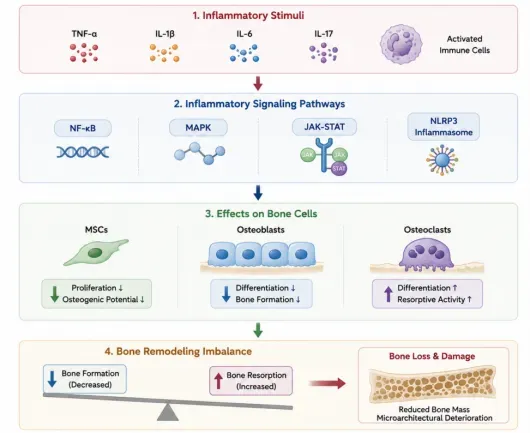
Schematic of inflammatory cascade leading to bone loss. Inflammatory cytokines activate NF-κB, MAPK, JAK-STAT and NLRP3 inflammasome, suppressing osteogenesis and boosting osteoclast activity, which disrupts bone homeostasis and causes bone damage.
3 Osteoclastogenesis & Immune Regulation
Osteoclasts originate from the monocyte/macrophage lineage of the hematopoietic system and serve as the primary effector cells for bone resorption. Their differentiation and maturation are governed by key signals such as RANKL and M-CSF. RANKL and a variety of inflammatory cytokines produced by immune cells can modulate the recruitment, differentiation and activation of osteoclast precursors. Therefore, osteoclasts act as critical cellular mediators linking the immune system and bone metabolism in osteoimmunology research.
In vitro models of osteoclast differentiation from monocytes/macrophages, combined with co-culture systems with osteoblasts, MSCs or immune cells, can be applied to investigate how immune signals affect osteoclast formation and bone resorptive function. Such models are also used to study inflammation-associated bone destructive diseases including osteoporosis, rheumatoid arthritis and periodontitis, as well as the mechanisms of action of anti-resorptive drugs.
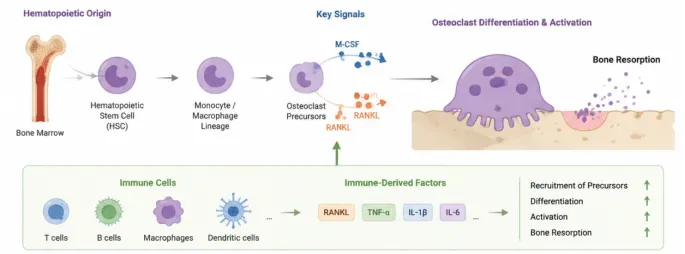
Schematic of osteoclast differentiation, activation and immune regulation. Osteoclasts originate from hematopoietic stem cells; M-CSF and RANKL drive maturation. Immune cells secrete cytokines to enhance precursor recruitment, differentiation and bone resorption.
4 Bone Marrow Immune Microenvironment
The bone marrow is not only an important source of cells within bone tissue, but also serves as a vital niche for the maintenance of hematopoietic and immune cells. Bone marrow stromal cells, MSCs, osteoblasts, vascular endothelial cells and immune cells collectively form a complex bone marrow microenvironment. They regulate bone metabolism and immune function through multiple modes including cell‑cell contact, cytokines and extracellular matrix.
By establishing multicellular 3D co-culture systems such as MSCs with immune cells, and osteoblasts with macrophages, we can recapitulate cellular crosstalk within the bone marrow microenvironment, and investigate how distinct cell populations jointly modulate bone formation, bone resorption, inflammatory responses and tissue repair. Such models can be further applied to the research of osteoporosis, bone aging, bone tumors and bone injury repair.
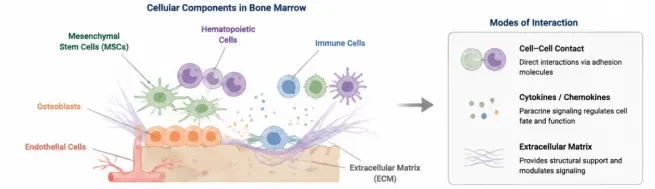
Schematic of bone marrow cellular components and cellular crosstalk. Multiple cell types and ECM reside in marrow niche; cell-cell contact, cytokine/chemokine paracrine signaling and ECM mediate intercellular communication.
5 Immunomodulation & Bone Regeneration
Bone regeneration is not a simple osteogenic process, but involves multiple sequential stages including inflammatory response, immune cell recruitment, angiogenesis, stem cell differentiation and tissue remodeling. In particular, immune cells such as macrophages play essential roles in the early inflammatory response upon injury and subsequent tissue repair. A 2024 study published in Bone Research investigated dynamic changes of immune cells during bone repair via multimodal analysis, and indicated that macrophages may serve as important regulatory targets for musculoskeletal injury regeneration.
Therefore, in bone tissue engineering research, MSCs, osteoblasts, endothelial cells and immune cells are further combined with biomaterials to explore how materials modulate immune responses and promote osteogenesis and angiogenesis. This supports the development of immunomodulatory bone tissue-engineered biomaterials and regenerative strategies.
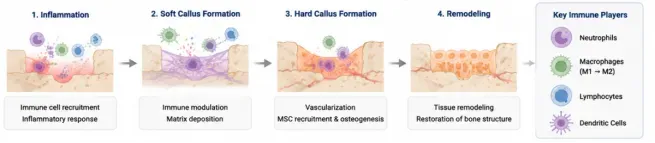
Schematic of fracture healing and immune regulation. Fracture repair includes inflammation, soft callus, hard callus and remodeling phases. Neutrophils, macrophages and other immune cells orchestrate bone regeneration.
Products:
Cells & Culture: Cytokines, Serum
Signaling Pathway Tools: Antibodies, Inhibitors / Agonists, Genetic Manipulation (Transfection)
Functional Assays: TRAP staining, ELISA (inflammatory factors), Antibodies, TSA Kits
Co-culture & Microenvironment: 3D Culture Related Products
Exosome Research: Exosome Assay Kits