
info@ucallmlabs.com
Immune cells are essential functional cells that maintain immune defense and immune homeostasis in the body. They play central roles in infection defense, inflammation regulation, tumor immunity, tissue repair, and the study of immune-related diseases. With the development of single-cell sequencing, multi-omics analysis, cell therapy, and immune engineering technologies, immune cells have become important research subjects in the fields of life science research and innovative drug development.
In basic research, immune cell models are widely used to elucidate immune signaling pathways, investigate cellular functions, explore disease mechanisms, and evaluate drug screening. In the field of translational medicine, technologies involving immune cells such as T cells, NK cells, and macrophages have become important directions for the development of cancer immunotherapy, cell therapy, and precision medicine.
Immune cells are an important group of cells that constitute the immune system. They are mainly derived from hematopoietic stem cells (HSCs) and undergo different processes of differentiation and maturation to form immune cells with diverse functions. According to the characteristics of immune responses, immune cells can be broadly divided into two major categories: innate immune cells and adaptive immune cells.
Innate immune cells include neutrophils, monocytes, macrophages, dendritic cells, NK cells, mast cells, eosinophils, basophils, and innate lymphoid cells (ILCs). They can rapidly recognize pathogens or signals of tissue damage and exert early defense functions through phagocytosis, cytotoxicity, inflammatory responses, and cytokine release. Adaptive immune cells mainly include T cells and B cells, which recognize antigens through highly specific antigen receptors and participate in cellular immunity and humoral immunity, respectively, while also generating immune memory.
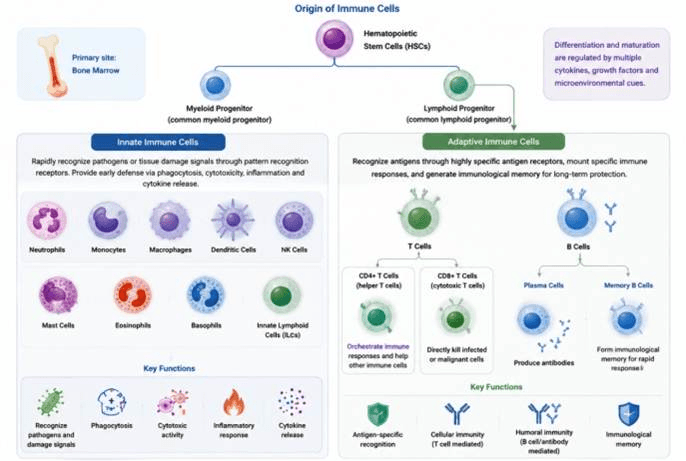
Schematic Diagram of Immune Cell Origins and Functional Classification. Immune cells are derived from hematopoietic stem cells and mainly include innate immune cells and adaptive immune cells. Different immune cells work together to participate in host defense and the maintenance of immune homeostasis through processes such as pathogen recognition, antigen presentation, cytokine regulation, and immune memory formation.
Different immune cells do not function independently. Instead, they form a complex immune regulatory network through antigen presentation, cytokines, chemokines, and cell–cell interactions, collectively participating in important physiological processes such as pathogen clearance, abnormal cell surveillance, inflammation regulation, tissue homeostasis maintenance, and the establishment of immune memory.
Based on different immune cell types and research needs, we provide high-quality immune cell-related products and technical support, covering immune cell culture, functional analysis, cytokine stimulation, immune detection, and related experimental applications, thereby supporting researchers in conducting studies on immune mechanisms, drug evaluation, and cell therapy.
Important current research areas in immune cell research include immune cell heterogeneity and single-cell analysis, the immune microenvironment and intercellular communication, tumor immunity and immune evasion, immune cell metabolism and epigenetic regulation, immune-related disease models, and engineered immune cell therapies. In particular, in the field of tumor immunology, researchers are using single-cell and spatial multi-omics approaches to characterize the states and interactions of T cells, NK cells, macrophages, dendritic cells, and other immune cells within the tumor microenvironment, while enhancing the targeted recognition and antitumor capabilities of immune cells through cell engineering technologies such as CAR-T and CAR-NK. In the future, immune cell research will further evolve from functional analysis of individual cell types toward integrated studies of multicellular interactions, spatial microenvironments, dynamic immune states, and precision cell therapies.
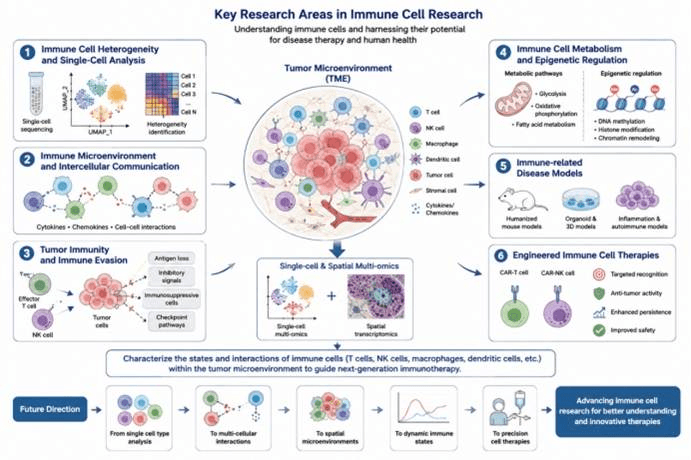
Key Research Areas in Immune Cell Research. Major areas include immune cell heterogeneity, intercellular communication, tumor immunity, metabolism and epigenetic regulation, disease models, and engineered immune cell therapies. Single-cell and spatial multi-omics provide insights into immune cell states and interactions, supporting the development of precision cell therapies.