
info@mail.ucallm.com
Polyethylenimine (PEI) is a class of cationic polymers with a high density of amino groups. Due to its strong nucleic acid-binding capacity and pronounced charge characteristics, PEI is widely used in non-viral nucleic acid delivery and gene transfection research. The amino groups in PEI can undergo protonation under different conditions and interact electrostatically with negatively charged nucleic acids such as DNA and RNA to form stable polymer–nucleic acid complexes (polyplexes), thereby enabling nucleic acid condensation, protection, and cellular delivery. With its relatively simple operation, strong nucleic acid-binding capacity, and good structural tunability, PEI has become one of the classic and widely used cationic polymers in non-viral gene delivery research. PEI is used not only for conventional plasmid DNA transfection, but also in the delivery of siRNA, miRNA, mRNA, and other nucleic acid molecules. Beyond life science research, PEI is also used in drug delivery, nanomaterials, biomedical materials, water treatment, papermaking, coatings, and other fields due to its abundant amino groups and good chemical modification capability. Therefore, PEI is both a classic nucleic acid delivery material and a functional polymer with broad application potential.
What Is PEI?
PEI is a polymer composed of ethyleneimine repeating units. According to its molecular structure, PEI can be mainly classified into linear PEI and branched PEI. Its molecular structure contains large numbers of primary, secondary, and tertiary amine groups, which give PEI a high cationic charge density and strong protonation capacity and provide an important structural basis for its role in nucleic acid delivery. During nucleic acid transfection, the phosphate backbones of DNA and RNA are generally negatively charged, while the protonated amino groups of PEI carry positive charges. The two can interact electrostatically to form PEI–nucleic acid complexes. PEI can condense relatively dispersed nucleic acid molecules into more compact complex structures, making the nucleic acids more suitable for interactions with cells and cellular uptake. After entering the cell, the polyamine structure and buffering capacity of PEI are also considered to contribute to the endosomal escape process, thereby helping the nucleic acids enter the intracellular environment and exert their biological functions.
Why Is PEI Widely Used in Research?
The widespread use of PEI in life science research is closely associated with its unique properties as a cationic polymer. First, PEI has strong nucleic acid-binding and condensation capabilities and can form stable polyplexes with negatively charged nucleic acids such as DNA and RNA, providing a basis for nucleic acid delivery into cells. Second, PEI contains numerous protonatable amino groups and has strong buffering capacity under acidic endosomal conditions, a property considered to contribute to the endosomal escape of some PEI–nucleic acid complexes. In addition, the structure and molecular weight of PEI can be modulated to some extent. Changes in polymer structure or molecular weight, as well as chemical modification, can be used to regulate nucleic acid binding, delivery performance, and biocompatibility. Compared with some more complex delivery systems, conventional PEI-mediated transfection generally offers relatively simple operation, convenient material availability, and low cost. Therefore, PEI has long been widely used for plasmid DNA transfection, transient protein expression, gene function studies, and nucleic acid delivery research. In experimental studies, PEI is also frequently used as a classic cationic polymer system for evaluating and comparing the performance of other novel non-viral nucleic acid delivery materials.
Why Is PEI Also Widely Used in Industrial Applications?
The applications of PEI are not limited to gene transfection. Its abundant amino groups and cationic properties also make it highly valuable in materials and industrial applications. PEI can interact with various negatively charged molecules, particles, and materials through electrostatic interactions, making it useful for surface modification, adsorption, flocculation, and functional material construction. Meanwhile, the large number of amino groups in PEI provides reactive sites for chemical conjugation and functional modification, allowing its structure to be designed and its properties adjusted according to different industrial requirements. In water treatment, PEI can utilize its cationic properties for pollutant adsorption, particle flocculation, and material surface modification. In papermaking, textiles, coatings, adhesives, and other fields, PEI can also function as a functional polymer to improve interactions between materials. Therefore, PEI combines biomedical and materials chemistry applications and represents a functional polymer with strong platform characteristics.
Common Applications of PEI
In life science research, the most established application of PEI is non-viral nucleic acid transfection. PEI can be used for plasmid DNA delivery to achieve exogenous gene expression, reporter gene assays, and recombinant protein expression. It can also be used to deliver RNA molecules such as siRNA and miRNA for gene knockdown, gene function studies, and signaling pathway analysis. In some research systems, PEI has also been investigated for the delivery of mRNA and other nucleic acid molecules.
PEI is also widely used for transient protein expression in mammalian cells. By introducing expression plasmids encoding target proteins into cells, relatively high levels of exogenous protein expression can be obtained within a short period of time. Therefore, PEI is commonly used in research involving recombinant proteins, antibodies, and other protein expression applications. In biotechnology production and viral vector research, PEI-mediated plasmid transfection can also be used to introduce multiple expression plasmids into producer cells, providing a basis for subsequent protein or viral vector production.
Beyond nucleic acid delivery, PEI is also used in gene delivery, drug delivery, and nanomaterial research. Researchers can functionalize PEI through PEGylation, targeting ligand modification, incorporation of biodegradable structures, and other approaches to construct PEI-derived materials with different delivery properties. These studies have promoted the development of PEI from a conventional transfection reagent into a functionalized nucleic acid delivery platform.
Basic Mechanism of PEI-Mediated Nucleic Acid Transfection
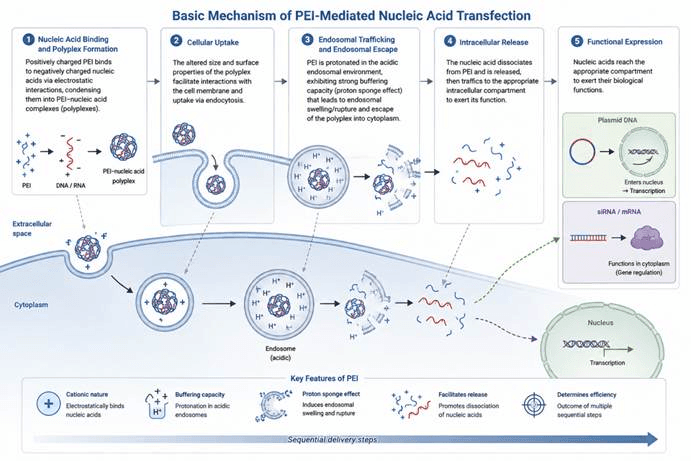
PEI-mediated nucleic acid delivery can be broadly described as a series of processes including nucleic acid binding, polyplex formation, cellular uptake, endosomal escape, and intracellular release. First, negatively charged DNA or RNA interacts electrostatically with positively charged PEI, allowing the nucleic acid to become progressively condensed by the polymer and form PEI–nucleic acid complexes. Following complex formation, the size and surface properties of the nucleic acid are altered, facilitating interactions with the cell membrane and cellular uptake through pathways such as endocytosis.
After entering the cell, PEI–nucleic acid complexes typically undergo endosomal trafficking. PEI has strong protonation and buffering capacity, and its protonation under the acidic conditions within endosomes is considered to contribute to endosomal escape. Following successful escape, the nucleic acid must further dissociate from the polymer complex and reach the appropriate intracellular compartment to exert its biological function.
For plasmid DNA, the nucleic acid ultimately needs to enter the nucleus and undergo transcription. In contrast, RNA molecules such as siRNA primarily exert their gene-regulatory functions in the cytoplasm. Therefore, the efficiency of PEI-mediated transfection is actually determined by the combined effects of multiple sequential delivery steps.
Main Types of PEI
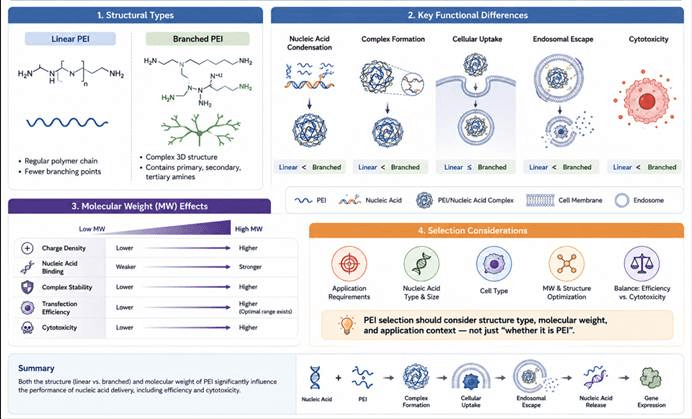
According to their molecular structures, PEI can be mainly classified into linear PEI and branched PEI. Linear PEI has a relatively regular polymer chain structure, whereas branched PEI has a more complex three-dimensional structure and contains different types of amino groups. Different PEI structures may differ in their nucleic acid condensation ability, complex formation, cellular uptake, endosomal escape, and cytotoxicity. In addition to structural type, the molecular weight of PEI is also an important factor affecting its transfection performance. In general, molecular weight can influence the charge density, nucleic acid binding ability, and complex stability of PEI, and may also affect cytotoxicity. Therefore, when selecting a PEI material, it is important to consider not only whether it is a PEI, but also its specific molecular structure, molecular weight, and intended application.
Main types of PEI.
What Factors Should Be Considered When Evaluating PEI Materials?
When evaluating PEI materials, it is necessary to comprehensively consider factors such as molecular structure, molecular weight, charge characteristics, nucleic acid binding capacity, complex properties, and cytocompatibility. PEI with different molecular weights and structures may exhibit different nucleic acid condensation capacities and cellular delivery efficiencies, while the ratio between PEI and nucleic acids can also directly affect complex formation and the final transfection performance.
In addition to the material itself, attention should also be paid to the particle size and surface charge of PEI–nucleic acid complexes, as well as the stability of these complexes under culture conditions. For actual transfection experiments, parameters such as PEI concentration, nucleic acid concentration, PEI-to-nucleic acid ratio, cell density, and culture conditions can also affect the final results. Therefore, PEI performance should not be evaluated based on a single transfection efficiency parameter, but rather through a comprehensive assessment combining cell viability, cell morphology, target gene expression, and other relevant indicators.
Why Does PEI Transfection Require Optimization?
Although PEI has broad applicability, there is no universal transfection condition that works for all cell types and nucleic acid types. The same PEI material may achieve good transfection performance in common cell lines such as HEK293, HeLa, and CHO, while its transfection efficiency and cellular tolerance may differ substantially when applied to primary cells, stem cells, neuronal cells, or certain immune cells. Therefore, PEI transfection needs to be specifically optimized according to the cell type, nucleic acid type, and experimental purpose.
When optimizing PEI transfection, cells should first be maintained in a healthy and stable growth state, with an appropriate cell density selected. On this basis, gradients can be established by adjusting the amount of nucleic acid, the amount of PEI, and the PEI-to-nucleic acid ratio, while simultaneously monitoring transfection efficiency and cell viability. For cells that are particularly sensitive to external stimuli, additional attention should be paid to post-transfection cell morphology, proliferation capacity, and normal biological functions.
How Should PEI Transfection Efficiency Be Evaluated?
PEI transfection performance should not be evaluated solely based on the percentage of transfection-positive cells. An ideal transfection system should provide high nucleic acid delivery efficiency, low cytotoxicity, and stable and reproducible biological effects. During optimization, reporter genes such as GFP and RFP can be used to initially evaluate the efficiency of nucleic acid delivery and expression, while cell viability and morphology should be assessed simultaneously to determine whether PEI treatment causes significant cellular damage.
For functional experiments, further evaluation should include target gene expression, protein expression, gene knockdown efficiency, or other relevant biological endpoints. Ultimately, transfection efficiency, cell viability, and biological function should be evaluated together rather than simply pursuing the highest percentage of fluorescent-positive cells. In some experiments, a slightly lower but more stable, less toxic, and more reproducible transfection condition may be more practically valuable than a condition that simply achieves the highest transfection rate.
PEI and Hard-to-Transfect Cells
For hard-to-transfect cells such as primary cells, stem cells, neuronal cells, and certain immune cells, PEI transfection conditions optimized for common cell lines such as HEK293 or HeLa should not be directly applied. These cell types are often more sensitive to extracellular stimuli, cationic materials, or the transfection process itself. Therefore, the optimization focus should shift from simply increasing transfection efficiency to achieving a balance between transfection efficiency and cellular health.
For primary cells and stem cells, particular attention should be paid to post-transfection cell survival, proliferation, and phenotypic changes. For neuronal cells, especially mature neurons, the impact of the transfection process on neurite morphology and neuronal structure should be minimized. For immune cells such as T cells, B cells, and NK cells, factors such as suspension growth, low proliferation rates, and sensitivity to external stimuli should be considered. When conventional PEI-mediated transfection does not achieve satisfactory results, different PEI structures and molecular weights can be compared, or alternative delivery methods such as electroporation, nucleofection, or other non-viral and viral delivery approaches can be considered according to the specific cell characteristics.
Advantages and Limitations of PEI
As a classic cationic polymer, PEI offers several advantages, including strong nucleic acid binding capacity, efficient nucleic acid condensation, relatively simple operation, low cost, and structural modifiability. It has therefore been widely used in non-viral nucleic acid delivery research for many years. PEI also provides a versatile platform for further optimization. Its delivery properties can be modulated by altering molecular weight, linear or branched structure, or introducing different functional groups.
However, PEI also has certain limitations. Although a high cationic charge density favors nucleic acid binding and delivery, it may also increase cytotoxicity. Some conventional PEI materials also have relatively low biodegradability and limited biocompatibility. Therefore, an important direction in PEI research is to improve biocompatibility while maintaining nucleic acid delivery capability by reducing cationic charge density, introducing biodegradable structures, or applying PEGylation and targeting modifications.
Development Directions of PEI Materials
With the development of non-viral nucleic acid delivery technologies, PEI has gradually evolved from a traditional “single-function cationic polymer” into a versatile platform with multiple functionalization strategies. Through structural optimization and chemical modification, researchers can further regulate PEI-mediated nucleic acid binding, cellular uptake, endosomal escape, and intracellular release while reducing nonspecific cytotoxicity.
Currently, low-toxicity PEI, biodegradable PEI, PEG-modified PEI, targeted PEI, and stimulus-responsive PEI derivatives have received increasing attention. These next-generation PEI systems aim to address the limitations of conventional PEI in terms of biocompatibility and in vivo delivery, and to advance PEI from a laboratory transfection material toward a more sophisticated and multifunctional nucleic acid delivery platform.