
info@mail.ucallm.com
1. Overview
Salmonella is a genus of Gram-negative, facultative anaerobic bacilli in the family Enterobacteriaceae and is the causative agent of salmonellosis. The genus is one of the leading causes of foodborne illness worldwide. Non-typhoidal Salmonella (NTS) is estimated to cause 93.8 million infections annually, resulting in significant global morbidity and mortality.
The genus Salmonella comprises two species: Salmonella enterica and Salmonella bongori. S. enterica is further divided into six subspecies and over 2,500 serovars. Clinically, Salmonella can be divided into typhoidal Salmonella (e.g., S. Typhi and S. Paratyphi A, causing enteric fever) and non-typhoidal Salmonella (NTS, e.g., S. Typhimurium and S. Enteritidis, primarily causing gastroenteritis). Typhoidal Salmonella is host-specific, infecting only humans, whereas NTS has a broad host range and can be transmitted between humans and animals.
The World Health Organization (WHO) has listed Salmonella as a priority foodborne pathogen. The global spread of multidrug-resistant (MDR) Salmonella lineages and the emergence of high-risk serovars such as monophasic S. Typhimurium and S. Infantis pose serious challenges for disease control.
2. Background Information
2.1 What is Salmonella?
Salmonella is a Gram-negative, facultative anaerobic bacillus of the family Enterobacteriaceae. The genus was first isolated in 1885 by the team of American veterinary pathologist Daniel Elmer Salmon. Salmonella is catalase-positive and oxidase-negative; most strains possess peritrichous flagella and are motile. The bacteria can colonize the intestinal tracts of humans and animals, are transmitted via the faecal-oral route, and cause a spectrum of diseases ranging from self-limiting gastroenteritis to fatal systemic infection.
2.2 Genome & Classification
The Salmonella genome is a circular chromosome of approximately 4.6–5.2 Mb. The genome of S. Typhi CT18 is approximately 4.8 Mb, containing about 4,600 coding sequences. The genome of S. Typhimurium LT2 is approximately 4.9 Mb, containing about 4,500 genes.
The taxonomy of Salmonella is complex, and a two-species classification system is currently used:
Taxonomic Level | Content |
Genus | Salmonella |
Species | S. enterica, S. bongori |
S. enterica subspecies | enterica, salamae, arizonae, diarizonae, houtenae, indica |
Serovars | Over 2,500 |
The Salmonella genome is highly plastic, and its pathogenicity is primarily attributed to the presence of Salmonella pathogenicity islands (SPIs) . SPIs are genomic regions acquired through horizontal gene transfer that encode multiple virulence factors. More than 20 SPIs have been identified, among which SPI-1 and SPI-2 are the most important, encoding type III secretion system 1 (T3SS-1) and T3SS-2, respectively.
2.3 What Are Salmonella Virulence Factors?
Salmonella virulence factors can be categorized as follows:
2.3.1 Secretion Systems
T3SS-1 (encoded by SPI-1) : Mediates Salmonella invasion of non-phagocytic cells (e.g., intestinal epithelial cells) and triggers intestinal inflammation. T3SS-1 injects effector proteins (such as SipA, SipC, SopE, SopE2, SopB, etc.) directly into the host cell cytoplasm, promoting bacterial internalization by manipulating the host actin cytoskeleton.
T3SS-2 (encoded by SPI-2) : Mediates Salmonella survival within macrophages and systemic dissemination. T3SS-2 is expressed within the Salmonella-containing vacuole (SCV) and injects effector proteins (such as SifA, SseF, SseG, etc.) into the host cell cytoplasm, modifying the SCV membrane to prevent fusion with lysosomes.
2.3.2 Toxins
Toxin | Main Function |
Typhoid toxin | Specifically expressed by S. Typhi, composed of CdtB, PltA, and PltB subunits; causes DNA damage and cell cycle arrest, associated with the development of typhoid symptoms |
Vi antigen | Capsular polysaccharide expressed by S. Typhi and S. Paratyphi C; exhibits antiphagocytic and immune evasion functions, and interferes with macrophage autophagy |
2.3.3 Adhesins
Protein/Structure | Main Function |
Type 1 fimbriae (Fim) | Mediates bacterial binding to host cell mannose receptors |
Type IVB pili (pil gene cluster) | Encoded by SPI-7; mediates S. Typhi invasion of host cells |
2.3 Mechanism of Infection and Pathogenesis
2.3.1 Adhesion and Invasion
Salmonella infection begins when the bacteria enter the host via the faecal-oral route. Upon reaching the small intestine, Salmonella uses T3SS-1 to invade intestinal epithelial cells. The effector proteins of T3SS-1 manipulate host cells through a series of precise mechanisms:
a. SipA: Stabilizes host actin filaments, promoting membrane ruffle formation
b. SopE/SopE2: Act as guanine nucleotide exchange factors (GEFs), activating host Rho GTPases (Cdc42 and Rac1) and inducing actin rearrangement
c. SopB: Acts as an inositol phosphatase, modulating host cell signalling pathways
Reprogramming role of SopE2: A 2025 study found that the T3SS-1 effector SopE2 reprograms macrophage metabolism, promoting Salmonella intracellular replication and virulence by affecting the serine synthesis pathway.
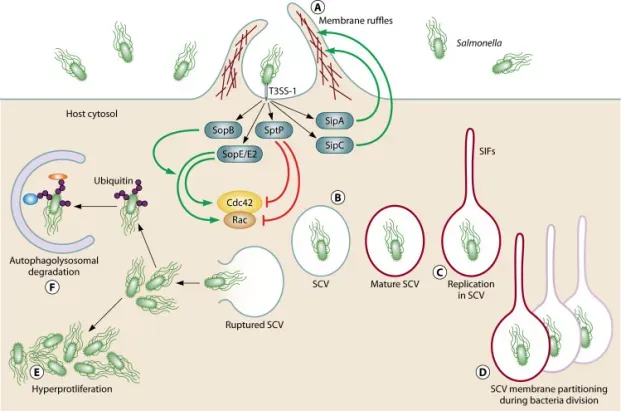
Attachment and internalization of Salmonella in host cell. (PMID: 38415623)
2.3.2 Intracellular Survival and Immune Evasion
After entering host cells, Salmonella forms a Salmonella-containing vacuole (SCV) , which protects it from host immune attack. T3SS-2 effector proteins modify the SCV membrane, preventing fusion with lysosomes and avoiding killing by reactive oxygen and nitrogen species produced by NADPH oxidase and inducible nitric oxide synthase (iNOS).
Immune evasion mechanism of Vi antigen: A 2024 study found that the Vi capsular polysaccharide of S. Typhi is highly expressed early in macrophage infection and inhibits macrophage autophagy by interfering with the expression of Nod2 and Galectin-8, thereby enhancing intracellular survival.
T4519 serine/threonine kinase: The T4519 kinase of S. Typhi manipulates the TLR2-Cystatin B-Cathepsin B-NF-κB-ROS pathway, inducing increased lysosomal membrane permeability and promoting its survival within human macrophages.
2.3.3 Systemic Dissemination
Typhoidal Salmonella (S. Typhi) can manipulate macrophages and disseminate to multiple organ systems. Unlike NTS, typhoidal Salmonella can cross the intestinal epithelial barrier, enter the lymphatic system and bloodstream, and colonize the liver, spleen, and bone marrow, causing systemic infection.
2.4 Transmission Routes and Process
Transmission of Salmonella occurs primarily via the faecal-oral route:
l Foodborne transmission: Ingestion of contaminated food (eggs, poultry, meat, unpasteurized dairy products, and fresh produce) is the most common route
l Waterborne transmission: Drinking contaminated water
l Contact transmission: Contact with infected animals or environments
l Person-to-person transmission: Via the faecal-oral route, possible in settings with poor sanitation
Process: Ingestion of contaminated food or water → Salmonella reaches the small intestine → uses T3SS-1 to invade intestinal epithelial cells → triggers local inflammation and diarrhoea (NTS) or crosses the epithelial barrier into the bloodstream (typhoidal) → survives and replicates within macrophages → disseminates to organs such as the liver and spleen → excreted into the intestine via bile → shed in faeces.
2.5 Symptoms and Treatment
2.5.1 Clinical Symptoms
Non-typhoidal Salmonella (NTS) infection: The incubation period is typically 6 hours to 6 days, primarily manifesting as self-limiting gastroenteritis, including diarrhoea, abdominal cramps, nausea, vomiting, and fever. Symptoms usually last 4–7 days. Immunocompromised individuals, young children, and the elderly may develop more severe disease, such as bloodstream infection, metastatic infection, sepsis, and multi-organ failure.
Typhoidal Salmonella infection (enteric fever) : The incubation period is typically 1–2 weeks, presenting with prolonged high fever, headache, fatigue, anorexia, constipation or diarrhoea. Severe cases may develop intestinal perforation, intestinal haemorrhage, and encephalopathy.
2.5.2 Treatment
Non-typhoidal Salmonella infection: Usually managed with supportive care (fluid and electrolyte management); routine antibiotic use is not recommended because antibiotics may prolong shedding. For high-risk patients (immunocompromised, young children, the elderly), azithromycin or ceftriaxone may be used.
Typhoidal Salmonella infection: Requires antibiotic treatment.
Drug | Recommendation Level | Considerations |
Azithromycin | First-line | Broad-spectrum activity, less resistance development, preferred by physicians |
Ceftriaxone | Use with caution | Caution due to emerging resistance |
Fluoroquinolones | Least recommended | Reduced efficacy due to widespread resistance; not approved for childre |
Amoxicillin | Alternative for children | Best alternative to fluoroquinolones |
2.6 Prevention
l Food safety: Thoroughly cook meat and eggs; avoid raw eggs and unpasteurized dairy products; separate raw and cooked foods; thoroughly wash produce
l Hand hygiene: Thorough handwashing with soap and water or alcohol-based hand sanitizer, especially after contact with animals, handling raw meat, or using the toilet
l Water safety: Drink boiled or bottled water
l Animal management: Strengthen biosecurity measures on livestock and poultry farms to reduce Salmonella transmission among animals
l Vaccination: Typhoid vaccines (Ty21a, Vi polysaccharide vaccine, Vi conjugate vaccine) are available for high-risk populations and travellers
l Surveillance and reporting: Strengthen Salmonella case surveillance and outbreak investigation, implement a One Health strategy integrating human, animal, and environmental surveillance systems
2.7 Targets for Intervention
2.7.1 Pathogen Targets
Target | Protein/Pathway | Biological Function |
T3SS-1 | Type III secretion system | Host cell invasion |
T3SS-2 | Type III secretion system | Intracellular survival |
SopE2 | T3SS-1 effector | Macrophage metabolic reprogramming |
Vi antigen | Capsular polysaccharide | Immune evasion, autophagy inhibition |
T4519 kinase | Serine/threonine kinase | Lysosomal membrane permeability |
2.7.2 Host Targets
Target | Type | Role in Infection |
Cdc42/Rac1 | Rho GTPases | SopE/SopE2-mediated actin rearrangement |
Nod2/Galectin-8 | Pattern recognition receptors | Vi antigen-mediated autophagy inhibition targets |
TLR2 | Pattern recognition receptor | T4519 kinase-mediated lysosomal membrane permeability |
2.8 Vaccine Types and Development Progress
2.8.1 Licensed Typhoid Vaccines
Vaccine | Type | Features |
Ty21a | Live attenuated | Oral, requires multiple doses |
Vi polysaccharide vaccine (ViPS) | Subunit | Injectable, requires booster |
Vi conjugate vaccine (TCV) | Conjugate | Highly immunogenic, WHO-recommended for use in endemic countries |
Limitations: None of the currently licensed vaccines provide adequate protection against S. Paratyphi A, and paratyphoid cases are increasing in many regions.
2.8.2 Bivalent Bacterial Ghost Vaccine
A 2026 study published in Vaccine developed a bivalent vaccine based on bacterial ghost (BG) technology targeting S. Typhi and S. Paratyphi A. Bacterial ghosts are non-living empty bacterial envelopes that retain the entire antigenic repertoire of the outer membrane, including pathogen-associated molecular patterns such as lipopolysaccharide, and possess intrinsic adjuvanticity. In a rabbit oral infection model, the bivalent immunogen induced strong antigen-specific immunity against both serovars without reactogenicity.
2.8.3 OmpX-IL-9 Fusion Protein Vaccine
A 2026 study published in ScienceDirect developed an OmpX-IL-9 fusion protein vaccine, enhancing the immunogenicity of OmpX by endogenously expressing IL-9 as a molecular adjuvant, achieving effective Salmonella protection in broiler chickens without the need for exogenous adjuvants.
2.8.4 ∆ssaV Deletion Live-Attenuated Vaccine
A 2026 study published in Vaccine constructed a S. Choleraesuis live-attenuated vaccine candidate by deleting the ssaV gene (encoding a T3SS-2 structural component). The mutant induced robust humoral and cellular immune responses in mice and achieved a 70% survival rate after lethal challenge.
2.8.5 Multi-Epitope Subunit Vaccine (Immunoinformatics Design)
A 2026 study published in PubMed used immunoinformatics and reverse vaccinology approaches to design a multi-epitope subunit vaccine targeting S. Infantis, integrating multiple antigenic epitopes to provide broad-spectrum protection.
2.9 Drugs
2.9.1 Pathogen-Targeted Drugs
Target | Drug/candidate | Mechanism | Stage |
T3SS-1 | 2-Imino-5-arylidene thiazolidinone | Blocks T3SS function | In vitro |
Caminoside A | First natural T3SS inhibitor | In vitro | |
T3SS-2 | SsaV inhibitors | Inhibit T3SS-2 function | In vitro |
SopE2 | Metabolic pathway inhibitors | Interfere with macrophage metabolic reprogramming | In vitro |
2.9.2 Antimicrobial Agents
Drug | Mechanism | Clinical Status |
Azithromycin | Protein synthesis inhibition | First-line |
Ceftriaxone | Cell wall synthesis inhibition | Use with caution |
Ciprofloxacin | DNA gyrase inhibition | Increasing resistance |
Amoxicillin | Cell wall synthesis inhibition | Alternative for children |
2.9.3 Phage Therapy
Synthetic phage-based CRISPR-Cas delivery systems: 2025–2026 studies developed synthetic phage-based CRISPR-Cas delivery systems for targeted elimination of Salmonella. CRISPR-Cas9-engineered phages: A 2025 study developed an efficient phage engineering platform using CRISPR-Cas9-assisted counterselection for targeted Salmonella clearance.
2.9.4 Nanomaterials
Silver-based nanomaterials: Exhibit potent antibacterial activity against Salmonella through mechanisms including cell membrane disruption, generation of reactive oxygen species (ROS) , and inhibition of essential cellular processes.
2.10 Recent Research
2.10.1 Molecular Epidemiology and Resistance Surveillance
A 2026 study published in Nature Communications revealed the distinct genomic trajectory of invasive S. Typhimurium ST313. The overall MDR rate of ST313 was 63.76% (1986/3115), with sublineage L2 (1949/2273, 85.75%) far exceeding L1 (34/296, 11.49%). Sublineage 2.1 is a multidrug-resistant branch carrying ESBL and azithromycin resistance genes. Sublineage 2.4 additionally carries blaOXA-1, blaCTX-M-15, and tet(A), suggesting ongoing AMR evolution within L2.
A 2026 study published in PubMed isolated three azithromycin-resistant S. Typhi strains from India with an MIC of 32 mg/L, all carrying acrB R717L/Q mutations.
2.10.2 Diagnostic Technology Advances
Nanobody-CRISPR/Cas12a platform: A 2025-developed Nanobody-Cas12a platform uses nanobody-conjugated magnetic beads (MB-FliC-Nb76) for rapid capture of S. Enteritidis, combined with recombinase-aided amplification and CRISPR/Cas12a sequence-specific recognition for detection. The detection limit is 1.7×10² CFU/mL, with results within 1 hour and 100% specificity against 12 non-target strains.
FEN1-guided autocatalytic DNA circuit-CRISPR/Cas12a: A 2025 study published in ScienceDirect developed a FEN1-guided autocatalytic DNA circuit-activated Cas12a detection method with a detection limit of 3 CFU/mL, demonstrating high reproducibility and effectiveness in complex samples.
RPA-CRISPR centrifugal microfluidic system: A 2025-developed portable detection system enables specific detection of 1×100 CFU/mL Salmonella within 50 minutes at 37℃.
CRISPR/Cas13a-SE detection: A 2026 study published in PLOS evaluated the diagnostic potential of CRISPR/Cas13a for clinical Salmonella detection, achieving a sensitivity of 87.5% (7/8) and saving 18-24 hours compared with conventional methods.
2.10.3 Host-Pathogen Interactions
SopE2 reprograms macrophage metabolism: A 2025 study found that the T3SS-1 effector SopE2 reprograms macrophage metabolism by affecting the serine synthesis pathway; increased pyruvate and lactate levels induce SPI-2 upregulation, promoting Salmonella intracellular replication and virulence.
T4519 kinase: The T4519 serine/threonine kinase of S. Typhi induces lysosomal membrane permeability by manipulating the TLR2-Cystatin B-Cathepsin B-NF-κB-ROS pathway, promoting its survival within human macrophages.
2.10.4 Environmental Surveillance and Outbreak Investigation
In 2026, UKHSA reported a nationwide outbreak of S. Enteritidis t5.9411 lasting 12 months, with 207 confirmed cases reported as of 13 August 2026; all cases belonged to the same 5-SNP single-linkage cluster, suggesting a common contamination source. 38% of cases were hospitalised due to salmonellosis symptoms, 2 developed bloodstream infections, and 1 died.
In 2026, a multi-country outbreak of S. Stanley ST2045 linked to flavoured noodle products was reported in the EU/EEA and the UK, with 106 confirmed cases reported across 13 EU/EEA countries and the UK.
2.10.5 New Directions in Non-Typhoidal Salmonella Vaccine Development
Plant-produced encapsulin nanoparticle vaccine: A 2026 study published in The FEBS Journal used a plant expression system to produce encapsulin displaying NTS antigens and assemble them into chimeric nanoparticles. Oral administration enables direct delivery to mucosal tissues, enhancing secretory immune responses.
3. Related Products & Services
l Recombinant Antigens & Receptors
l Antibodies
l Detection Kits
l Recombinant Protein Expression Services
l Antibody Development Services
4. Resources
5. References
1. Kirk, M. D., Pires, S. M., Black, R. E., et al. (2015). World Health Organization Estimates of the Global and Regional Disease Burden of 22 Foodborne Bacterial, Protozoal, and Viral Diseases, 2010: A Data Synthesis. PLoS medicine, 12(12), e1001921.
2. Hendriksen, R. S., Vieira, A. R., Karlsmose, S., et al. (2011). Global monitoring of Salmonella serovar distribution from the World Health Organization Global Foodborne Infections Network Country Data Bank: results of quality assured laboratories from 2001 to 2007. Foodborne pathogens and disease, 8(8), 887–900.
3. Issenhuth-Jeanjean, S., Roggentin, P., Mikoleit, M., et al. (2014). Supplement 2008-2010 (no. 48) to the White-Kauffmann-Le Minor scheme. Research in microbiology, 165(7), 526–530.
4. Deng, W., Liou, S. R., Plunkett, G., et al. (2003). Comparative genomics of Salmonella enterica serovar Typhi strains Ty2 and CT18. Journal of bacteriology, 185(7), 2330–2337.
5. Marcus, S. L., Brumell, J. H., Pfeifer, C. G., et al. (2000). Salmonella pathogenicity islands: big virulence in small packages. Microbes and infection, 2(2), 145–156.
6. LaRock, D. L., Chaudhary, A., Miller, S. I. (2015). Salmonellae interactions with host processes. Nature reviews. Microbiology, 13(4), 191–205.
7. Han, J., Aljahdali, N., Zhao, S., et al. (2024). Infection biology of Salmonella enterica. EcoSal Plus, 12(1), eesp00012023.
8. Jennings, E., Thurston, T. L. M., Holden, D. W. (2017). Salmonella SPI-2 Type III Secretion System Effectors: Molecular Mechanisms And Physiological Consequences. Cell host & microbe, 22(2), 217–231.
9. Fàbrega, A., Vila, J. (2013). Salmonella enterica serovar Typhimurium skills to succeed in the host: virulence and regulation. Clinical microbiology reviews, 26(2), 308–341.
10. Jiang, L., Wang, P., Song, X., et al. (2021). Salmonella Typhimurium reprograms macrophage metabolism via T3SS effector SopE2 to promote intracellular replication and virulence. Nature communications, 12(1), 879.
11. Meiring, J. E., Khanam, F., Basnyat, B., et al. (2023). Typhoid fever. Nature reviews. Disease primers, 9(1), 71.
12. Spanò, S., Ugalde, J. E., Galán, J. E. (2008). Delivery of a Salmonella Typhi exotoxin from a host intracellular compartment. Cell host & microbe, 3(1), 30–38.
13. Galán J. E. (2026). Typhoid toxin: reframing enteric fever. Microbiology and molecular biology reviews : MMBR, 90(2), e0000825.
14. Zhang, Y., Xie, Z., Yang, F., et al. (2025). Vi capsular polysaccharide of Salmonella enterica serovar Typhi disturbs autophagy to increase intracellular survival in macrophages. Microbial pathogenesis, 199, 107265.
15. Chakraborty, S., Ganguli, D., Nagaraja, T., et al. (2025). Salmonella Typhi serine threonine kinase T4519 induces lysosomal membrane permeabilization by manipulating Toll-like receptor 2-Cystatin B-Cathepsin B-NF-κB-reactive oxygen species pathway and promotes survival within human macrophages. PLoS pathogens, 21(4), e1013041.
16. Felise, H. B., Nguyen, H. V., Pfuetzner, R. A., et al. (2008). An inhibitor of gram-negative bacterial virulence protein secretion. Cell host & microbe, 4(4), 325–336.
17. Gopinath, S., Princy, V., Christian, B, A., et al. (2017). Investigations of binding mode insight in Salmonella Typhi type-III secretion system tip protein (SipD): a molecular docking and MD simulation study. Informatics in Medicine Unlocked, 9, 166–172.
18. Shreya, Pant, T., Kailoo, S., Kumar, Y. (2025). Targeting Type III Secretion System using Salmonella: A Promising Candidate for Innovative Antibacterial Therapy. Indian journal of microbiology, 65(2), 898–912.
19. Giorgio, R. T., Helaine, S. (2025). Antibiotic-recalcitrant Salmonella during infection. Nature reviews. Microbiology, 23(5), 276–287.
20. World Health Organization. (2018). Typhoid: vaccine-preventable diseases surveillance standards. WHO.
21. Qadri, F., Khanam, F., Liu, X., et al. (2021). Protection by vaccination of children against typhoid fever with a Vi-tetanus toxoid conjugate vaccine in urban Bangladesh: a cluster-randomised trial. Lancet (London, England), 398(10301), 675–684.
22. Pan, H., Zhao, J., Yang, J., et al. (2026). A ∆ssaV deletion attenuates Salmonella Choleraesuis to generate a self-limiting, immunogenic vaccine candidate. Vaccine, 80, 128546.
23. Chundru, D., Ghanem, M. (2026). In silico design of a multiepitope subunit vaccine targeting Salmonella enterica serovar Infantis: an immunoinformatics and reverse vaccinology approach. Frontiers in immunology, 17, 1717278.
24. Charron, C. A., Kaldis, A., Shamriz, S., et al. (2026). Simultaneous modification of Thermotoga maritima encapsulin subunits to produce multivalent nanoparticle vaccines for non-typhoidal Salmonella enterica. The FEBS journal, 10.1111/febs.70561. Advance online publication.
25. Chen, J., Lu, Y., Meng, X., et al. (2025). Visual and self-contained diagnosis of Salmonella using RPA-CRISPR on a centrifugal force driven microfluidic system. Food microbiology, 132, 104844.