
info@mail.ucallm.com
Product Introduction
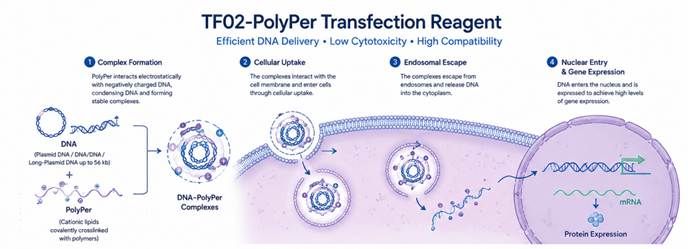
PolyPer in vitro DNA Transfection Reagent is a high-performance, reliable DNA delivery reagent with good cell compatibility, specifically designed for efficient delivery of exogenous DNA into mammalian cells, insect cells, and other eukaryotic cells. PolyPer uses a unique chemical formulation that covalently crosslinks cationic lipids with polymers, creating a DNA delivery system with dual characteristics. This design enhances DNA condensation and cellular uptake while maintaining good cell compatibility.
During transfection, PolyPer interacts electrostatically with negatively charged DNA through its cationic components, efficiently condensing the DNA and forming stable DNA–transfection reagent complexes. The resulting complexes facilitate interactions between DNA and the cell membrane and enter cells through cellular uptake, enabling intracellular delivery of exogenous DNA. Through the synergistic design of cationic lipids and polymers, PolyPer enables efficient DNA transfection while maintaining low cytotoxicity.
One of the key features of PolyPer is its very low cytotoxicity. Under recommended conditions, transfection-related cytotoxicity is generally low and may even be difficult to detect under certain experimental conditions. Its good cell compatibility makes PolyPer suitable for research systems requiring continued cell culture, protein expression, functional analysis, or other downstream applications after transfection.
PolyPer is compatible with DNA constructs of different sizes and can be used for the delivery of large DNA constructs of up to approximately 56 kb. PolyPer supports both single DNA transfection and co-transfection of multiple DNA constructs, meeting different experimental needs including routine gene expression, multi-gene expression, and viral vector production.
PolyPer can also be used for recombinant protein expression and viral-related research. Efficient DNA delivery facilitates the entry of exogenous expression vectors into cells and supports high levels of gene expression, making PolyPer suitable for the expression of recombinant proteins, antibodies, and other exogenous proteins. For viral vector-related experiments, PolyPer can be used for DNA transfection in viral packaging systems and may also be used as a transfection aid in certain viral infection-related studies.
Product Advantages
Ø Synergistic Delivery of Cationic Lipids and Polymers
PolyPer covalently crosslinks cationic lipids with polymers to create a DNA delivery material that differs from conventional lipid-only or polymer-only systems. This design helps enhance DNA condensation, transfection complex formation, and cellular uptake, thereby enabling efficient DNA delivery.
Ø High Transfection Efficiency with Very Low Cytotoxicity
One of the key advantages of PolyPer is its ability to achieve high DNA transfection efficiency while maintaining very low cytotoxicity. Under recommended conditions, transfection-related cytotoxicity is generally low, helping maintain cell viability and cell condition for subsequent experiments.
Ø Supports Large DNA Constructs
PolyPer can be used to deliver large DNA constructs of up to approximately 56 kb, providing support for complex gene constructs, large DNA fragment expression, and other applications requiring the delivery of large DNA molecules.
Ø Supports Single DNA Transfection and DNA Co-transfection
PolyPer supports both single DNA transfection and simultaneous delivery of multiple DNA constructs, meeting different experimental needs including gene expression, multi-gene co-expression, and viral packaging.
Ø High-Level Recombinant Protein Expression
Efficient DNA delivery can promote high levels of exogenous gene expression and can be used for the transient expression and functional studies of recombinant proteins, antibodies, and other proteins.
Ø Viral-Related Applications
PolyPer can be used for DNA transfection in viral packaging systems and, in specific experimental systems, may help improve viral infection efficiency. It is suitable for certain viral-related studies involving hard-to-transfect cells.
Ø Cost-Effective
1.0 mL of PolyPer supports approximately 666 transfections in a 24-well plate or 333 transfections in a 6-well plate. The high number of reactions supported per unit volume helps reduce the cost per experiment, making PolyPer suitable for routine experiments and large-scale DNA transfection studies.
Storage Conditions
Store at 4°C. When stored under the recommended conditions, the product can remain stable for 12 months or longer.
PolyPer is broadly compatible with a variety of mammalian cell lines, including HEK293, 293T, 293E, CHO, COS-1, HeLa, and NIH/3T3, as well as primary cells, hard-to-transfect cells, and insect cell lines. The table below lists representative cell types that have been validated to date. In addition to the cells listed in the table, other mammalian cells may also be suitable for transfection. Actual performance depends on the cell type, culture conditions, and transfection parameters; optimization for the specific cell type is recommended.
Cell Type | Cell Line | Species |
Lewis lung carcinoma cells | 3LL | Mouse |
Melanoma cells | B16-F10 | Mouse |
Bovine aortic endothelial cells | BAEC | Bovine |
Kidney cells | BHK-21 | Hamster |
Cervical cancer cells | Ca Ski, HeLa, SiHa, HeLa-S3 | Human |
Colorectal adenocarcinoma cells | Caco-2, LS180 | Human |
Chinese hamster ovary cells | CHO | Hamster |
Chondrocyte-like cells | HCS-2/8 | Human |
Embryonic kidney cells | HEK-293, HEK293T | Human |
Human lymphatic endothelial cells | HLMEC | Human |
Human microvascular endothelial cells | H-MVEC | Human |
Liver cancer cells | Huh-7D12, McArdle 7777, Hep G2 | Human, Rat |
Pituitary tumor cells | ATT20 | Mouse |
Neuroblastoma cells | SK-N-SH, SHEP, Neuro-2A, SH-SY5Y, N2a / Neuro-2a | Human, Mouse |
Breast cancer cells | MDA-MB-231, MCF-7, BT474 | Human |
Fibroblasts | 3T3-442A, L929, NIH 3T3 | Mouse |
African green monkey kidney cells | COS-7, CV-1 | African green monkey |
Retinal pigment epithelial cells | D407 | Human |
Colorectal cancer cells | DHD Pro.b | Rat |
Canine kidney cells | MDCK | Dog |
Leukemia cells | K562 | Human |
Pheochromocytoma cells | PC12 | Rat |
Ovarian cancer cells | SKOV3, IGROV1 | Human |
Human umbilical vein endothelial cells | HUVEC | Human |
T-cell leukemia cells | Jurkat | Human |
Epithelial / fibroblast-like cells | 6CSFMEo | Human |
B-cell lymphoma cells | WEHI-231 | Mouse |
Osteosarcoma cells | SAOS-2 | Human |
Neuron-like cells | SN56 | Mouse |
Osteoprogenitor cells | MC3T3-E1 | Mouse |
Myoblasts | C2C12 | Mouse |
Primary melanocytes | Primary melanocytes | Primary |
Lung adenocarcinoma cells | A549 | Human |
Human lung fibroblasts | HLF | Human |
Mammary epithelial cells | MCF-12F | Human |
Osteosarcoma cells | U2OS | Human |
Embryonic kidney cell derivative | HEK293A | Human |
Suspension embryonic kidney cells | 293F | Human |
Primary mouse skin fibroblasts | Primary murine skin fibroblasts | Mouse |
Primary mouse keratinocytes | Primary murine keratinocytes | Mouse |