
info@mail.ucallm.com
Product Introduction
PolyPer max DNA In Vitro Transfection Reagent is an upgraded formulation of PolyPer DNA In Vitro Transfection Reagent. It incorporates proprietary Enhancer Peptide Technology to further optimize the original DNA delivery system, with the aim of improving DNA transfection efficiency across different cell types while maintaining good cell compatibility. Compared with the original formulation, PolyPer max can achieve a 3–20-fold increase in transfection efficiency in a variety of mammalian cells. By optimizing the synergistic interaction between the enhancer peptide and the DNA delivery system, PolyPer max promotes plasmid DNA condensation, transfection complex formation, and cellular uptake, thereby improving the intracellular delivery efficiency of exogenous DNA. The resulting DNA–transfection reagent complexes interact with cells and enter the cells through processes such as endocytosis, allowing the delivered DNA to subsequently participate in gene expression. This delivery system is particularly suitable for cell models requiring high DNA transfection efficiency.
PolyPer max is also suitable for the delivery of larger DNA constructs. The product provides good transfection performance for DNA constructs of up to approximately 46 kb, making it suitable for the in vitro delivery of large plasmids, complex expression vectors, and other large DNA constructs. In terms of culture conditions, PolyPer max maintains good transfection performance under serum- and antibiotic-containing culture conditions in most cell types, reducing the need for additional medium replacement or removal of culture components during transfection and helping maintain a stable cellular environment. For certain cell types, even better transfection performance may be observed in the presence of serum and antibiotics.
PolyPer max is also suitable for experiments requiring high-level exogenous gene expression. Efficient DNA delivery can support high-level recombinant protein expression and is suitable for applications such as protein function studies, recombinant protein production, antibody expression, reporter gene assays, and gene function studies. For experiments requiring the co-expression of multiple plasmids, PolyPer max can also be used for DNA co-transfection.
In terms of cost efficiency, 1.0 mL of PolyPer max reagent supports approximately 667 transfections in a 24-well plate or approximately 333 transfections in a 6-well plate. The high number of reactions supported per unit volume, combined with high DNA transfection efficiency, can help reduce the cost per transfection, making PolyPer max suitable for routine DNA transfection, repetitive experiments, and large-scale multi-well plate studies.
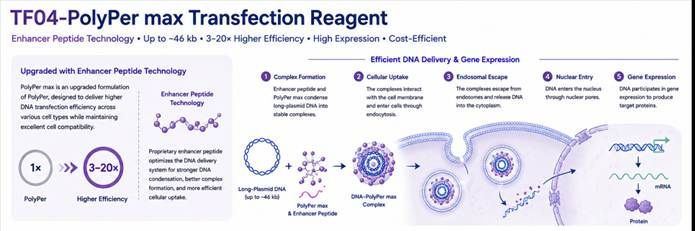
Key Upgrade Features
Ø 3–20-fold increase in transfection efficiency: The degree of improvement varies depending on the cell type.
Ø Enhanced Peptide Technology: Further optimizes DNA delivery efficiency through a proprietary enhancing peptide.
Ø Suitable for Hard-to-Transfect Cells: Optimized for a variety of cell models with relatively low transfection efficiency.
Ø Broad Cell Compatibility: Suitable for a wide range of mammalian cells, primary cells, and insect cells.
Ø Large DNA Delivery: Provides good transfection performance for DNA constructs of up to approximately 46 kb.
Ø Serum/Antibiotic Compatibility: Most cells can be transfected under standard culture conditions.
Ø High-Level Protein Expression: Suitable for high-level expression of recombinant proteins and other exogenous proteins.
Ø Low Cytotoxicity: Designed to improve DNA delivery efficiency while maintaining good cell viability.
Storage Conditions
Store at 4°C. When stored under the recommended conditions, the product can remain stable for 12 months or longer.
PolyPer max is suitable for most cell types, including primary cells, hard-to-transfect cells, and cells sensitive to cytotoxicity. It enables efficient DNA delivery into mammalian cell lines and insect cells. The table below lists representative cell types that have been validated to date. In addition to the cells listed in the table, other mammalian cells may also be suitable for transfection. Actual performance depends on the cell type, culture conditions, and transfection parameters; optimization for the specific cell type is recommended.
Cell Type | Cell Line / Cell | Species |
Embryonic kidney cells | HEK293, HEK293T / 293T, HEK293E | Human |
Chinese hamster ovary cells | CHO | Hamster |
African green monkey kidney cells | COS-1, COS-7 | African green monkey |
Cervical cancer cells | HeLa | Human |
Fibroblasts | NIH/3T3, L929 | Mouse |
Insect cells | Sf9, Sf21 | Insect |
Primary vascular smooth muscle cells | Primary rat aortic smooth muscle cells | Rat |
Osteosarcoma cells | U2OS | Human |
Pancreatic cancer cells | Panc-02 | Mouse |
Lung adenocarcinoma cells | A549 | Human |
Glioma cells | Glioma cells | Human |
Epidermoid carcinoma cells | A431-WT | Human |
Newt limb dermal fibroblasts | AL1 | Newt |