
info@mail.ucallm.com
Product Overview
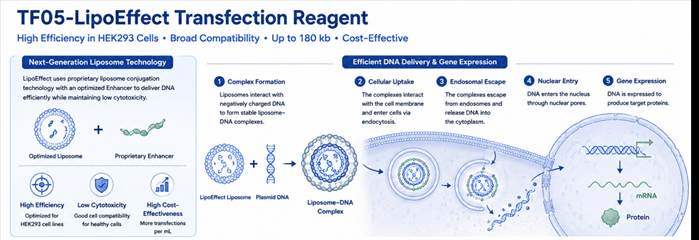
LipoEffect in vitro DNA Transfection Reagent is a next-generation DNA transfection reagent developed using proprietary liposome conjugation technology. It incorporates an optimized proprietary Enhancer and is specifically designed for efficient DNA delivery into HEK293 cells and their derivatives, while also supporting a wide range of other mammalian cells. Through further optimization of the liposomal composition, chemical structure, and enhancer system, LipoEffect is designed to improve DNA delivery efficiency while maintaining good cell compatibility, providing a stable in vitro transfection solution for high-level gene expression.
LipoEffect features a finely optimized liposomal formulation that interacts with negatively charged plasmid DNA to form stable liposome-DNA transfection complexes. These complexes promote interactions between DNA and the cell membrane and facilitate cellular uptake, enabling intracellular delivery of exogenous DNA. Once inside the cell, the delivered DNA can be used for transient expression of target genes, making LipoEffect suitable for a variety of applications, including reporter gene assays, recombinant protein expression, and gene function studies.
As a DNA transfection reagent specifically optimized for HEK293 cell lines, LipoEffect enables high DNA transfection efficiency in HEK293 and its derivatives while maintaining relatively low cytotoxicity. For cell models such as HEK293 and HEK293T, which are widely used for protein expression, viral packaging, and gene function studies, LipoEffect provides stable and efficient DNA delivery.
In addition to HEK293-derived cells, LipoEffect can also be used with a variety of other mammalian cells. For different cell types, transfection conditions can be optimized based on cell condition, cell density, DNA amount, and transfection reagent amount to achieve an optimal balance between transfection efficiency and cell health.
LipoEffect also offers high cost-effectiveness. 1.0 mL of reagent supports approximately 666 transfections in 24-well plates or approximately 333 transfections in 6-well plates, making it suitable for routine DNA transfection, repetitive experiments, large-scale cell culture, and protein expression studies. The high number of reactions supported per unit volume can effectively reduce the cost per DNA transfection, providing an economical and practical option for experiments requiring large numbers of DNA transfections.
Features
Specifically Optimized for HEK293 Cell Lines
LipoEffect features a lipid formulation specifically optimized for HEK293 and HEK293-derived cells, enabling efficient DNA delivery in commonly used cell lines such as HEK293 and HEK293T. Its optimized liposome-based system promotes the formation of stable DNA transfection complexes and enhances cellular uptake, making it suitable for a variety of applications, including gene expression, protein expression, and viral vector production.
High-Efficiency Viral Vector Production
LipoEffect is suitable for the efficient delivery of packaging plasmids during viral vector production. For viral production systems requiring the simultaneous introduction of multiple plasmids, its DNA co-transfection capability enables the co-delivery of different functional plasmids into production cells such as HEK293/HEK293T, supporting efficient viral vector production and potentially higher viral titers.
Supports Very Large DNA Constructs
LipoEffect has good delivery capability for relatively large DNA constructs. According to the official product information, it can be used for transfection of very large DNA constructs up to approximately 180 kb. This feature makes it suitable for large plasmids, complex genetic constructs, and other applications requiring efficient delivery of large DNA molecules. Actual transfection efficiency may still be affected by DNA size, structure, purity, and cell type.
Suitable for Suspension HEK293 Cells
In addition to conventional adherent HEK293 cells, LipoEffect is also suitable for suspension-adapted HEK293 cells, including cell models such as 293F and 293H. This feature makes it suitable for large-scale protein expression and viral vector production in suspension cell systems, providing a flexible DNA transfection solution for applications requiring scale-up.
Supports High-Level Recombinant Protein Expression
LipoEffect efficiently delivers expression plasmids and can be used for the expression of recombinant proteins, antibodies, and other exogenous proteins in mammalian cells. Efficient DNA transfection can help achieve high levels of exogenous gene expression, making LipoEffect suitable for protein function studies, protein production, and optimization of expression conditions.
Serum and Antibiotic Compatible
In HEK293 cell systems, the presence of serum and antibiotics does not significantly interfere with LipoEffect transfection performance and, under certain culture conditions, may even help improve transfection efficiency. Therefore, when compatible with the experimental system, there may be less need to modify standard culture conditions specifically for transfection, helping maintain a stable cellular environment.
Suitable for Both Single-DNA and Multi-DNA Co-transfection
LipoEffect can be used for both single-plasmid DNA transfection and co-delivery of multiple plasmid DNA constructs. This makes it suitable for conventional gene expression experiments as well as applications requiring simultaneous expression of multiple genes, such as viral vector production and recombinant protein expression.
Storage
Store at 4°C. Under the recommended storage conditions, the product can remain stable for 12 months or longer.
LipoEffect is suitable for HEK293 and CHO cells and has also demonstrated good performance in primary cells and hard-to-transfect cells. The table below lists representative cell types that have been experimentally validated to date. Other mammalian cells not listed in the table may also be suitable for transfection. Actual performance depends on cell type, culture conditions, and transfection parameters; optimization is recommended for specific cell models.
Cell Type | Cell Line / Cell | Species |
Embryonic kidney cells | HEK293, HEK293T / 293T | Human |
SV40 large T antigen-transformed embryonic kidney cells | HEK293T / 293T | Human |
Suspension embryonic kidney cells | 293F | Human |
Suspension/adapted HEK293 cells | 293H | Human |
Chinese hamster ovary cells | CHO | Hamster |
Liver cancer cells | HepG2 | Human |
Cervical cancer cells | HeLa | Human |
Osteosarcoma cells | U2OS | Human |
Mouse embryonic fibroblasts | MEF | Mouse |
Embryonic kidney-derived packaging cells | Plat-E | Human |
Tumor / prostate cancer cells | FAK+/+ / FAK−/−, LNCaP | Human |