
info@mail.ucallm.com
Product Overview
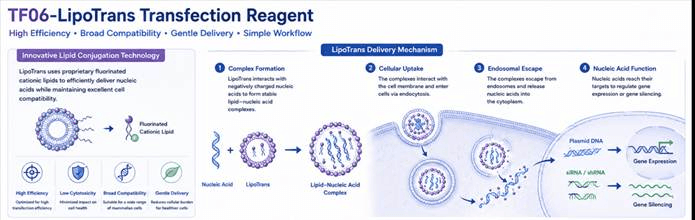
LipoTrans is a high-efficiency in vitro nucleic acid delivery system developed based on innovative lipid conjugation technology. It features a proprietary formulation of fluorinated cationic lipids and is designed for efficient delivery of plasmid DNA and/or siRNA into a wide range of mammalian cells. LipoTrans interacts with negatively charged nucleic acids through its lipid components to form stable lipid-nucleic acid transfection complexes, promoting interactions between the nucleic acids and the cell membrane and facilitating cellular uptake for efficient intracellular nucleic acid delivery. Compared with conventional cationic lipid-based transfection systems, LipoTrans features an optimized fluorinated cationic lipid structure specifically designed to improve nucleic acid binding, complex formation, and cellular delivery. This design enables high transfection efficiency while maintaining good cell compatibility. By optimizing the lipid structure and formulation, LipoTrans may help reduce the cellular burden associated with high amounts of conventional cationic lipids, providing a lipid-based transfection solution for efficient and gentle nucleic acid delivery in vitro.
LipoTrans can be used for plasmid DNA, siRNA, shRNA, and DNA/siRNA co-transfection, supporting a variety of research applications involving gene expression and gene silencing. Plasmid DNA transfection can be used for transient gene expression, reporter gene analysis, recombinant protein expression, and gene function studies. siRNA transfection can be used for RNA interference (RNAi), Gene Knockdown, Target Validation, and Loss-of-Function Studies. For studies requiring simultaneous exogenous gene expression and knockdown of a specific endogenous gene, LipoTrans can also be used for DNA/siRNA co-transfection. LipoTrans features a simple lipid complex preparation workflow. After nucleic acids and LipoTrans are mixed at the recommended ratio to form transfection complexes, the complexes can be directly added to cells without specialized equipment or complicated procedures. This makes LipoTrans suitable for routine cell culture and multi-well plate-based transfection experiments. The simplified workflow can help improve experimental reproducibility and facilitate parallel optimization of multiple conditions and high-throughput transfection studies. Another advantage of LipoTrans is its balance between transfection efficiency and cell compatibility. While maintaining efficient nucleic acid delivery, the optimized lipid structure and formulation are designed to minimize adverse effects on cell health, making LipoTrans suitable for experimental systems in which maintaining cell viability is particularly important.
Contents
LipoTrans Reagent — 1.0 mL is sufficient for approximately 1,000 DNA transfections and 1,000 siRNA transfections in 24-well plates.
LipoTrans Transfection Buffer (5×)
Features
Versatile Nucleic Acid Delivery Platform
LipoTrans can be used for the in vitro delivery of common nucleic acids, including plasmid DNA, siRNA, and DNA/siRNA co-transfection. A single transfection platform can support different experimental applications, including gene expression, gene silencing, and combined functional studies, reducing the need to switch between different transfection systems for different nucleic acid types.
High Efficiency with Low Cytotoxicity
LipoTrans uses an optimized fluorinated cationic lipid structure to enhance nucleic acid delivery while maintaining good cell compatibility. Compared with some conventional lipid-based transfection systems that require relatively high lipid amounts, appropriately optimized LipoTrans conditions can help reduce cellular burden while maintaining good cell health, providing a stable cellular foundation for subsequent gene expression and functional analyses.
Serum and Antibiotic Compatible
LipoTrans can be used under conventional serum-containing culture conditions and is compatible with commonly used antibiotics. This helps reduce the need to replace culture medium or modify culture conditions during transfection. Maintaining a relatively stable culture environment may also help preserve cell health and improve experimental reproducibility.
Simple Workflow with Single-Tube Preparation
LipoTrans uses a simplified lipid complex preparation workflow. Nucleic acids and the transfection reagent are mixed at the recommended ratio to form transfection complexes, without the need for specialized equipment or additional processing steps. The simple workflow is suitable for routine experiments and facilitates parallel optimization of multiple transfection conditions.
Storage
LipoTrans Reagent should be stored at 4°C, while LipoTrans Transfection Buffer (5×) should be stored at room temperature. When stored properly, the product can remain stable for 12 months or longer.
LipoTrans is broadly compatible with a variety of mammalian cell lines, including suspension cells. The table below lists representative cell types that have been experimentally validated to date. Other mammalian cells not listed in the table may also be suitable for transfection. Actual performance depends on cell type, culture condition, and transfection parameters; optimization is recommended for specific cell models.
Cell Type | Cell Line / Cell | Species |
Embryonic kidney cells | HEK293 / 293T, HEK293T | Human |
Fibroblasts | 3T3 / NIH-3T3 | Mouse |
Preadipocytes | 3T3-L1 | Mouse |
Lung adenocarcinoma cells | A549 | Human |
Melanoma cells | B16-F10, A375 | Mouse, Human |
Hepatocyte cell line | BNLCL.2 | Mouse |
Myoblasts | C2C12 | Mouse |
Mesenchymal precursor cells | C3H/10T1/2 | Mouse |
Colorectal adenocarcinoma cells | Caco-2, HT-29, HRT-18 | Human |
Primary cardiomyocytes | Rat primary cardiomyocytes | Rat |
Chinese hamster ovary cells | CHO | Hamster |
Monkey kidney cells | COS-1, COS-7 | African green monkey |
Bladder carcinoma cells | Human bladder carcinoma cells | Human |
Mouse embryonic stem cells | mES | Mouse |
Immortalized mouse embryonic fibroblasts | iMEF | Mouse |
Human bronchial epithelial cells | HBEC | Human |
Colorectal cancer cells | HCT116 | Human |
Cervical cancer cells | HeLa | Human |
Liver cancer cells | HepG2, HuH-7 | Human |
Prostate cancer cells | LNCaP, PC3 | Human |
Osteoblast precursor cells | MC3T3-E1 | Mouse |
Mammary epithelial cells | MCF10A | Human |
Breast cancer cells | MCF7 | Human |
Triple-negative breast cancer cells | MDA-MB-231 | Human |
Canine kidney cells | MDCK | Dog |
Mouse embryonic fibroblasts | MEF | Mouse |
Primary melanocytes | Human primary melanocytes | Human |
Primary melanoma cells | Human primary melanoma | Human |
Immortalized microglia | Human immortalized microglia | Human |
Renal collecting duct epithelial cells | mIMCD-3 | Mouse |
Embryonic lung fibroblasts | MRC-5 | Human |
Neuroblastoma cells | N2A / Neuro-2a, SH-SY5Y | Mouse, Human |
Macrophages | RAW264.7 | Mouse |
Retinal pigment epithelial cells | RPE | Human |
Ovarian cancer cells | SK-OV-3 | Human |
Osteosarcoma cells | U-2OS, 143B TK⁻ | Human |
African green monkey kidney cells | VERO | African green monkey |
Human embryonic stem cells | hESCs | Human |
EBV-positive 293 cells | 293-EBV | Human |
BMRF1-deficient 293-EBV cells | B072-1 | Human |
Esophageal adenocarcinoma cells | OE33 | Human |
Clear cell renal cell carcinoma | 786-O | Human |