
info@mail.ucallm.com
Product Overview
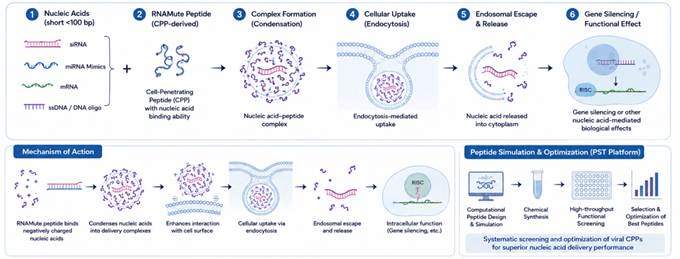
RNAMute siRNA Transfection Reagent is an innovative peptide-based nucleic acid delivery platform developed based on the design principles of Cell-Penetrating Peptides (CPPs). It is specifically designed for efficient siRNA delivery and gene silencing in mammalian cells. Unlike conventional liposome- or polymer-based nucleic acid delivery systems, RNAMute is based on peptide structures with cell-penetrating properties. By systematically screening and optimizing naturally derived viral CPPs, RNAMute provides peptide-based delivery materials with efficient nucleic acid binding, condensation, and cellular delivery capabilities.
The RNAMute platform utilizes Peptide Simulation Technology (PST) to computationally simulate, design, chemically synthesize, and functionally screen hundreds of viral cell-penetrating peptides (CPPs), followed by systematic evaluation of their nucleic acid delivery capabilities in multiple mammalian cell models. Through this high-throughput screening and optimization process, peptide-based RNAMute delivery systems with excellent nucleic acid delivery performance were identified. These systems can efficiently condense short nucleic acids and facilitate their cellular uptake, providing a peptide-based delivery approach for RNA interference (RNAi) and other nucleic acid functional studies.
RNAMute is well suited for the delivery of short nucleic acids, including single- or double-stranded nucleic acids shorter than 100 bp, such as siRNA, miRNA mimics, and DNA oligonucleotides. During nucleic acid delivery, RNAMute interacts with negatively charged nucleic acids to condense free siRNA and other small nucleic acid molecules into nucleic acid–peptide complexes suitable for cellular uptake. These delivery complexes enhance interactions between nucleic acids and the cell surface and facilitate cellular uptake through processes such as endocytosis. Once inside the cell, the nucleic acids can participate in the corresponding intracellular functional processes, resulting in gene silencing or other nucleic acid-mediated biological effects. Learn More About Peptide-Based Nucleic Acid Delivery
Specifications
RNAMute Transfection Reagent: 1.0 mL is sufficient for approximately 1,333 reactions, based on transfection of 0.5–5.0 pmol siRNA or miRNA mimic in a 24-well plate.
RNAMute Transfection Buffer (5×)
Applications
Nucleic Acid Type | Main Application | Typical Research Objectives |
siRNA | Gene Knockdown | Gene Silencing, Gene Function Studies, Target Validation, Loss-of-Function Studies |
miRNA Mimic | miRNA Function Studies | miRNA Functional Studies, Target Gene Regulation, Signaling Pathway Analysis, Cellular Phenotype Studies |
DNA Oligonucleotide | Gene Regulation Studies | Gene Regulation, Regulatory Element Studies, Oligonucleotide Functional Studies |
DNA + siRNA | Co-transfection | Combined Gene Expression and Gene Knockdown Studies, Target Validation, Rescue Experiments |
Storage
RNAMute Transfection Reagent should be stored at 4°C, while RNAMute Transfection Buffer (5×) should be stored at room temperature. When stored properly, the product can remain stable for 12 months or longer.
Advantages
Optimized for siRNA Delivery
RNAMute is optimized for siRNA delivery. In some mammalian cells, significant gene silencing can be achieved with an siRNA final concentration as low as 1.0 nM. The use of lower siRNA concentrations helps reduce nucleic acid consumption and potential nonspecific effects, making RNAMute suitable for gene knockdown experiments where siRNA dosage is a concern.
High-Level Gene Knockdown in a Wide Range of Cells
RNAMute can achieve more than 95% gene silencing in a variety of mammalian cells. Actual gene silencing efficiency may vary depending on cell type, target gene expression level, siRNA sequence, cell density, and transfection conditions. Optimizing the siRNA concentration and transfection conditions can help achieve optimal experimental results.
Simple Operation for Routine and High-Throughput Experiments
RNAMute uses a simple nucleic acid transfection workflow. siRNA and the transfection reagent can be easily mixed and briefly incubated to form delivery complexes, which are then added to the cells for transfection. No specialized equipment or complicated procedures are required, making RNAMute suitable for routine cell culture experiments and multi-well plate applications.
Serum and Antibiotic Compatible
RNAMute can be used for transfection under standard cell culture conditions containing serum and antibiotics. This helps minimize the need to change the culture medium or modify culture conditions during transfection, thereby simplifying the workflow and maintaining a relatively stable cellular environment.
Good Cell Compatibility
RNAMute is designed to combine efficient siRNA delivery with good cell compatibility, making it suitable for gene silencing experiments involving cells that are sensitive to transfection conditions. The use of lower siRNA concentrations may also help reduce nonspecific cellular responses associated with high nucleic acid concentrations. Actual cytotoxicity depends on the cell type, siRNA concentration, and transfection reagent amount, and optimization is recommended for specific cell models.
RNAMute is broadly applicable to a variety of mammalian cell lines. The table below lists representative cell types that have been experimentally validated to date. In addition to the cells listed in the table, other mammalian cells may also be suitable for transfection. Actual performance depends on the cell type, culture conditions, and transfection parameters. Optimization is recommended for specific cell types and experimental conditions.
Cell Type | Cell Line / Cell | Species |
Embryonic Kidney Cells | HEK293 | Human |
Lung Adenocarcinoma Cells | A549 | Human |
Breast Cancer Cells | MCF-7 | Human |
Osteosarcoma Cells | U2OS, 143B | Human |
Cervical Cancer Cells | HeLa | Human |
Fibroblasts | NIH-3T3 | Mouse |
Canine Kidney Cells | MDCK | Dog |
Mouse Embryonic Fibroblasts | MEF | Mouse |
Leukemia Cells | K562 | Human |
Colorectal Cancer Cells | HCT-116 | Human |
Embryonal Carcinoma Cells | NCCIT | Human |
Osteosarcoma Cells | 143B | Human |
Primary Nucleus Pulposus Cells | Human Primary Nucleus Pulposus Cells (hNPCs) | Human |