
info@mail.ucallm.com
Product Overview
PerMute Transfection Reagent is a biodegradable, non-liposomal polymer-based nucleic acid delivery reagent designed for the delivery of siRNA, miRNA, and DNA in mammalian cells. Unlike conventional liposome-based transfection reagents, PerMute uses a biodegradable polymer as the primary delivery material and incorporates pH-Dependent Conformational Change (PDCC) technology. By introducing hydrophobic groups onto the polymer side chains, PerMute is designed to optimize nucleic acid complex formation, stability, and intracellular delivery.
PerMute can be used for the transfection of siRNA, miRNA mimics, and DNA individually, as well as for DNA/siRNA and DNA/miRNA co-transfection. With efficient nucleic acid delivery and good cell compatibility, PerMute is suitable for a wide range of mammalian cells. Its applications include gene knockdown, miRNA functional studies, gene function validation, DNA expression, and nucleic acid co-transfection.
The product is supplied with PerMute Transfection Buffer, which is used for the dilution of nucleic acids and transfection reagent and for the preparation of nucleic acid–polymer complexes, helping to achieve more stable and reproducible transfection results.
Mechanism of Action
PerMute works through a biodegradable cationic polymer-based nucleic acid delivery mechanism. Negatively charged siRNA, miRNA, or DNA interacts electrostatically with cationic groups in the polymer to form nucleic acid–polymer complexes. These complexes help protect nucleic acids from unfavorable conditions in the culture environment and promote interactions between the nucleic acids and the cell membrane, facilitating cellular uptake through processes such as endocytosis.
PerMute incorporates pH-Dependent Conformational Change (PDCC) technology to optimize the polymer-based delivery system. This technology introduces selected hydrophobic groups onto the side chains of the biodegradable polymer, enabling its hydrophobic interactions and conformation to respond to changes in the local pH environment. This design may help improve the stability of nucleic acid complexes and enhance intracellular delivery.
By using a biodegradable polymer as the nucleic acid delivery material, PerMute is designed to balance nucleic acid-binding capacity with cell compatibility compared with non-degradable polymer systems. The polymer forms stable complexes with negatively charged nucleic acids and gradually undergoes degradation after entering cells, which may help reduce the effects associated with prolonged intracellular accumulation of the delivery material.
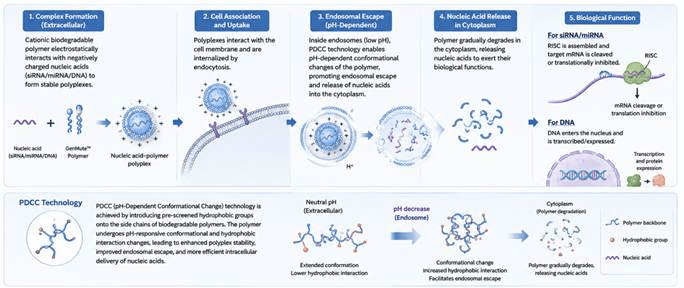
PerMute Transfection Reagent Technical Principle Diagram
Product Advantages
Non-Liposomal Nucleic Acid Delivery
PerMute is a non-liposomal polymer-based transfection reagent that enables intracellular nucleic acid delivery by forming complexes between biodegradable polymers and nucleic acids.
Low-Concentration siRNA Transfection
PerMute enables effective gene silencing at low siRNA concentrations. As little as 1.0 nM siRNA/miRNA mimic can achieve excellent low-concentration gene silencing performance.
Low Cytotoxicity
The biodegradable polymer-based system of PerMute is designed to balance nucleic acid delivery efficiency and cell compatibility, making it suitable for gene silencing and functional studies that require maintenance of healthy cell conditions.
Serum Compatibility
PerMute is not significantly affected by serum or antibiotics and can be used for transfection under culture conditions containing serum and antibiotics. There is no need to completely alter conventional cell culture conditions specifically for transfection.
Broad Compatibility with Mammalian Cells
PerMute has been used in a wide range of mammalian cell systems.
Broad Nucleic Acid Compatibility
PerMute is a non-liposomal delivery reagent with broad nucleic acid compatibility and is primarily suitable for the following nucleic acid types:
Nucleic Acid Type | Typical Applications |
siRNA | Gene Knockdown, Gene Function Studies |
miRNA Mimic | miRNA Functional Studies, Pathway Regulation |
miRNA Inhibitor | miRNA Inhibition and Functional Validation |
Plasmid DNA | Gene Expression, Reporter Gene Studies |
DNA + siRNA | Combined Gene Expression and Gene Knockdown Studies |
DNA + miRNA | Combined miRNA Regulation and Gene Expression Studies |
Product Components:
The PerMute product consists of PerMute Transfection Reagent and the accompanying PerMute Transfection Buffer (5×). One 1.0 mL bottle of PerMute Transfection Reagent supports approximately 2,000 reactions, based on a reference condition of transfecting 5.0 pmol siRNA or miRNA mimic per well in a 24-well plate.
Storage:
PerMute Transfection Reagent should be stored at 4°C, while PerMute Transfection Buffer (5×) should be stored at room temperature. When stored properly, the product is stable for 12 months or longer.
PerMute is broadly compatible with a wide range of mammalian cell lines, including certain hard-to-transfect cells. The table below lists representative cell types that have been experimentally validated. In addition to the cells listed in the table, other mammalian cell types may also be suitable for transfection. Actual performance depends on the specific cell type, culture conditions, and transfection parameters. Optimization is recommended for each specific cell type.
Cell Type | Cell Line / Cell | Species |
Embryonic Kidney Cells | HEK293 | Human |
Cervical Cancer Cells | HeLa | Human |
Hepatocellular Carcinoma Cells | HepG2, HCC Cells | Human |
Pancreatic Cancer Cells | PANC-1 | Human |
Colorectal Cancer Cells | SW480, RKO, HT29, DLD1 | Human |
Non-Small Cell Lung Cancer | Lung Cancer Cells | Human |
Human Bronchial Epithelial Cells | HBE | Human |
Macrophages | RAW264.7 | Mouse |
Pulmonary Vascular Endothelial Cells | Pulmonary Artery Endothelial Cells (PAECs) | Human |
Osteosarcoma | Osteosarcoma Cells | Human |
Human Skin Fibroblasts | Hs27 | Human |
Glial Cells | Microglia, Astrocytes | Human |
Oral Squamous Cell Carcinoma-Associated Cells | Oral Cancer Cells | Human |
Melanoma | Melanoma Cells | Human |
Prostate Cancer Cells | LNCaP, LAPC4, 22Rv1, VCaP | Human |
Triple-Negative Breast Cancer | 4T1 / TNBC-Related Cells | Mouse |