
info@mail.ucallm.com
Product Overview
PowerTrans is an enhanced liposome-based nucleic acid delivery reagent specifically designed for efficient siRNA delivery and gene silencing studies in mammalian cells. The product utilizes an optimized liposomal formulation to enhance the stability of siRNA transfection complexes, facilitate cellular uptake and intracellular delivery of siRNA, and thereby achieve effective gene silencing. PowerTrans is compatible with a wide range of mammalian cells while balancing nucleic acid delivery efficiency and cell compatibility. It can be used for gene knockdown, gene function studies, target validation, and DNA/siRNA co-transfection.
Technical Principle
PowerTrans is a liposome-based siRNA delivery system. siRNA carries a strong negative charge and can interact electrostatically with cationic lipid components during the transfection process, forming siRNA–lipid complexes suitable for cellular uptake. After interacting with the cell membrane, these complexes can enter cells through processes such as endocytosis and subsequently release siRNA intracellularly, allowing siRNA to participate in the RNA interference (RNAi) pathway and reduce target gene expression. PowerTrans incorporates pH-Dependent Conformational Change (PDCC) technology to optimize the delivery system. By regulating hydrophobic interactions and conformational changes within the delivery system, this technology helps improve the stability of siRNA complexes and enhance the intracellular delivery performance of nucleic acids.
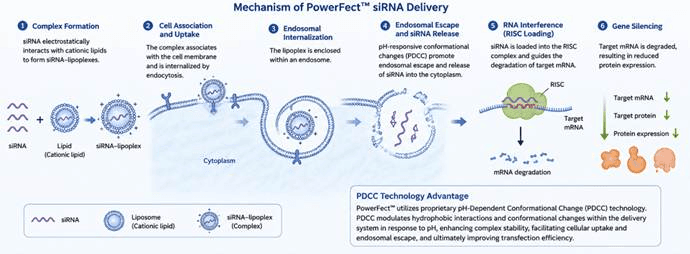
PowerTrans Technical Principle Diagram
Product Advantages
High-Efficiency siRNA Delivery
PowerTrans utilizes an enhanced liposomal formulation to facilitate the formation of stable delivery complexes between siRNA and the transfection components, thereby improving siRNA delivery efficiency into cells. By optimizing complex formation and cellular uptake, PowerTrans can be used to achieve consistent gene silencing.
Broad Cell Compatibility
PowerTrans is compatible with a wide range of mammalian cells and can also be used with certain cell types that are relatively difficult to transfect using conventional liposome-based systems. Since different cell types have different sensitivities to transfection reagents, transfection conditions should be optimized according to factors such as cell type, cell status, seeding density, and siRNA concentration.
Good Cell Compatibility
PowerTrans is designed to balance nucleic acid delivery efficiency and cell compatibility, helping minimize the impact of the transfection process on cell viability while achieving effective gene silencing. For primary cells, sensitive cells, or other cell types that are particularly susceptible to external stimuli, cell viability, cell morphology, and gene silencing efficiency should be evaluated together.
Serum Compatibility
PowerTrans can be used for siRNA transfection in serum-containing culture conditions, making it suitable for conventional mammalian cell culture systems. There is no need to change the routine culture conditions specifically for transfection, helping simplify experimental procedures and minimize the effects of culture-condition changes on cell status.
Supports DNA/siRNA Co-transfection
In addition to standalone siRNA delivery, PowerTrans also supports DNA/siRNA co-transfection. This feature can be used in experiments that require simultaneous expression of an exogenous gene and suppression of a specific endogenous gene, including reporter gene analysis, gene function validation, and mechanistic studies.
Suitable for High-Throughput Research
PowerTrans supports multi-well plate-based in vitro siRNA transfection and can be used for gene knockdown screening, target validation, and large-scale gene function studies. Its transfection system is relatively simple to operate, making it suitable for parallel comparison of multiple genes or experimental conditions.
Product Components
The PowerTrans in vitro siRNA Transfection System includes:
PowerTrans siRNA Transfection Reagent
PowerTrans Transfection Buffer
One 1.0 mL bottle of PowerTrans Transfection Reagent can support a large number of small-volume siRNA transfection reactions, with approximately 1,330 transfections in a 24-well plate, based on 5 pmol siRNA per well.
Storage
PowerTrans Transfection Reagent should be stored at 4°C, while the accompanying Transfection Buffer should be stored at room temperature. When stored properly, the product is stable for 12 months or longer.
PowerTrans is broadly compatible with a wide range of mammalian cell lines, including certain hard-to-transfect cells. The table below lists representative cell types that have been experimentally validated. In addition to the cells listed in the table, other mammalian cell types may also be suitable for transfection. Actual performance depends on the specific cell type, culture conditions, and transfection parameters. Optimization is recommended for each specific cell type.
Cell Type | Cell Line / Cell | Species |
|---|---|---|
Cervical Cancer Cells | HeLa | Human |
Embryonic Kidney Cells | HEK293 | Human |
Kidney Epithelial Cells | MDCK | Dog |
Hepatocellular Carcinoma Cells | HepG2 | Human |
Mouse Embryonic Fibroblasts | NIH3T3 | Mouse |
Kidney Fibroblast-like Cells | BHK-21 | Hamster |
Chinese Hamster Ovary Cells | CHO | Hamster |
Pheochromocytoma / Neuronal-like Cells | PC12 | Rat |
Monkey Kidney Cells | CV-1, COS-1, COS-7 | Monkey |
Mouse Melanoma Cells | B16 | Mouse |
Triple-Negative Breast Cancer Cells | MDA-MB-231 | Human |
Mouse Testicular Leydig Cells | MA10 | Mouse |
Mouse Pituitary Tumor Cells | AtT-20 | Mouse |
Colorectal Cancer Cells | LS174T, DLD1, SW480, SW620, HCT8, HCT116, HT29, RKO | Human |
Ovarian Cancer Cells | A2780, SKOV3, OVCAR3 | Human |
Normal Epithelial / Mesothelial Cells and Ovarian Cancer Cells | SKOV3, A2780, IOSE80, HEK293T, Primary Peritoneal Mesothelial Cells | Human |
Colorectal Cancer | Human Colorectal Cancer Cells | Human |