
info@mail.ucallm.com
Product Overview
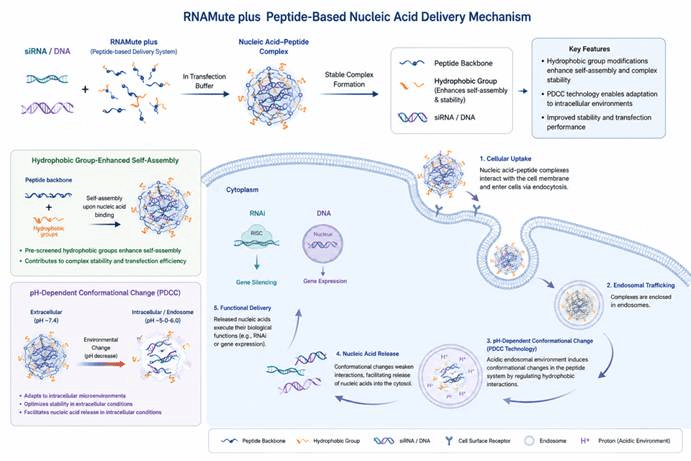
RNAMute plus Transfection Reagent is an upgraded version of the RNAMute Transfection Reagent (TF08). It utilizes an optimized peptide-based nucleic acid delivery system specifically designed for efficient delivery of siRNA and DNA into mammalian cells. Unlike conventional liposome- or polymer-based transfection reagents, RNAMute plus is based on a peptide backbone incorporating pre-screened hydrophobic groups to enhance its interactions with nucleic acids and its self-assembly capability. This enables the formation of stable delivery structures during nucleic acid complex formation, thereby facilitating cellular uptake of nucleic acids.
RNAMute plus has been used for siRNA transfection, DNA transfection, and DNA/siRNA co-transfection in a variety of mammalian cells. It is particularly suitable for in vitro studies requiring efficient gene silencing and can be used for Gene Knockdown, Gene Function Studies, Target Validation, and DNA/siRNA Co-transfection. The accompanying RNAMute plus Transfection Buffer is used for dilution of nucleic acids and transfection reagent and for preparation of transfection complexes, helping establish a stable and reproducible transfection system. Learn More About Peptide-Based Nucleic Acid Delivery
Technical Principle
RNAMute plus is a peptide-based nucleic acid delivery reagent. During transfection, negatively charged siRNA or DNA interacts with the peptide-based delivery system and forms nucleic acid–peptide complexes in the supplied transfection buffer. The resulting complexes facilitate interactions between nucleic acids and the cell membrane and enter cells through cellular uptake processes, thereby enabling intracellular nucleic acid delivery. An important feature of RNAMute plus is the incorporation of hydrophobic group modifications into the peptide backbone. These pre-screened hydrophobic groups enhance the self-assembly capability of RNAMute plus during nucleic acid binding, allowing the formation of delivery complexes suitable for nucleic acid transport. This design enables RNAMute plus to contribute to structural assembly during complex formation, thereby improving the stability and transfection performance of the nucleic acid delivery system. RNAMute plus incorporates pH-Dependent Conformational Change (PDCC) technology. By regulating hydrophobic interactions and conformational changes within the peptide-based delivery system, this technology enables the delivery system to adapt to different intracellular microenvironments, thereby optimizing nucleic acid complex stability and intracellular delivery. In the extracellular environment, RNAMute plus can form stable complexes with negatively charged nucleic acids. After cellular uptake, changes in the intracellular environment can alter the conformation and intermolecular interactions of the delivery system, which may facilitate the release of nucleic acids from the delivery complexes. Through the coordinated design of the peptide backbone, hydrophobic groups, and PDCC technology, RNAMute plus provides an alternative nucleic acid delivery approach for siRNA and DNA that differs from conventional liposome- and polymer-based transfection systems.
Product Advantages
Peptide-Based Delivery System
RNAMute plus utilizes a peptide-based delivery material, providing a differentiated chemical delivery system compared with liposome-based and conventional polymer-based transfection reagents. Its peptide backbone is optimized with hydrophobic groups to facilitate the formation of stable nucleic acid complexes and utilizes self-assembly properties to construct nucleic acid complexes suitable for cellular delivery.
Efficient Gene Silencing
RNAMute plus is optimized for siRNA delivery and can be used for efficient RNA interference experiments. For most adherent cells and some primary cells, the official product information recommends starting with low-to-moderate siRNA concentrations for condition optimization. For hard-to-transfect cells, the siRNA amount can be further increased according to the specific cell type. Actual gene silencing efficiency may be affected by factors such as cell type, siRNA sequence, cell density, and transfection conditions.
Suitable for Hard-to-Transfect Cells
RNAMute plus is designed as a nucleic acid delivery tool with broad cell compatibility, making it particularly suitable for mammalian cells that require further optimization of transfection conditions.
Good Cell Compatibility
RNAMute plus is designed to improve nucleic acid delivery efficiency while maintaining good cell compatibility, making it suitable for gene knockdown experiments where maintaining healthy cell conditions is important. Actual cytotoxicity is closely associated with cell type, nucleic acid concentration, and transfection reagent dosage. Therefore, cell viability and gene silencing efficiency should be evaluated simultaneously.
Serum and Antibiotic Compatibility
RNAMute plus is not significantly affected by serum or antibiotics and can be used for transfection in complete culture medium containing serum and antibiotics. This helps minimize changes in culture conditions during transfection and reduce their potential impact on cell status.
Simple and Convenient Operation
RNAMute plus uses a relatively simple transfection complex preparation procedure. Nucleic acids and RNAMute plus are mixed in the supplied Transfection Buffer to form transfection complexes. After a short incubation period, the complexes can be added directly to the cells, making the system suitable for routine cell experiments and multi-well plate-based transfection studies. A complex formation time of approximately 15 minutes at room temperature is recommended.
Compatible Nucleic Acid Types
RNAMute plus is primarily designed for the in vitro delivery of siRNA and DNA and also supports DNA/siRNA co-transfection. It can be used for standalone siRNA transfection, plasmid DNA transfection, and combined DNA/siRNA delivery, making it suitable for gene knockdown, gene expression, and combined functional studies.
Nucleic Acid Type | Main Applications |
siRNA | Gene Knockdown, Gene Function Studies |
Plasmid DNA | Gene Expression, Reporter Gene Studies |
DNA + siRNA | Combined Gene Expression and Gene Knockdown Studies |
Contents:
– RNAMute plus Transfection Reagent (1.0 mL of RNAMute plus is sufficient for approximately 1,000 reactions when transfecting 2.5 pmol siRNA in a 24-well plate).
– RNAMute plus Transfection Buffer (5×).
Storage:
RNAMute plus Transfection Reagent should be stored at 4°C, while RNAMute plus Transfection Buffer (5×) should be stored at room temperature. When stored properly, the product is stable for 12 months or longer.
RNAMute plus is broadly compatible with a wide range of mammalian cell lines. The table below lists representative cell types that have been experimentally validated. In addition to the cells listed in the table, other mammalian cell types may also be suitable for transfection, with performance depending on the specific cell type, culture conditions, and transfection parameters. Optimization is recommended for each specific cell type.
Cell Type | Cell Line / Cell | Species |
Human Embryonic Kidney Cells | HEK293 | Human |
Hepatocellular Carcinoma Cells | HepG2 | Human |
Mesenchymal Stem Cells | Mouse Bone Marrow-Derived MSCs (mdMSCs) | Mouse |
Breast Cancer Cells | MDA-MB-231 | Human |
Osteoblast Model | MC-3T3 | Mouse |
Osteoblast / Osteoprogenitor Cells | MC-3T3E1 Clone 4 (MC-3T3 CL4) | Mouse |
Myoblasts | C2C12 Myoblasts | Mouse |
Vascular Smooth Muscle Cells | Mouse Vascular Smooth Muscle Cells (mVSMCs) | Mouse |
Vascular Smooth Muscle Cells | Porcine Aortic Vascular Smooth Muscle Cells (VSMCs) | Pig |
Atrial-Derived Cardiomyocytes | HL-1 | Mouse |
Monocytic / Myeloid Immune Cells | Cultured Monocytes | Mouse |
Broadly Compatible Mammalian Cells | Multiple Mammalian Cell Types | Multiple Species |
Primary / Hard-to-Transfect Mammalian Cells | Primary Cells / Hard-to-Transfect Cells | Multiple Species |