
info@mail.ucallm.com
1. Overview
Western Equine Encephalitis Virus (WEEV) is a member of the genus Alphavirus within the family Togaviridae and is the causative agent of Western Equine Encephalitis (WEE). It is an enveloped, positive-sense, single-stranded RNA virus with a spherical virion. WEEV was first isolated in 1930 from the brain tissue of a horse in California, USA, and was once one of the most important mosquito-borne encephalitis pathogens in the western United States and Canada. The virus is maintained in a natural cycle primarily between Culex tarsalis mosquitoes and wild birds, with humans and horses serving as dead-end hosts. During the 1930s and 1940s, WEEV caused thousands of human infections in North America, with a human case fatality rate of up to 15%. Since the last U.S. epidemic in 1987, only 5 sporadic human cases have been reported in North America.
However, in 2023, WEEV caused the first major human outbreak in South America in 40 years, involving thousands of horses and more than 100 confirmed human cases. Between November 2023 and April 2024, 17 provinces in Argentina reported 1,543 horses with neurologic disease, a significant signal that WEEV is re-emerging as a public health threat. No licensed human WEEV vaccine or specific antiviral drug is currently available, and clinical management is supportive.
2. Background Information
2.1 What is WEEV?
WEEV is an enveloped, positive-sense, single-stranded RNA virus belonging to the family Togaviridae and genus Alphavirus. The genome is a positive-sense single-stranded RNA of approximately 11.5 kb, containing a 5′ non-structural open reading frame and a 3′ structural open reading frame. The 5′ ORF encodes four non-structural proteins (nsP1–nsP4), which together form the viral replication complex. The 3′ ORF is translated from the 26S subgenomic RNA into five structural proteins.
The WEEV genome is evolutionarily unique: its capsid protein and 3′ non-translated region sequences are closely related to Eastern equine encephalitis virus (EEEV) , whereas the glycoproteins E2 and E1 are more closely related to those of Old World viruses (such as Sindbis virus). This unique genetic composition indicates that WEEV is a recombinant virus, likely arising from genetic reassortment between an EEEV ancestor and an Old World alphavirus.
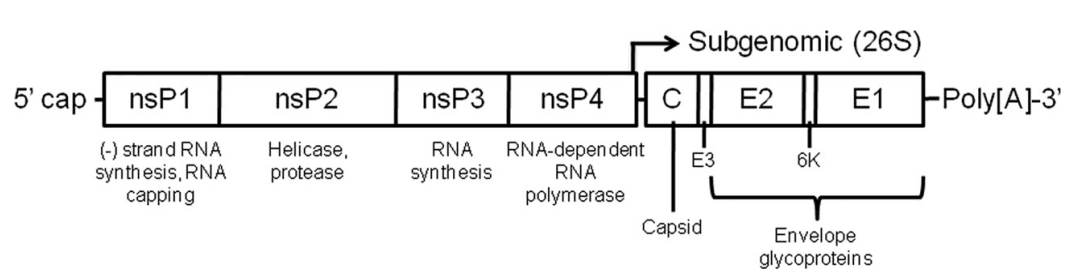
Diagram of the alphavirus genome (PMID: 20631130)
2.2 WEEV Genome & Classification
The WEEV genome is approximately 11.5 kb, encoding a non-structural polyprotein and a structural polyprotein. The non-structural polyprotein is cleaved into four non-structural proteins: nsP1, nsP2, nsP3, and nsP4. The structural polyprotein is translated from the 26S subgenomic RNA into five structural proteins: capsid (C), E3, E2, 6K, and E1.
WEEV belongs to the genus Alphavirus and is the prototype member of the WEE antigenic complex. This complex also includes Highlands J virus, Fort Morgan virus, Buggy Creek virus, and Aura virus. The nucleotide composition of WEEV is 28% A, 25% C, 25% G, and 22% U.
2.3 What Are WEEV Proteins?
2.3.1 Structural proteins
WEEV encodes five structural proteins:
Protein | Full name | Main Function |
C | Capsid | Encapsidates viral genomic RNA, forming the nucleocapsid core |
E3 | Envelope protein 3 | Signal peptide; involved in viral assembly |
E2 | Envelope glycoprotein 2 | Responsible for receptor binding; mediates viral binding to host cell receptors |
6K | 6K protein | Signal peptide and possible viroporin |
E1 | Envelope glycoprotein 1 | Class II fusion protein; mediates fusion of the viral membrane with the host cell membrane |
2.3.2 Non-structural proteins
Protein | Main Function |
nsP1 | RNA capping, membrane association |
nsP2 | Protease, helicase, host immune antagonism |
nsP3 | Replication complex assembly |
nsP4 | RNA-dependent RNA polymerase (RdRp) |
2.4 Mechanism of Cell Entry and Replication
2.4.1 Viral Attachment and Receptor Recognition
WEEV infection begins with the binding of the viral E2 glycoprotein to host cell surface receptors. A 2024 study published in Cell Research identified Protocadherin 10 (PCDH10) as a neuronal receptor for WEEV. PCDH10 is a neuron-enriched transmembrane protein of the cadherin family; overexpression of PCDH10 dramatically increased infection by both WEEV pseudoviruses and authentic WEEV, but did not affect VEEV or SINV infection. In addition, LDLR and its family members VLDLR and LRP4 also increase WEEV infection, while chicken MXRA8 is the WEEV receptor in avian reservoirs.
2.4.2 Viral Entry
WEEV enters host cells via clathrin-mediated endocytosis. Within the endosome, the decrease in pH triggers conformational changes in the envelope protein E1, exposing the fusion peptide, which inserts into the endosomal membrane, mediating fusion of the viral envelope with the endosomal membrane and releasing the viral nucleocapsid into the cytoplasm. Studies also show that WEEV can cross the blood-brain barrier into the central nervous system via caveola-mediated transcytosis.
2.4.3 Viral RNA Replication
After release into the cytoplasm, the 5′ ORF of the viral genomic RNA is directly translated into the non-structural polyprotein. The non-structural polyprotein is cleaved into nsP1–nsP4, which assemble into the replication complex. The protease activity of nsP2 is critical for accurate processing of the nsP123 polyprotein. The replication complex forms a replication spherule in ER-derived membrane vesicles, where NS5 (RdRp) catalyses viral RNA replication.
2.4.4 Viral Assembly and Release
Newly synthesized structural proteins and genomic RNA assemble and bud at the plasma membrane to form progeny virions.
2.5 Symptoms and Treatment
2.5.1 Clinical Symptoms
The incubation period for WEEV infection is typically 5–10 days. Most infections are asymptomatic or present as a mild febrile illness. Symptomatic patients may develop fever, headache, nausea, vomiting, and malaise. Approximately 5%–15% of cases progress to severe neuroinvasive disease, presenting with encephalitis, with symptoms including high fever, altered mental status, seizures, and focal neurological deficits.
The case fatality rate is approximately 3%–15%, and a high proportion of survivors experience long-term neurological sequelae. During the North American epidemics of the 1930s–1940s, the human case fatality rate reached 15%. Children and the elderly are more likely to develop severe disease.
2.5.2 Antiviral Treatment
Currently, no specific antiviral therapy is approved for WEEV. Clinical management is primarily supportive: rest, fluids, and over-the-counter pain medications may relieve some symptoms. In severe cases, patients often need to be hospitalized to receive intravenous fluids, pain medication, and nursing care. Patients with severe meningeal symptoms often require pain control for headaches and antiemetic therapy; patients with encephalitis require close monitoring for the development of elevated intracranial pressure, seizures, and inability to protect their airway.
2.6 Targets for Intervention
2.6.1 Viral Targets
Target | Protein | Biological Role |
E1/E2 | Envelope glycoproteins | Receptor binding & membrane fusion |
nsP2 | Non-structural protein 2 | Protease, helicase |
nsP4 | Non-structural protein 4 | RNA-dependent RNA polymerase |
nsP1 | Non-structural protein 1 | RNA capping |
2.6.2 Host Receptors & Entry Factors
Host Target | Type | Role in Infection |
PCDH10 | Neuronal receptor | Neuron-enriched receptor for WEEV |
LDLR/VLDLR/LRP4 | Receptors | Low-affinity receptors, promote infection |
MXRA8 (chicken) | Receptor | Avian host receptor |
2.6.3 Host Signaling Pathways
Host Target | Type | Biological Role |
TLRs/RLRs pathways | TLRs, RIG-I | Viral RNA sensing |
Inflammatory signaling | IL-6, TNF-α | Pro-inflammatory cytokine synthesis |
Interferon pathway | IFN-α/β | Antiviral response |
2.6.4 Immune & Inflammatory Targets
Target | Category | Major Role |
IFN-α | Cytokine | Antiviral response |
IFN-β | Cytokine | Antiviral response |
IL-6 | Cytokine | Inflammatory response |
TNF-α | Cytokine | Inflammation |
2.7 Vaccine Types and Development Progress
Currently, no human WEEV vaccine is licensed worldwide. Equine WEEV vaccines (inactivated) are licensed and widely used. Several vaccine candidates are in development.
2.7.1 Trivalent Virion-Based Vaccine (VEEV/EEEV/WEEV)
A 2025 study published in Science Translational Medicine developed an inactivated trivalent virion-based vaccine against VEEV, EEEV, and WEEV. The vaccine uses a combination of attenuated chimeric Sindbis-VEEV/EEEV/WEEV viruses inactivated with H₂O₂ treatment to enhance safety and preserve virion surface epitopes. The alum-adjuvanted vaccine conferred complete protection in mice with two doses, and substantial or complete protection in nonhuman primates at low and high doses, respectively.
2.7.2 MVA-BN-WEV (Recombinant Live-Attenuated Vaccine)
MVA-BN-WEV is a recombinant multivalent vaccine based on the Modified Vaccinia Ankara vector, encoding the envelope surface proteins of three equine encephalitis viruses. The Phase 1 clinical trial showed acceptable safety at all doses, with the highest dose group inducing robust immune responses. A Phase 2 clinical trial (NCT06899802) was initiated in March 2025.
2.7.3 DNA Vaccine
DNA vaccine strategies have identified protective WEEV structural proteins, including the E1 and E2 glycoproteins. DNA vaccines based on these antigens have shown protective efficacy in mouse models.
2.7.4 Live-Attenuated Vaccines
A 2026 study published in PMC used informed mutation to confer heparan sulfate binding to WEEV, providing a new strategy for the rational design of live-attenuated vaccines.
2.8 Drugs
Currently, no specific small-molecule antiviral is approved for WEEV.
2.8.1 Virus-Targeted Drugs
Target/mechanism | Drug/candidate | Mechanism | Stage |
nsP2 protease | N83 and N85 | Covalently inhibit nsP2 protease, blocking nsP123 polyprotein processing; active against WEEV | Mouse model |
Broad-spectrum antiviral | BDGR-164 | Novel quinazolinone with subnanomolar potency against VEEV, EEEV, WEEV | Mouse model |
2.9 Epidemiology
l First identified: 1930, California, USA
l Geographic distribution: historically primarily in western North America (western United States and western Canada). In recent years, re-emergence has occurred in South America, with the 2023–2024 Argentina outbreak involving 17 provinces
l Vectors: Culex tarsalis is the principal vector
l Natural cycle: mosquitoes ↔ wild birds; humans and horses are dead-end hosts
l Historical North American epidemics: during the 1930s–1940s, thousands of human infections with a case fatality rate of up to 15%; after the last U.S. epidemic in 1987, only 5 sporadic cases have been reported
l South American re-emergence:
Ø Argentina (2023–2024) : 17 provinces reported 1,543 horses with neurologic disease; 3 of 27 mosquito pools (n = 1,089 mosquitoes) were WEEV-positive (2 Ae. albifasciatus)
Ø Human cases: Argentina reported its first human WEE case in over 40 years, in a rural worker in an area where horses had tested positive for WEEV
Ø Increased rainfall, agricultural expansion, vector proliferation, and low vaccination coverage were likely key factors contributing to the re-emergence
l Climate impact: climate change affects WEEV distribution in South America, with related research ongoing
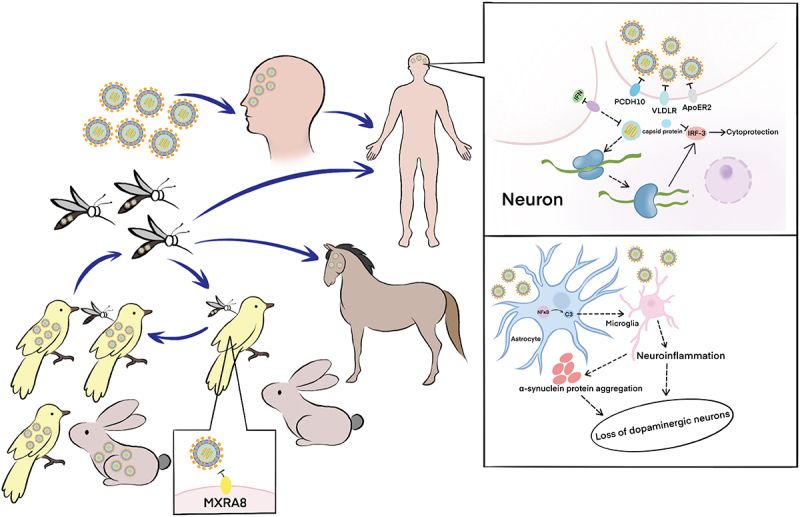
The natural transmission cycle of WEEV(PMID: 41178425)
2.10 Diagnosis
Diagnosis of WEEV infection relies on laboratory testing:
l Virus isolation: isolation of WEEV from clinical material (requires BSL-3 laboratory)
l Nucleic acid testing (NAT) : detection of WEEV RNA in clinical material (real-time RT-PCR)
l Serology: detection of WEEV-specific IgM antibodies in serum or cerebrospinal fluid, the preferred test method; confirmatory plaque reduction neutralization test (PRNT) requires live virus and BSL-3 facilities
Diagnostic challenges: affected countries lack facilities equipped with BSL-3 laboratories, hindering laboratory diagnosis and surveillance. A chimeric vesicular stomatitis virus (VSV) bearing WEEV envelope proteins E2-E1 has been developed as a surrogate for PRNT.
2.11 Prevention
l Vaccination: no licensed human WEEV vaccine is currently available; equine WEEV inactivated vaccines are licensed and widely used, with annual vaccination recommended
l Avoid mosquito bites: prevention of WEE depends on personal protective measures to decrease exposure to infected mosquitoes
Ø Use insect repellent
Ø Wear long-sleeved shirts and pants
Ø Treat clothing and gear with 0.5% permethrin
Ø Take steps to control mosquitoes indoors and outdoors, including emptying water-holding containers
l Equine management: vaccinating horses against WEEV is an important measure for preventing equine infection
l Personal protective measures: wear appropriate personal protective equipment (PPE) when in mosquito-active areas
l Surveillance and reporting: WEEV is a notifiable disease in the United States; strengthen surveillance of human cases, mosquito vectors, and horses
3. Related Products & Services
l Recombinant Antigens & Receptors
l Antibodies
l Detection Kits
l Recombinant Protein Expression Services
l Antibody Development Services
4. Resources
5. References
1. Yang, Y., Zhao, L. X., Li, Z. Q., et al. (2024). PCDH10 is a neuronal receptor for western equine encephalitis virus. Cell research, 34(11), 802–805.
2. Li, W., Plante, J. A., Lin, C.,et al. (2024). Shifts in receptors during submergence of an encephalitic arbovirus. Nature, 632(8025), 614–621.
3. Campos, A. S., Franco, A. C., Godinho, F., et al. (2024). Molecular epidemiology of Western equine encephalitis virus in Brazil, 2023-2024. medRxiv : the preprint server for health sciences, 2024.04.15.24305848.
4. Spinsanti, L., Fabbri, C., Piskorz, A., et al. (2026). Epidemiologic, Entomologic, and Virologic Findings during Reemergence of Western Equine Encephalitis Virus, Argentina. Emerging infectious diseases, 32(8), 1275–1285.
5. Forrester, N. L., Palacios, G., Tesh, R. B., et al. (2012). Genome-scale phylogeny of the alphavirus genus suggests a marine origin. Journal of virology, 86(5), 2729–2738.
6. Weaver, S. C., Kang, W., Shirako, Y., et al. (1997). Recombinational history and molecular evolution of western equine encephalomyelitis complex alphaviruses. Journal of virology, 71(1), 613–623.
7. Powers, A. M., Brault, A. C., Shirako, Y., et al. (2001). Evolutionary relationships and systematics of the alphaviruses. Journal of virology, 75(21), 10118–10131.
8. Strauss, J. H., & Strauss, E. G. (1994). The alphaviruses: gene expression, replication, and evolution. Microbiological reviews, 58(3), 491–562.
9. Kuhn, R. J. (2007). Togaviridae: the viruses and their replication. In Fields Virology (5th ed.). Lippincott Williams & Wilkins.
10. Ryman, K. D., Klimstra, W. B. (2008). Host responses to alphavirus infection. Immunological reviews, 225, 27–45.
11. MacDonald, G. H., Johnston, R. E. (2000). Role of dendritic cell targeting in Venezuelan equine encephalitis virus pathogenesis. Journal of virology, 74(2), 914–922.
12. Mertz, G. J., Miedzinski, L., Goade, D., et al. (2004). Placebo-controlled, double-blind trial of intravenous ribavirin for the treatment of hantavirus cardiopulmonary syndrome in North America. Clinical infectious diseases : an official publication of the Infectious Diseases Society of America, 39(9), 1307–1313.
13. Zacks, M. A., Paessler, S. (2010). Encephalitic alphaviruses. Veterinary microbiology, 140(3-4), 281–286.
14. Ronca, S. E., Dineley, K. T., & Paessler, S. (2016). Neurological Sequelae Resulting from Encephalitic Alphavirus Infection. Frontiers in microbiology, 7, 959.
15. Weaver, S. C., Reisen, W. K. (2010). Present and future arboviral threats. Antiviral research, 85(2), 328–345.
16. Calisher C. H. (1994). Medically important arboviruses of the United States and Canada. Clinical microbiology reviews, 7(1), 89–116.
17. VanderGiessen, M., de Jager, C., Leighton, J.,et al. (2024). Neurological manifestations of encephalitic alphaviruses, traumatic brain injuries, and organophosphorus nerve agent exposure. Frontiers in neuroscience, 18, 1514940.