
info@mail.ucallm.com
1. Overview
Zika virus (ZIKV) is a major member of the genus Orthoflavivirus within the family Flaviviridae and is the causative agent of Zika virus disease. It is an enveloped, positive-sense, single-stranded RNA virus with a spherical virion approximately 40–60 nm in diameter.
Zika virus was first isolated in 1947 from a rhesus macaque in the Zika Forest of Uganda, and the first human infections were reported in Uganda and Tanzania in 1952. The virus is transmitted primarily by Aedes mosquitoes, mainly Aedes aegypti and Aedes albopictus. Zika virus disease is usually a self-limiting mild illness, but the congenital Zika syndrome (CZS) and microcephaly identified during the 2015–2016 Brazilian outbreak made it a global public health emergency. In addition, Zika virus infection is closely associated with neurological complications such as Guillain-Barré syndrome (GBS). Currently, no specific vaccine or antiviral therapy is approved for Zika virus.
2. Background Information
2.1 What is Zika Virus?
Zika virus is an enveloped, positive-sense, single-stranded RNA virus belonging to the family Flaviviridae and genus Orthoflavivirus. The virion is spherical, approximately 50 nm in diameter. The virus structure consists, from inside to outside, of a nucleocapsid, an envelope, and surface proteins. The nucleocapsid is composed of genomic RNA and capsid protein (C); the envelope is derived from the host cell membrane and is studded with membrane protein (prM/M) and envelope protein (E).
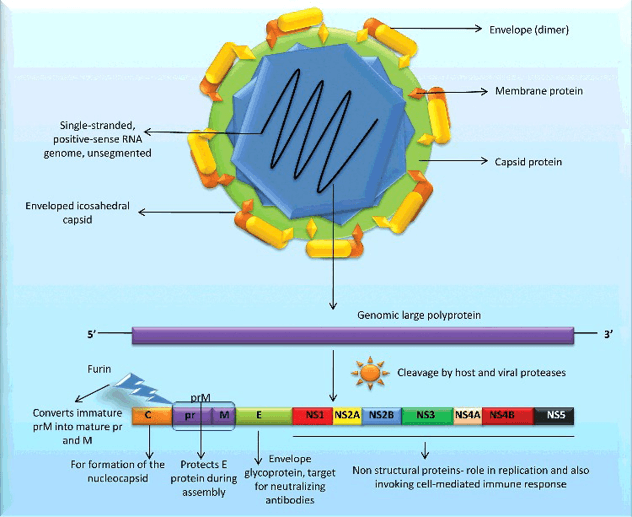
Structure of Zika viruses and its genomes (PMID: 27158761)
2.2 Zika Virus Genome & Classification
The Zika virus genome is a positive-sense single-stranded RNA of approximately 10.7–11 kb. It possesses a methylated nucleotide cap at the 5′ end but lacks a poly(A) tail at the 3′ end, forming a circular structure. This 3′ terminal secondary structure can generate subgenomic flavivirus RNA (sfRNA) through host XRN1-mediated degradation of genomic RNA; sfRNA plays important roles in viral pathogenesis and suppression of host RIG-I antiviral activity.
The genome contains a single open reading frame (ORF) encoding a polyprotein precursor of approximately 3,419 amino acids. The polyprotein is co-translationally and post-translationally cleaved by host and viral proteases into 10 mature proteins.
2.3 What Are Zika Virus Proteins?
Zika virus encodes 10 proteins, including 3 structural proteins and 7 non-structural proteins:
2.3.1 Structural Proteins
Protein | Full name | Main Function |
C | Capsid | Composed of 122 amino acids; binds genomic RNA to form the nucleocapsid core |
prM/M | pre-Membrane/Membrane | prM is cleaved by furin during maturation to produce M protein; M protein locks E protein in its mature conformation after prM cleavage |
E | Envelope | Major surface protein (<53 kDa); mediates receptor binding and membrane fusion; N-glycosylation at Asn154 affects protein expression, secretion, packaging, and infectivity; primary target of neutralizing antibodies |
2.3.2 Non-structural Proteins
The seven non-structural proteins (NS1, NS2A, NS2B, NS3, NS4A, NS4B, NS5) participate in viral RNA replication, virion morphogenesis, membrane rearrangement, and modulation of host immune responses:
Protein | Molecular weight | Main Function |
NS1 | — | Involved in viral replication; has immunomodulatory activity; can be secreted from infected cells |
NS2A | ~22 kDa | Function remains to be fully elucidated |
NS2B | ~14 kDa | Cofactor for NS3 protease |
NS3 | ~70 kDa | Trypsin-like serine protease (polyprotein processing) and helicase activity (viral RNA replication) |
NS4A | ~16 kDa | Together with NS4B, participates in regulation of Akt-mTOR signaling and autophagy induction |
NS4B | ~27 kDa | Together with NS4A, participates in formation of the viral replication complex |
NS5 | ~103 kDa | Possesses methyltransferase (5′ cap methylation) and RNA-dependent RNA polymerase (RdRp) activities; core enzyme for viral RNA replication |
2.4 Mechanism of Cell Entry and Replication
The Zika virus replication cycle resembles that of other flaviviruses and occurs entirely in the host cell cytoplasm.
2.4.1 Viral Attachment and Receptor Recognition
Infection begins with the binding of the viral E protein to one or more receptors on the host cell surface.
The virus can also utilize apoptotic mimicry, using phosphatidylserine (PS) on the envelope surface to bind host TAM family receptors and mediate entry.
2.4.2 Viral Entry
Zika virus enters host cells via clathrin-mediated endocytosis. After internalization, endosomal acidification triggers low-pH-induced conformational changes in E protein, mediating fusion of the viral envelope with the endosomal membrane. Following fusion, the viral genomic RNA is released into the host cell cytoplasm.
2.4.3 Viral RNA Replication
Upon release, the viral RNA immediately associates with host ribosomes and initiates translation on the rough endoplasmic reticulum (ER) membrane. The polyprotein precursor is co-translationally and post-translationally cleaved to produce structural and non-structural proteins.
The non-structural proteins assemble into a replication complex on ER-derived membrane vesicles. NS5 (RdRp) synthesizes a negative-sense RNA intermediate using the positive-sense RNA as template; the negative-sense RNA then serves as template for synthesis of multiple positive-sense genomic RNA copies. Replication occurs in cytoplasmic viral factories on the ER surface
2.4.4 Viral Assembly and Maturation
Newly synthesized viral genomic RNA interacts with structural proteins C, prM, and E on the ER membrane and buds into the ER lumen to form immature virions. During transport through the Golgi apparatus, prM protein is cleaved by host furin protease to produce M protein. This cleavage triggers rearrangement of the viral envelope proteins, maturing the virions. Mature virions are finally released via exocytosis.
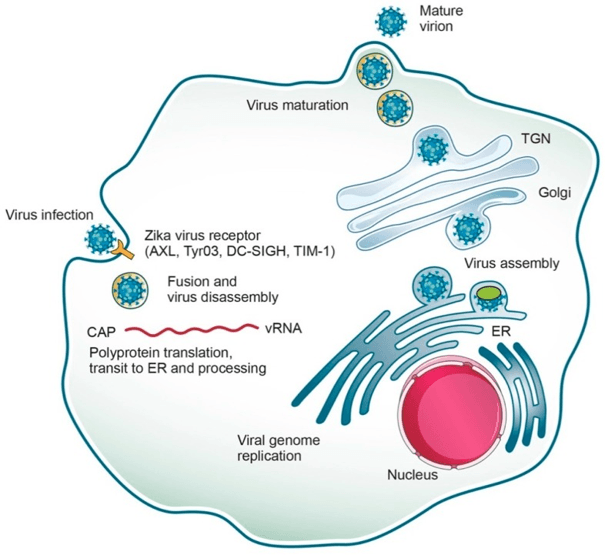
The life cycle of Zika virus. (PMID: 31261947)
2.5 Symptoms and Treatment
2.5.1 Clinical Symptoms
The incubation period of Zika virus infection is not fully defined. Approximately 80% of infections are asymptomatic. About 20% of infected individuals develop clinical symptoms, usually presenting as a mild, self-limiting illness. Common symptoms include:
l Rash (maculopapular)
l Fever (low-grade)
l Conjunctivitis
l Arthralgia
l Myalgia
l Headache (may be accompanied by retro-orbital pain)
l Fatigue
Symptoms usually resolve spontaneously within several days to one week. However, Zika virus infection can cause severe neurological complications:
l Congenital Zika syndrome (CZS): microcephaly and other birth defects can occur in fetuses after maternal infection
l Guillain-Barré syndrome (GBS)
l Encephalitis (including brainstem encephalitis)
2.5.2 Treatment
Currently, no specific antiviral therapy is approved for Zika virus. Treatment is primarily supportive:
l Rest
l Adequate hydration
l Fever and pain management: acetaminophen/paracetamol
l Non-steroidal anti-inflammatory drugs (NSAIDs) should be avoided: until dengue is ruled out, NSAIDs may increase bleeding risk
2.6 Targets for Intervention
2.6.1 Viral Targets
Target | Protein | Biological Role |
E | Envelope protein | Receptor binding & membrane fusion |
NS2B-NS3 | Protease complex | Polyprotein processing |
NS3 | Helicase | RNA unwinding |
NS5 | RNA polymerase (RdRp) | RNA replication |
Methyltransferase | 5′ cap methylation |
2.6.2 Host Target
Host Target | Type | Role in Infection |
AXL | Receptor tyrosine kinase | Viral entry |
TYRO3 | Receptor tyrosine kinase | Viral entry |
DC-SIGN | C-type lectin receptor | Viral entry |
TIM1 | T-cell immunoglobulin and mucin family | Viral entry |
2.7 Vaccine Types and Development Progress
Currently, no Zika virus vaccine is licensed worldwide. However, several candidates have entered clinical trials.
2.7.1 VLA1601 (Second-Generation Adjuvanted Inactivated Vaccine, Valneva)
VLA1601 is a second-generation adjuvanted inactivated vaccine candidate developed by Valneva.
l Phase 1 clinical trial (VLA1601-102): approximately 150 participants aged 18–49 years enrolled in the United States
l Regimen: two doses (4 weeks apart), evaluating low, medium, and high antigen doses
l Adjuvant regimens: aluminum adjuvant alone, or aluminum adjuvant combined with CpG 1018® or 3M-052-AF
l Safety and tolerability: generally safe and well tolerated across all five treatment groups
l Immunogenicity: the dual-adjuvant groups (aluminum + 3M-052-AF and aluminum+CpG1018) had the highest neutralizing antibody titers; peak seroconversion rate >93% (86% for the first-generation vaccine), and peak geometric mean titer fold increase >56-fold (>7-fold for the first-generation vaccine)
2.7.2 mRNA-1893 (mRNA Vaccine, Moderna)
mRNA-1893 is an mRNA vaccine candidate developed by Moderna.
l Phase 2 clinical trial (NCT04917861): evaluating safety, tolerability, and immunogenicity in 809 adults aged 18–65 years
2.7.3 Other Vaccine Candidates
As of 2025, two mRNA Zika vaccine candidates have entered clinical trials. In addition, multiple platforms including DNA vaccines are in development.
2.8 Drugs
Currently, no specific small-molecule antiviral is approved for Zika virus. Several novel antiviral candidates have shown significant progress:
2.8.1 Virus-Targeted Drugs
Target | Drug/candidate | Mechanism | Stage |
Viral replication | PAV-05 (naphthoquinone) | Inhibits viral replication | In vitro |
NS2B-NS3 protease | Fragment screening compounds | Protease inhibition | Crystallographic fragment screening |
NS3 helicase | Phenylurea derivatives | Helicase inhibition | In vitro |
E protein | Quercetin | E protein inhibition | Molecular docking and dynamics simulation |
Pinocembrin | E protein inhibition | Molecular docking and dynamics simulation | |
Naringenin | E protein inhibition | Molecular docking and dynamics simulation | |
Ponatinib | FDA-approved drug; targets three E protein domains | Computational drug repurposing | |
Multiple targets | Cephalotaxine | Antiviral activity | High-throughput screening |
Docusate sodium | Antiviral activity | High-throughput screening | |
Saikosaponin B2 | Antiviral activity | High-throughput screening | |
Broad-spectrum antiviral | Eicosapentaenoic acid (EPA) | Inhibits enveloped virus infection | In vitro |
Multiple stages | Synthetic peptide GA-KKALKKLKKALKKAL-CONH2 | Inhibits virus at multiple stages of the replication cycle | In vitro |
2.9 Epidemiology
l First identified: 1947, Zika Forest, Uganda (monkey)
l First human infections: 1952, Uganda and Tanzania
l 2015–2016 outbreak: large-scale outbreak in Brazil, associated with microcephaly and congenital Zika syndrome
l 2025 outbreak overviews:
Ø Global: reported cases declined compared with 2024. In 2025, 7 cases were reported globally (16 in 2024)
Ø Amazonas, Brazil: 202 cases reported before epidemiological week 49 of 2025, including 25 confirmed cases
Ø Argentina: 1,045 confirmed cases reported in 2025, nearly double the 564 cases in 2024
Ø Italy: 5 imported cases (no deaths)
Ø Mainland France: 11 imported cases reported from May to November 2025
Ø Île-de-France region, France: 7 cases reported as of 1 July 2025
Ø Dhaka, Bangladesh: virus strain detected in May 2025, distinct from known lineages
l Transmission routes:
Ø Mosquito-borne: bites of Aedes mosquitoes (mainly Aedes aegypti and Aedes albopictus)
Ø Sexual transmission: can be transmitted through sexual contact
Ø Vertical transmission: maternal infection can be transmitted to the fetus, causing congenital Zika syndrome
Ø Transfusion transmission: can be transmitted through blood transfusion
2.10 Diagnosis
Diagnosis of Zika virus infection relies on laboratory testing:
l RT-PCR (reverse transcription polymerase chain reaction): detection of viral RNA in blood, urine, or saliva (acute phase)
l Serology: detection of anti-ZIKV IgM/IgG antibodies (attention should be paid to cross-reactivity with dengue and other flaviviruses)
l Placental/fetal testing: for diagnosis of congenital infection
2.11 Prevention
l Mosquito control: reduce mosquito breeding sites, use bed nets and repellents
l Personal protection: wear long-sleeved clothing, use insecticide-treated bed nets
l Safe sexual practices: adopt safe sexual practices (condoms) in or after returning from endemic areas, especially for pregnant women
l Traveller precautions: pregnant women should postpone travel to endemic areas; travellers should take strict anti-mosquito measures
l Blood donor screening: blood donor screening in endemic areas
l Vaccines: no licensed vaccine currently available
3. Related Products & Services
l Recombinant Antigens & Receptors
l Antibodies
l Detection Kits
l Recombinant Protein Expression Services
l Antibody Development Services
4. Resources
5. References
1. Petersen, L. R., Jamieson, D. J., Powers, A. M., et al. (2016). Zika virus. New England Journal of Medicine, 374(16), 1552–1563.
2. Pierson, T. C., Diamond, M. S. (2018). The emergence of Zika virus and its new clinical syndromes. Nature, 560(7720), 573–581.
3. Sirohi, D., Chen, Z., Sun, L., et al. (2016). The 3.8 Å resolution cryo-EM structure of Zika virus. Science, 352(6284), 467–470.
4. Kostyuchenko, V. A., Lim, E. X., Zhang, S., et al. (2016). Structure of the thermally stable Zika virus. Nature, 533(7603), 425–428.
5. Hasan, S. S., Sevvana, M., Kuhn, R. J., et al. (2018). Structural biology of Zika virus and other flaviviruses. Nature Structural & Molecular Biology, 25(1), 13–20.
6. Liu, Z. Y., Shi, W. F., Qin, C. F. (2019). The evolution of Zika virus from Asia to the Americas. Nature Reviews Microbiology, 17(3), 131–139.
7. Cao-Lormeau, V. M., Blake, A., Mons, S., et al. (2016). Guillain-Barré syndrome outbreak associated with Zika virus infection in French Polynesia: a case-control study. The Lancet, 387(10027), 1531–1539.
8. Rasmussen, S. A., Jamieson, D. J., Honein, M. A., et al. (2016). Zika virus and birth defects — reviewing the evidence for causality. New England Journal of Medicine, 374(20), 1981–1987.
9. Brasil, P., Pereira, J. P., Moreira, M. E., et al. (2016). Zika virus infection in pregnant women in Rio de Janeiro. New England Journal of Medicine, 375(24), 2321–2334.
10. Tabata, T., Petitt, M., Puerta-Guardo, H., et al. (2016). Zika virus targets different primary human brain cells, including neuronal progenitors, astrocytes, and microglia. Cell Host & Microbe, 20(5), 673–678.
11. Lei, J., Hansen, G., Nitsche, C., et al. (2016). Crystal structure of Zika virus NS2B-NS3 protease in complex with a boronate inhibitor. Science, 353(6298), 503–505.
12. Phoo, W. W., Li, Y., Zhang, Z., et al. (2016). Structure of the NS2B-NS3 protease from Zika virus after self-cleavage. Nature Communications, 7, 13410.
13. Zhang, Z., Li, Y., Loh, Y. R., et al. (2016). Crystal structure of unlinked NS2B-NS3 protease from Zika virus. Science, 354(6319), 1597–1600.
14. Meertens, L., Labeau, A., Dejarnac, O., et al. (2017). Axl Mediates ZIKA Virus Entry in Human Glial Cells and Modulates Innate Immune Responses. Cell reports, 18(2), 324–333.
15. Abbink, P., Stephenson, K. E., Barouch, D. H. (2018). Zika virus vaccines. Nature Reviews Microbiology, 16(10), 594–600.
16. Xu, M., Lee, E. M., Wen, Z., et al. (2016). Identification of small-molecule inhibitors of Zika virus infection and induced neural cell death via a drug repurposing screen. Nature Medicine, 22(10), 1101–1107.
17. Coyne, C. B., Lazear, H. M. (2016). Zika virus — reigniting the TORCH. Nature Reviews Microbiology, 14(11), 707–715.
18. Musso, D., Ko, A. I., Baud, D. (2019). Zika virus infection — after the pandemic. New England Journal of Medicine, 381(15), 1444–1457.
19. D’Ortenzio, E., Matheron, S., de Lamballerie, X., et al. (2016). Evidence of sexual transmission of Zika virus. New England Journal of Medicine, 374(22), 2195–2198.
20. Lackritz, E. M., Ng, L. C., Marques, E. T. A., et al. (2025). Zika virus vaccines and monoclonal antibodies: a priority agenda for research and development. The Lancet Infectious Diseases, 25(7), e402–e415.