
info@mail.ucallm.com
From Nutrient Availability to Cellular Adaptation — Empowering Comprehensive Metabolic Signaling Research with Validated Antibody Solutions
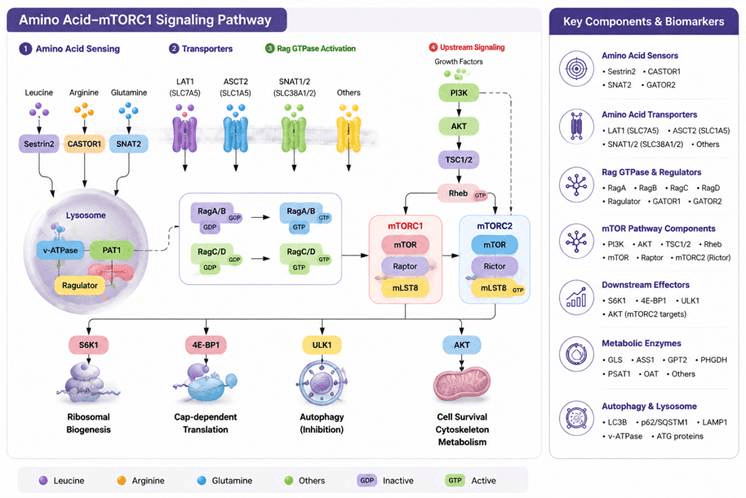
Amino acid metabolism is a fundamental regulator of cellular physiology, integrating nutrient availability, energy homeostasis, protein synthesis, immune function, and disease progression. Beyond serving as building blocks for protein synthesis, amino acids function as critical signaling molecules that directly regulate the mechanistic target of rapamycin (mTOR) pathway, one of the most important nutrient-sensing networks controlling cellular growth and metabolism.
Amino acid-dependent mTOR activation is mediated through coordinated regulation of:
- Direct amino acid sensors
- Amino acid transport systems
- Rag GTPase nutrient signaling machinery
- PI3K–AKT–TSC–Rheb pathway
- mTORC1/mTORC2 complexes
- Metabolic enzymes controlling amino acid utilization
- Downstream anabolic and autophagy programs
We provide comprehensive antibody solutions for investigating amino acid metabolism and mTOR signaling—from nutrient sensing and transporter regulation to metabolic remodeling, immune adaptation, cancer metabolism, and therapeutic target discovery.
Validated antibodies enable researchers to characterize:
- Amino acid sensing mechanisms
- mTORC1 nutrient activation pathways
- Amino acid transporter regulation
- Metabolic reprogramming in cancer and immune cells
- Autophagy–lysosome nutrient adaptation
- Protein synthesis and translational control
- Metabolic stress responses
Amino Acid Metabolism & mTOR Nutrient Sensing Biomarker Antibody Portfolio
—Comprehensive Solutions for Nutrient Detection, mTOR Activation Profiling, and Metabolic Adaptation Research
Amino acid availability serves as a critical regulatory signal connecting nutrient sensing, cellular growth, metabolism, and stress adaptation. The mTOR signaling network integrates amino acid inputs through coordinated regulation of amino acid sensors, transport systems, lysosomal signaling machinery, metabolic enzymes, and downstream translational programs.
Our validated antibody portfolio enables comprehensive characterization of amino acid–mTOR signaling networks, supporting research in:
Research Focus | Representative Biomarkers | Key Applications |
Amino Acid Sensing & Nutrient Recognition | SESN2 (Sestrin2), CASTOR1 (GATSL3), CASTOR2 (GATSL2), SAMTOR (BMT2), SLC38A9, LARS1, EIF2AK4 (GCN2) | Decoding leucine, arginine, methionine sensing mechanisms and nutrient stress responses |
mTOR Activation & Regulatory Signaling | mTOR, Raptor, Rictor, RagA/B, RagC/D, GATOR complexes, Rheb, TSC1/2 | Profiling nutrient-dependent mTORC1/mTORC2 activation and upstream regulatory networks |
Amino Acid Transport & Nutrient Uptake | SLC7A5 , SLC7A8 , SLC3A2 , SLC1A5 , SLC38A1/2 , SLC7A11 (xCT), SLC7A1, SLC15A4 | Investigating amino acid availability, transporter regulation, and metabolic adaptation |
Metabolic Reprogramming & Amino Acid Utilization | BCAT1, BCAT2, BCKDHA, BCKDHB, GLS, GLS2, GLUL, GLUD1, IDO1, TDO2, KMO, ARG1, ARG2, NOS2, PHGDH, PSAT1, SHMT2, MTHFD2, MAT2A, GCLC, GCLM, GSS, GSR, GPX4 | Characterizing cancer metabolism, immune metabolism, and metabolic vulnerabilities |
Protein Synthesis & Translational Control | RPS6KB1 (p-p70 S6K Thr389), RPS6 (p-S6 Ser240/244), EIF4EBP1 (p-4E-BP1 Thr37/46), EIF4E, MYC, HIF1A | Monitoring mTOR-driven anabolic growth and translational regulation |
Autophagy & Lysosomal Adaptation | ULK1 (p-ULK1 Ser757), ATG13, RB1CC1 (FIP200), MAP1LC3B (LC3B), SQSTM1/p62, BNIP3, TFEB, TFE3 | Studying nutrient deprivation responses, autophagy regulation, and metabolic homeostasis |
Energy Stress & Metabolic Adaptation | PRKAA1/2 (AMPKα), p-AMPKα Thr172, ATF4, FOXO1/3, NFE2L2 | Investigating cellular stress responses and nutrient availability adaptation |
Featured Amino Acid Metabolism & mTOR Signaling Research Panels
— Comprehensive Antibody Panels for Nutrient Sensing, Metabolic Remodeling, and Cellular Adaptation Analysis
Amino acid metabolism is dynamically regulated through interconnected signaling networks that control nutrient availability, cellular growth, protein synthesis, autophagy, and metabolic adaptation. Integrated biomarker profiling enables researchers to investigate how cells sense environmental nutrients, reprogram metabolic pathways, and respond to physiological or pathological stress.
Our validated antibody panels support comprehensive analysis of major metabolic processes, including amino acid sensing, mTOR pathway activation, transporter regulation, metabolic enzyme activity, and downstream functional responses.
Amino Acid Sensor & Nutrient Recognition Panel—Decoding molecular mechanisms that detect amino acid availability and regulate mTOR activation
Key Markers
Sestrin2 | CASTOR1/2 | SAMTOR | SLC38A9 | LARS | GCN2 |
mTOR Pathway Activation & Regulatory Network Panel—Profiling nutrient-dependent signaling from upstream sensors to downstream effectors
Key Markers
mTOR | Raptor | Rictor | RagA/B & RagC/D |
Rheb | TSC1/TSC2 | AMPKα | AKT / p-AKT |
Amino Acid Transport & Nutrient Uptake Panel—Understanding how transporter networks regulate intracellular nutrient availability
Key Markers
SLC7A5 | SLC1A5 | SLC38A1/2 | SLC3A2 | SLC7A11 | SLC7A1 | SLC15A4 |
Metabolic Reprogramming & Amino Acid Utilization Panel—Characterizing amino acid catabolism, biosynthesis, and metabolic adaptation
Key Markers
BCAA Metabolism | BCAT1 | BCAT2 | BCKDHA | BCKDHB |
Glutamine Metabolism | GLS | GLS2 | GLUL | GLUD1 |
Tryptophan Metabolism | IDO1 | TDO2 | KMO |
|
Arginine Metabolism | ARG1 | ARG2 | NOS2 |
|
One-Carbon Metabolism | SHMT2 | MAT2A | PHGDH | PSAT1 |
Redox Metabolism | GCLC | GCLM | GSS | GPX4 |
mTOR Downstream Functional Output Panel—Evaluating cellular consequences of nutrient-driven signaling activation
Key Markers
Protein Translation | p-S6K | S6 | p-4E-BP1 | eIF4E |
Metabolic Adaptation | HIF-1α | MYC | ATF4 | DDIT3 |
Autophagy Regulation | ULK1 | ATG13 | LC3B | p62/SQSTM1 |
Lysosomal Regulation | TFEB | MITF |
|
|
Mitophagy & Stress Response | BNIP3 | FOXO1 | FOXO3 |
|
Why Researchers Choose Our Amino Acid Metabolism & mTOR Antibody Solutions
Validated Nutrient Sensors. Comprehensive Pathway Coverage. Reliable Metabolic Insights.
Our antibody portfolio supports complete metabolic research workflows:
Research Challenge | Our Solution |
How can I identify amino acid-dependent mTOR activation? | Sestrin2, CASTOR1, Rag proteins, mTOR, p-S6K, p-4E-BP1 signaling solutions |
How can I study cancer metabolic reprogramming? | LAT1, ASCT2, GLS, PHGDH, IDO1, MYC metabolic pathway markers |
How can I investigate immune cell nutrient adaptation? | CD98, amino acid transporters, mTOR, AMPK, GCN2 signaling panels |
How can I analyze autophagy responses during nutrient stress? | ULK1, TFEB, LC3B, p62/SQSTM1 pathway markers |
How can I evaluate metabolic pathway activation? | Phosphorylation-specific antibodies and pathway activity markers |
How can I perform spatial metabolic profiling? | Multiplex IF/IHC-compatible validated antibody solutions |
Key reference
Cara L Green, Dudley W Lamming (2022). Molecular mechanisms of dietary restriction promoting health and longevity. Nat Rev Mol Cell Biol. 2022 Jan;23(1):56-73.
Coen C. Paulusma, Wouter H. Lamers (2022). Amino acid metabolism, transport and signalling in the liver revisited. Biochem Pharmacol. 2022 Jul:201:115074.
Luming Yang, Zhaole Chu (2023). Amino acid metabolism in immune cells: essential regulators of the effector functions, and promising opportunities to enhance cancer Immunotherapy. J Hematol Oncol. 2023 Jun 5;16(1):59.
Yue Zheng, Yiran Yao (2023). Amino acid metabolism reprogramming: shedding new light on T cell anti-tumor Immunity. J Exp Clin Cancer Res. 2023 Nov 3;42(1):291.
Claire Goul, Roberta Peruzzo (2023). The molecular basis of nutrient sensing and signalling by mTORC1 in metabolism regulation and disease. Nat Rev Mol Cell Biol. 2023 Dec;24(12):857-875.
Philipp A Voss 1, Sebastian G Gornik (2023). Host nutrient sensing is mediated by mTOR signaling in cnidarian-dinoflagellate symbiosis. Curr Biol. 2023 Sep 11;33(17):3634-3647.e5.
Martine G. E. Knol, Vera C. Wulfmeyer (2024). Amino acid metabolism in kidney health and disease. Nat Rev Nephrol. 2024 Dec;20(12):771-788.