
info@mail.ucallm.com
From B Cell Activation to Germinal Center Formation and TLS Maturation — Empowering Comprehensive Spatial Immune Profiling with Validated Antibody Solutions
B cells are essential regulators of adaptive immunity, antigen presentation, antibody production, immune memory, and local immune organization. In chronically inflamed tissues and tumors, persistent antigen stimulation and inflammatory signaling can promote the recruitment and organization of B cells, T cells, dendritic cells, follicular dendritic cells, stromal cells, and specialized vasculature into tertiary lymphoid structures (TLS).
Unlike conventional lymphoid organs, TLS develop ectopically within non-lymphoid tissues and exhibit considerable structural and functional heterogeneity. They may range from loosely organized lymphocyte aggregates to highly organized structures containing B-cell follicles, T-cell zones, follicular dendritic cell networks, high endothelial venules (HEVs), and germinal centers. Mature TLS can provide localized niches for antigen presentation, B-cell activation, affinity maturation, antibody production, and coordinated cellular immune responses.
In cancer, increasing evidence connects B-cell-rich TLS with the organization of the tumor immune microenvironment and with responses to immune checkpoint blockade. However, the biological consequences of B-cell and TLS infiltration can depend on B-cell phenotype, TLS maturity, anatomical location, cellular composition, and tumor context.
Our validated antibody solutions support comprehensive investigation of the B cell–TLS immune axis, from B-cell recruitment and lineage identification to germinal-center formation, TLS maturation, immune-cell spatial organization, and antitumor immune function.
Validated antibodies enable researchers to characterize:
· B-cell identity, abundance, and tissue infiltration
· B-cell activation, survival, and differentiation
· BCR-associated signaling and immune regulation
· Tfh–B-cell communication
· Germinal-center formation and B-cell proliferation
· Somatic hypermutation and class-switch-associated responses
· Lymphotoxin and chemokine networks driving TLS formation
· FDC and HEV-associated lymphoid architecture
· TLS organization and maturation
· Plasma-cell differentiation and antibody production
· Cytotoxic and regulatory immune populations within TLS
· TLS-associated antitumor immunity and immunotherapy response
B Cell Immunity & TLS Biomarker Antibody Portfolio
—Comprehensive Solutions for B Cell Profiling, Germinal Center Characterization, TLS Architecture, and Immune Function
B-cell and TLS biology cannot be adequately characterized using a single marker. Integrated profiling combines lineage markers, activation markers, functional markers, chemokines, stromal/vascular markers, and immune effector markers to resolve both cellular composition and spatial organization.
Research Focus | Representative Biomarkers | Research Applications |
B Cell Identity & Infiltration | CD19, CD20/MS4A1, CD79A, PAX5, CD45R/B220 | Identification, quantification, and spatial mapping of B-cell populations |
B Cell Activation & Survival | IgM, IgD, CD79A, CD79B, CD40, BAFF, BAFF-R, NF-κB | Analysis of B-cell activation, survival, maturation, and signaling |
Germinal Center Formation | BCL6, AID/AICDA, CD10, GL7, Ki-67, CD38, CD10, BCL6, FAS/CD95 | Characterization of GC formation, proliferation, and maturation |
Tfh–B Cell Communication | CXCL13, CXCR5, PD-1, ICOS, CD40L | Investigation of Tfh recruitment and T-cell-dependent B-cell responses |
TLS Initiation & Organization | LTβR, LTα, LTβ, CXCL13, CCL19, CCL21 | Analysis of lymphoid chemokine networks and TLS development |
TLS Architecture & Maturation | CD21, CD23, PNAd/MECA-79, CD20, CD4, BCL6, CD35, CD3 | Evaluation of B-cell follicles, FDC networks, T-cell zones, HEVs, and mature TLS |
Plasma Cell & Humoral Immunity | CD138, MUM1/IRF4, IgG, IgA | Characterization of plasma-cell differentiation and local antibody responses |
Antitumor Immune Function | CD8, Granzyme B, PD-1, PD-L1, FOXP3 | Profiling cytotoxic, regulatory, and checkpoint-associated immune responses |
Spatial TLS Profiling | Multiplex combinations of B-cell, T-cell, GC, FDC, HEV, and effector markers | Spatial characterization of TLS composition, architecture, and functional state |
B Cell & TLS Regulatory Network
—Key Molecular Networks Coordinating B Cell Activation, Germinal Center Formation, TLS Organization, and Local Immune Responses
B cell and TLS biology is governed by interconnected signaling networks that coordinate antigen recognition, B cell activation and survival, T-cell help, germinal center differentiation, lymphoid chemokine signaling, and tissue organization. These pathways establish the cellular architecture and functional state of TLS and influence the quality of local antitumor immunity.
Core Regulatory Architecture
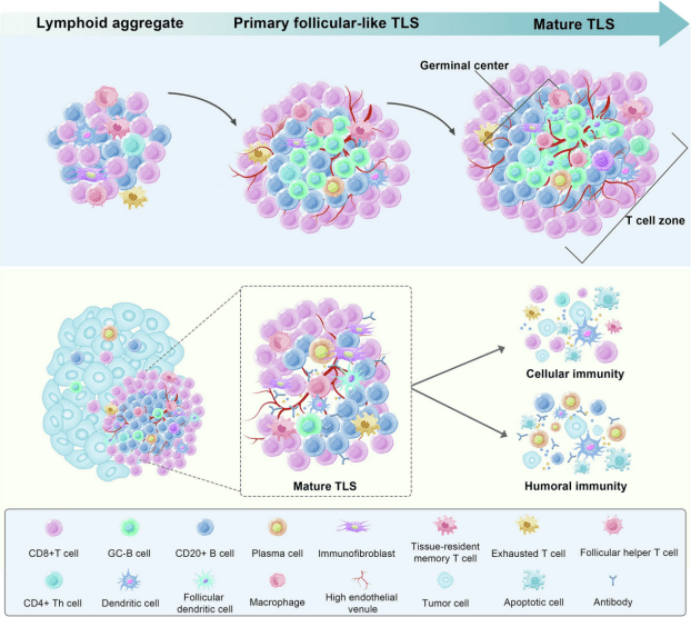
The development stage and structure of TLS.(PMID: 39198425)
Featured B Cell & Tertiary Lymphoid Structure Research Panels
—Comprehensive Antibody Panels for B Cell Activation, Germinal Center Responses, TLS Organization, and Antitumor Immunity
B cell immunity and tertiary lymphoid structures (TLS) are shaped by coordinated interactions among B cell activation and differentiation, Tfh–B cell crosstalk, germinal center formation, lymphoid chemokine signaling, stromal organization, and local immune effector responses. Integrated biomarker profiling enables researchers to characterize B cell states, TLS development and maturation, humoral immune responses, and their functional contribution to tumor immunity.
n B Cell Identity & Tissue Infiltration—Defining B Cell Lineage, Abundance, and Spatial Distribution
CD19 | CD20 | CD79A | PAX5 | CD45R/B220 |
n B Cell Activation, Survival & Differentiation—Decoding BCR Signaling and BAFF-Dependent Immune Regulation
BCR | CD40 | BAFF | BAFF-R | NF-κB | TACI | BCMA |
nTfh–B Cell Interaction & Follicular Signaling——Mapping the Cellular Communication Network That Supports Germinal Center Responses
CXCL13 | CXCR5 | PD-1 | ICOS | CD40 | CD40L |
n Germinal Center Formation & B Cell Maturation—Resolving B Cell Proliferation, Selection, Affinity Maturation, and Class Switching
BCL6 | AID/AICDA | CD10 | GL7 | Ki-67 |
n TLS Initiation & Lymphoid Organization—From Chronic Inflammation to Organized Ectopic Lymphoid Niches
LTβR | LTα | LTβ | CXCL13 | CCL19 | CCL21 |
n TLS Architecture & Maturation—From Lymphocyte Aggregates to Functional Germinal Center-Containing Structures
CD20 | CD21 | CD23 | BCL6 | CD4 | MECA-79 |
CD8 | Granzyme B | PD-1 | PD-L1 | FOXP3 | IgG/IgA | CD138 |
n TLS-Associated Antitumor Immunity—Connecting B Cell Organization with Local Cellular and Humoral Antitumor Response
Why Researchers Choose Our B Cell & Tertiary Lymphoid Structure Antibody Solutions
Validated B-Cell Targets. Integrated TLS Panels. Reliable Insights into Immune Organization and Function.
Our antibody portfolio supports comprehensive B-cell and TLS research workflows, enabling researchers to move from B-cell identification and activation to TLS formation, maturation, immune organization, and functional anti-tumor responses.
Research Challenge | Our Solution |
How can I identify and characterize B-cell populations? | CD19, CD20/MS4A1, CD79A, PAX5 and B220/CD45R marker antibodies for profiling B-cell identity, abundance, and tissue infiltration |
How can I analyze Tfh–B-cell interactions? | CXCR5, CXCL13, PD-1, ICOS and CD40L markers for investigating Tfh recruitment, cognate T-cell help, and B-cell–T-cell communication within TLS |
How can I determine TLS architecture and maturation? | CD20, CD21, CD23, BCL6, CD4 and PNAd/MECA-79 markers for evaluating B-cell follicles, follicular dendritic cell networks, T-cell zones, HEV formation, and mature TLS architecture |
How can I characterize TLS-associated anti-tumor immunity? | CD8, Granzyme B, PD-1, PD-L1 and FOXP3 markers for profiling cytotoxic activity, immune checkpoint signaling, regulatory T-cell populations, and local immune suppression |
How can I evaluate B-cell differentiation and humoral immunity? | IgG, IgA, together with B-cell and germinal-center markers, for studying antibody-producing responses, plasma-cell differentiation, and tissue-associated humoral immunity |
How can I investigate the relationship between TLS and therapeutic response? | Integrated B-cell, T-cell, germinal-center, chemokine, checkpoint, and effector-marker panels for evaluating TLS-associated immune activation and mechanisms underlying immunotherapy response |
How can I resolve the spatial organization of B cells and TLS? | Multiplex IF/IHC-compatible antibody solutions for simultaneous visualization of B-cell follicles, T-cell zones, germinal centers, HEVs, stromal compartments, and immune effector populations |
Key reference
1. Sawada J, Kikuchi Y, Duah M, Herrera JL, Kanamori F, Csomos K, Stansel T, Hiraoka N, Yoshida M, Walter J, Ware CF, Komatsu M. Simultaneous STING and lymphotoxin-β receptor activation induces B cell responses in tertiary lymphoid structures to potentiate antitumor immunity. Nat Immunol. 2025 Oct;26(10):1766-1780.
2. Fridman WH, Meylan M, Pupier G, Calvez A, Hernandez I, Sautès-Fridman C. Tertiary lymphoid structures and B cells: An intratumoral immunity cycle. Immunity. 2023 Oct 10;56(10):2254-2269.
3. Chen C, An M, Zheng H, Pang M, Li Y, Diao X, Luo Y, Lin Y, Liu D, Li W, Chen J, Liu Z, Chen Z, Hu A, Zhong W, Huang J, Lin T. B cells disrupt tertiary lymphoid structure formation and suppress anti-tumor immunity. Cancer Cell. 2026 Mar 9;44(3):551-566.e17.
4. Fridman WH, Meylan M, Petitprez F, Sun CM, Italiano A, Sautès-Fridman C. B cells and tertiary lymphoid structures as determinants of tumour immune contexture and clinical outcome. Nat Rev Clin Oncol. 2022 Jul;19(7):441-457.
5. Hu C, You W, Kong D, Huang Y, Lu J, Zhao M, Jin Y, Peng R, Hua D, Kuang DM, Chen Y. Tertiary Lymphoid Structure-Associated B Cells Enhance CXCL13+CD103+CD8+ Tissue-Resident Memory T-Cell Response to Programmed Cell Death Protein 1 Blockade in Cancer Immunotherapy. Gastroenterology. 2024 Jun;166(6):1069-1084.
6. Zhang Y, Xu M, Ren Y, Ba Y, Liu S, Zuo A, Xu H, Weng S, Han X, Liu Z. Tertiary lymphoid structural heterogeneity determines tumour immunity and prospects for clinical application. Mol Cancer. 2024 Apr 6;23(1):75.
7. Chen S, Wang Y, Chen J, Xie W, Chen J, Liao G, Ren X, Lei K, Zhang Y, Wang S, Yang Y, Kang Y, Chen Q, Wen Y, Lai J, Yang P, Shen S, Li S, Yiu-Nam Lau J, Yin C, Kuang M. PD-1 blockade unleashes local hepatitis B virus-related B cell response inhibiting hepatocellular carcinoma. Cancer Cell. 2026 Aug 10;44(8):1549-1567.e12.