
info@ucallmlabs.com
From Cortical Architecture to Neuronal Identity — Empowering Precision Neuroscience Research with Validated Layer-Specific Marker Antibodies
The cerebral cortex represents one of the most structurally and functionally complex regions of the mammalian brain, consisting of six anatomically and molecularly distinct neuronal layers (Layer I–VI). Each cortical layer contains specialized neuronal populations with unique developmental origins, transcriptional programs, projection patterns, and functional roles, forming the structural basis for sensory processing, cognition, learning, memory, and higher-order brain functions.
During corticogenesis, neural progenitor cells undergo precisely regulated processes of proliferation, migration, differentiation, and maturation, generating projection neurons and interneurons that establish layer-specific organization. Molecular determinants including RELN, CUX1, CUX2, RORB, SATB2, BCL11B (CTIP2), FEZF2, TBR1, and FOXP2 serve as critical markers for defining neuronal identity, developmental lineage, and cortical lamination.
Our Cortical Layers Marker Research Solutions provide highly validated antibodies targeting key layer-specific transcription factors, neuronal subtype markers, and functional proteins, enabling comprehensive analysis of:
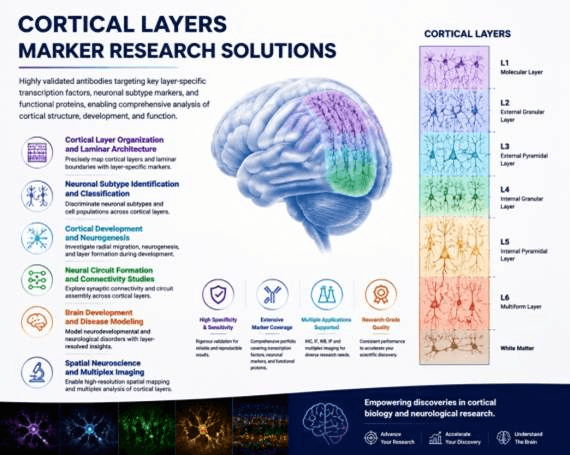
Cortical Layer Marker Antibody Portfolio
—Comprehensive Solutions for Cortical Lamination, Neuronal Identity, and Brain Development Research
Understanding cortical organization requires integrated evaluation of layer-specific transcription factors, neuronal subtype markers, interneuron populations, and developmental regulators.
Research Area | Representative Markers | Applications | Scientific Significance |
Layer I Molecular Identification | RELN | Identification of marginal zone neurons and Cajal–Retzius cells | Defines superficial cortical architecture and early cortical development |
Upper-Layer Neuron Characterization (Layer II–III) | CUX1, CUX2, SATB2, CALB1, POU3F2, VIP | Identification of superficial projection neurons and interneurons | Defines callosal projection neurons and upper-layer neuronal identity |
Layer IV Sensory Cortex Characterization | RORB, NECAB1, GAD2, LAMP5, RYR3 | Analysis of granular layer neurons and interneuron populations | Characterizes sensory processing-related cortical circuits |
Deep-Layer Projection Neuron Identification (Layer V) | BCL11B/CTIP2, FEZF2, TLE4, PCP4, CNTN6 | Identification of corticofugal projection neurons | Defines long-range cortical output neurons |
Layer VI Corticothalamic Neuron Characterization | TBR1, FOXP2, CTGF | Identification of corticothalamic projection neurons | Reveals deep cortical developmental programs |
Interneuron Subtype Profiling | PVALB, SST, VIP, GAD2, LAMP5 | Classification of inhibitory neuronal populations | Enables analysis of cortical inhibitory circuitry |
Neuronal Development & Differentiation | TBR1, FEZF2, CUX1, CUX2, SATB2 | Cortical neurogenesis and neuronal fate studies | Defines temporal progression of cortical neuron generation |
Key Cortical Layer Biomarkers
——Molecular Functions, Research Applications, and Scientific Value
Marker | Biological Function | Research Application | Scientific Relevance |
RELN | Extracellular matrix protein regulating neuronal migration and cortical positioning | Identification of Layer I Cajal–Retzius cells | Essential regulator of cortical layering and neuronal migration |
CUX1/CUX2 | Homeobox transcription factors controlling upper-layer neuron development | Layer II–IV neuronal identification | Classical markers of superficial cortical neurons |
SATB2 | Nuclear transcription factor regulating callosal projection neuron identity | Upper-layer projection neuron characterization | Defines corticocortical neuronal populations |
RORB | Nuclear receptor transcription factor enriched in Layer IV neurons | Sensory cortex layer identification | Marker of granular layer organization |
BCL11B (CTIP2) | Transcription factor controlling corticospinal neuron development | Deep Layer V neuron profiling | Identifies corticofugal projection neurons |
FEZF2 | Zinc finger transcription factor regulating corticospinal neuron fate | Projection neuron characterization | Critical regulator of deep-layer neuronal identity |
TBR1 | T-box transcription factor controlling corticothalamic neuron development | Layer VI neuron identification | Defines early-born deep cortical neurons |
FOXP2 | Transcription factor associated with corticothalamic neurons | Deep-layer neuronal profiling | Marker of specialized Layer VI neuronal populations |
FOXP2 | Transcription factor associated with corticothalamic neurons | Deep-layer neuronal profiling | Marker of specialized Layer VI neuronal populations |
PVALB | Calcium-binding protein expressed in fast-spiking interneurons | Interneuron subtype analysis | Defines major inhibitory neuronal populations |
SST | Somatostatin neuropeptide expressed in inhibitory interneurons | Cortical interneuron characterization | Identifies SST-positive inhibitory circuits |
VIP | Vasoactive intestinal peptide expressed in interneurons | Interneuron subtype profiling | Defines regulatory inhibitory networks |
GAD2 | Enzyme responsible for GABA synthesis | Identification of GABAergic neurons | Marker of inhibitory neuronal populations |
CALB1 | Calcium-binding protein expressed in specific neuronal populations | Neuronal subtype characterization | Supports cortical neuronal diversity analysis |
PCP4 | Calcium-associated neuronal regulatory protein | Layer V neuronal profiling | Associated with cortical projection neurons |
Featured Cortical Layer Research Panels
Comprehensive Marker Panels for Laminar Organization and Neuronal Identity Profiling
Cortical Layer Mapping Panel—Defining Six-Layer Cortical Architecture
Key Markers
RELN | CUX1/CUX2 | RORB | FEZF2 | BCL11B/CTIP2 |
Projection Neuron Identity Panel—Characterizing Cortical Output Neuronal Populations
Key Markers
SATB2 | CUX1 | CUX2 | FEZF2 | TLE4 | TBR1 | CTIP2 |
Cortical Interneuron Profiling Panel—Decoding Inhibitory Circuit Organization
Key Markers
PVALB | SST | VIP | GAD2 | LAMP5 |
Cortical Development Panel—Investigating Neuronal Fate Specification and Migration
Key Markers
TBR1 | FEZF2 | BCL11B | SATB2 | CUX1 | RELN |
Cortical Layer Research
——From Molecular Identification to Spatial Neuroscience Discovery
We provide comprehensive research solutions for dissecting cortical organization through precise molecular and spatial characterization of neuronal populations. Validated cortical layer markers enable researchers to define layer-specific architecture, identify projection neuron and interneuron subtypes, and investigate developmental lineage, neuronal migration, and circuit connectivity. Integrated multiplex immunofluorescence and spatial profiling approaches further reveal cellular diversity and functional organization within complex cortical networks. These advanced tools support neuroscience research focused on brain development, neural circuitry, neurodevelopmental disorders, and mechanisms underlying cortical dysfunction.
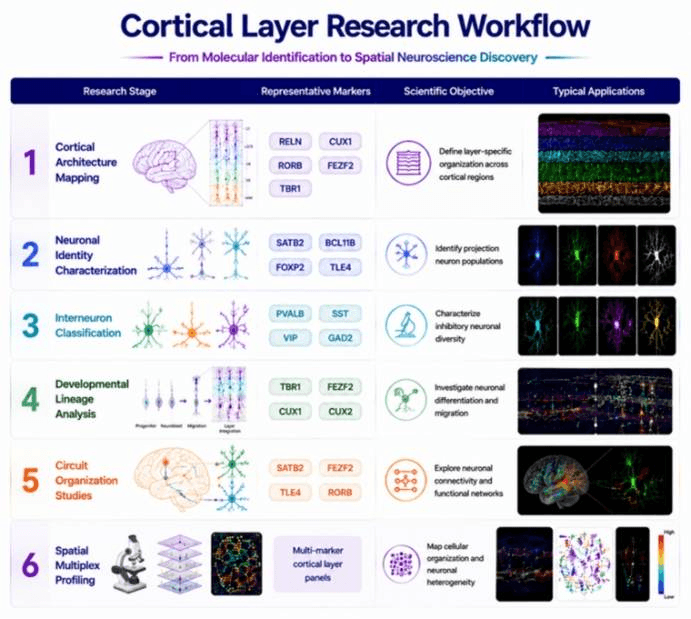
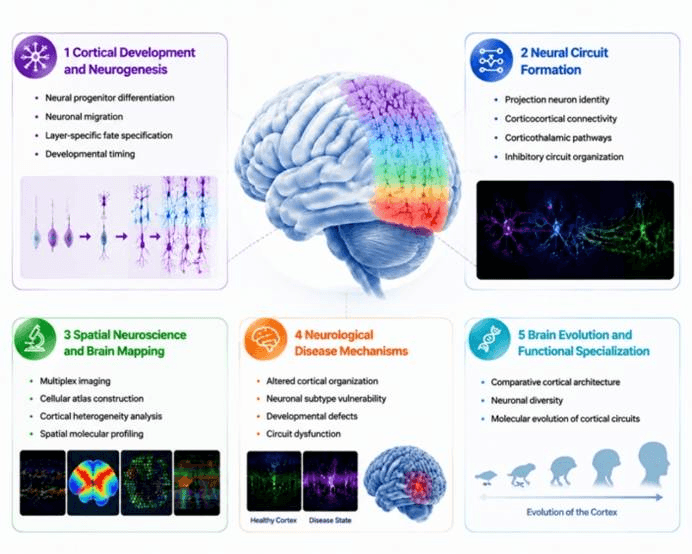
Research Frontiers Driving Cortical Layer Discovery
We support advanced cortical neuroscience research by enabling precise investigation of cortical development, neuronal diversity, and functional circuit organization. Validated molecular markers facilitate the study of neural progenitor differentiation, layer-specific neuronal fate determination, projection neuron identity, and inhibitory circuit complexity. Integrated spatial profiling and multiplex imaging approaches provide powerful tools for mapping cortical architecture, cellular heterogeneity, and molecular organization. These technologies accelerate understanding of cortical evolution, brain specialization, and disease-associated alterations, including neurodevelopmental disorders and circuit dysfunction, driving new insights into the molecular mechanisms underlying complex brain function.
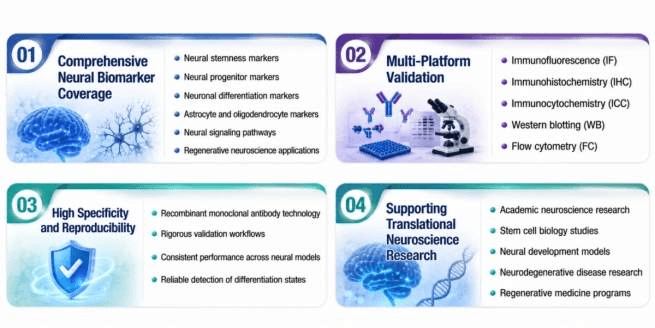
Why Researchers Choose Our Cortical Layer Marker Solutions?
Validated Targets. Comprehensive Panels. Reliable Neuroscience Research.
Our antibody portfolio supports comprehensive cortical research workflows, from layer identification and neuronal classification to developmental studies and spatial neuroscience applications.
Research Challenge | Our Solution |
How can I identify cortical layers? | Layer-specific markers including RELN, CUX1/CUX2, RORB, FEZF2, BCL11B, and TBR1 |
How can I distinguish neuronal subtypes? | Projection neuron and interneuron panels covering SATB2, FOXP2, PVALB, SST, VIP, and GAD2 |
How can I study cortical development? | Developmental transcription factor markers including TBR1, FEZF2, CUX1, and BCL11B |
How can I analyze cortical organization in disease models? | Multiparametric marker combinations for neuronal identity and structural remodeling |
How can I perform spatial neuroscience studies? | Multiplex-compatible antibodies optimized for high-resolution tissue imaging |
How can I improve reproducibility? | Validated antibodies optimized for IHC, IF, WB, and multiplex applications |
Key References
Qian X., et al. (2025).Spatial Transcriptomics Reveals Human Cortical Layer and Area Specification.Nature. 644:153–163.
Bhaduri A., et al. (2021).An Atlas of Cortical Arealization Identifies Dynamic Molecular Signatures.Nature. 598:200–204.
Tasic B., et al. (2018).Shared and Distinct Transcriptomic Cell Types Across Neocortical Areas. Nature . 563: 72–78.