
info@mail.ucallm.com
From Danger Sensing to Inflammatory Cell Death — Empowering Integrated Innate Immune and Inflammasome Profiling with Validated Antibody Solutions
Innate immunity provides the first line of cellular defense against pathogens, tissue injury, metabolic stress, and endogenous danger signals. A diverse network of pattern-recognition receptors (PRRs) detects pathogen-associated molecular patterns (PAMPs) and damage-associated molecular patterns (DAMPs), initiating coordinated signaling programs that regulate type I interferon responses, inflammatory gene expression, inflammasome assembly, cytokine maturation, and inflammatory cell death.
Innate immune activation is organized through interconnected sensing and signaling pathways, including:
Toll-like receptor (TLR) signaling
RIG-I-like receptor (RLR)–MAVS antiviral sensing
cGAS–STING cytosolic DNA sensing
NF-κB and IRF3 transcriptional signaling
NLRP and AIM2 inflammasome activation
Canonical and non-canonical inflammatory caspase pathways
Gasdermin-mediated pyroptosis
PANoptosis and integrated inflammatory cell-death programs
Our validated antibody solutions enable researchers to investigate innate immune activation from initial danger recognition through downstream inflammatory signaling and functional cell-death outcomes, supporting mechanistic studies across infection, cancer, autoimmunity, metabolic disease, neuroinflammation, tissue injury, and inflammatory disorders.
Validated antibodies support analysis of:
PAMP/DAMP recognition and innate immune sensing
TLR, RLR, and cGAS–STING signaling
NF-κB and type I interferon responses
Inflammasome assembly and activation
Inflammatory caspase activation
IL-1β and IL-18 maturation
Gasdermin D cleavage and pyroptosis
PANoptosis and inflammatory cell death
Innate immune remodeling and disease-associated inflammation
Inflammasome Biomarker Antibody Portfolio
—Comprehensive Solutions for Innate Sensing, Signal Transduction, Inflammasome Activation, Cytokine Maturation, and Inflammatory Cell Death
Our antibody portfolio covers key biomarkers spanning pattern recognition, adaptor-mediated signaling, inflammatory transcription, inflammasome assembly, inflammatory caspase activation, cytokine maturation, pyroptosis, and integrated inflammatory cell death.
Research Focus | Representative Biomarkers | Research Applications |
TLR-Mediated Innate Immune Recognition | TLR2, TLR3, TLR4, TLR7, TLR8, TLR9, MyD88, TRIF, IRAK4, TRAF6 | Profiling PAMP/DAMP recognition and TLR-dependent inflammatory and antiviral signaling |
NF-κB Inflammatory Signaling | TAK1, IKKα/β, IκBα, p-IκBα, NF-κB p65/RELA, p-p65 | Monitoring inflammatory signal transduction and inflammasome priming |
RIG-I–MAVS Antiviral Sensing | RIG-I/DDX58, MDA5/IFIH1, MAVS, TBK1, p-TBK1, IRF3, p-IRF3 | Characterizing cytosolic RNA sensing and type I interferon signaling |
cGAS–STING DNA Sensing | cGAS/MB21D1, STING/TMEM173, p-STING, TBK1, p-TBK1, IRF3, p-IRF3 | Investigating cytosolic DNA sensing, innate immune activation, and interferon responses |
Inflammasome Sensors | NLRP3, NLRP1, NLRC4, AIM2 | Defining sensor-specific inflammasome activation mechanisms |
Inflammasome Assembly & Regulation | ASC/PYCARD, ASC speck, NEK7 | Characterizing inflammasome assembly, ASC oligomerization, and NLRP3 activation |
Inflammatory Caspase Activation | Caspase-1, Cleaved Caspase-1, Caspase-4, Caspase-5, Caspase-11* | Investigating canonical and non-canonical inflammasome signaling |
Inflammatory Cytokine Maturation | pro-IL-1β, IL-1β, IL-18 | Assessing inflammasome-dependent cytokine processing and inflammatory output |
Pyroptosis Execution | GSDMD, Cleaved GSDMD | Defining gasdermin-mediated pore formation and pyroptotic cell death |
PANoptosis & Cell-Death Crosstalk | ZBP1, RIPK1, RIPK3, p-MLKL, MLKL, Caspase-8, Cleaved Caspase-8, Caspase-3, Cleaved Caspase-3, GSDMD | Dissecting crosstalk among pyroptosis, apoptosis, and necroptosis |
Innate Immune Recognition Molecular Network & Inflammasome Regulatory Network
—From PAMP/DAMP Sensing to Inflammasome Activation and Inflammatory Cell Death
Innate immune recognition is coordinated through multiple interconnected sensing systems. Extracellular and endosomal receptors detect microbial and danger-associated signals, while cytosolic sensors recognize viral RNA, cytosolic DNA, bacterial components, and intracellular stress signals.
These pathways converge on transcriptional and inflammasome signaling networks that determine the magnitude and functional outcome of inflammation.
Core Innate Immune Signaling Architecture
This network provides a conceptual framework for integrating innate immune sensing, inflammatory signaling, inflammasome activation, cytokine maturation, and pyroptotic cell death within a unified experimental strategy.
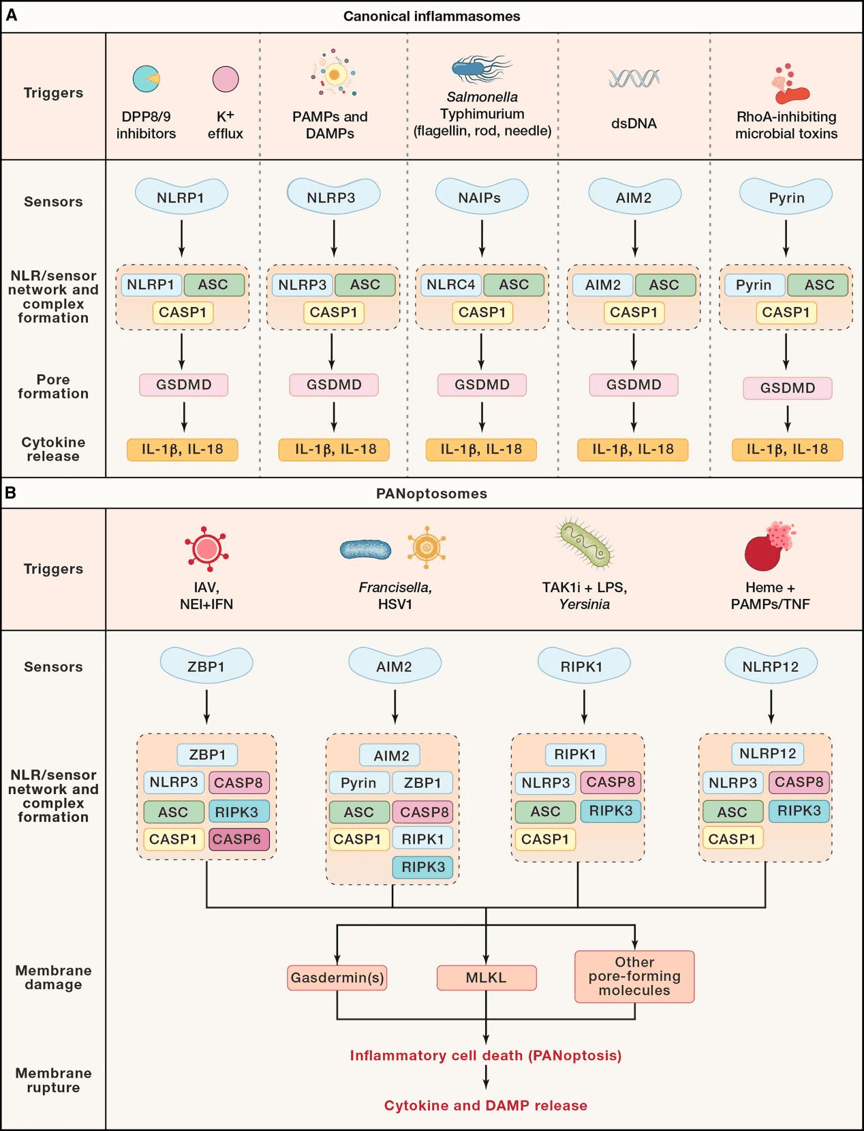
NLRs in inflammasomes and PANoptosomes(PMID: 38599165)
Featured Innate Immunity & Inflammasome Research Panels
—Integrated Antibody Solutions for Innate Sensing, Inflammatory Signaling, Inflammasome Activation, and Cell-Death Mechanism Discovery
Innate immune responses are orchestrated through interconnected molecular networks that translate pathogen- and damage-associated signals into inflammatory signaling, inflammasome activation, cytokine maturation, and inflammatory cell death.
Our validated antibody panels enable researchers to profile these processes from upstream recognition to downstream functional outcomes.
n TLR & Innate Immune Recognition Panel—Profiling pathogen-associated and danger-associated molecular recognition
TLR2 | TLR3 | TLR4 | TLR7 | IRAK4 | TRAF6 | TAK1 |
TLR8 | TLR9 | MyD88 | TRIF | IKKα/IKKβ | IκBα / p-IκBα | NF-κB p65/p-p65 |
n Cytosolic RNA & DNA Sensing Panel—Mapping antiviral and nucleic-acid-triggered innate immune signaling
RIG-I/DDX58 | MDA5/IFIH1 | MAVS | cGAS |
STING | TBK1 | IRF3 | p-IRF3 |
n Inflammasome Activation Panel—Characterizing inflammasome assembly and inflammatory caspase activation
NLRP3 | NLRP1 | NLRC4 | AIM2 | ASC Speck |
ASC | NEK7 | Cleaved Caspase-1 | Caspase-1 |
|
n Pyroptosis & Inflammatory Cell Death Panel—Defining functional execution of inflammasome-associated cell death
GSDMD | Cleaved GSDMD | Caspase-1 | Caspase-4 | Caspase-5 |
Caspase-11 | IL-1β | pro-IL-1β | IL-18 |
|
n Inflammasome Regulation & PANoptosis Panel—Investigating integrated inflammatory cell-death programs and immune homeostasis
NLRP3 | ASC | Caspase-1 | Caspase-8 | GSDMD |
RIPK1 | RIPK3 | MLKL | Cleaved Caspase-3 | ZBP1 |
Why Researchers Choose Our Innate Immunity & Inflammasome Antibody Solutions
Validated Innate Immune Targets. Integrated Pathway Coverage. Mechanism-Driven Inflammation Research.
Our antibody portfolio supports researchers in tracing innate immune responses from initial danger sensing through signal transduction, inflammasome activation, cytokine maturation, and inflammatory cell-death execution.
Research Challenge | Our Solution |
How can I detect innate immune activation? | TLR2/3/4/7/8/9, MyD88, TRIF, NF-κB pathway antibodies |
How can I study antiviral innate immunity? | RIG-I, MDA5, MAVS, TBK1, IRF3 and phospho-signaling markers |
How can I investigate cytosolic DNA sensing? | cGAS, STING, TBK1, IRF3 pathway solutions |
How can I determine whether the inflammasome is activated? | NLRP3, ASC, ASC speck, cleaved caspase-1 and NEK7 markers |
How can I distinguish inflammasome priming from activation? | NLRP3/pro-IL-1β profiling combined with cleaved caspase-1 and GSDMD readouts |
How can I confirm pyroptosis? | GSDMD, cleaved GSDMD, caspase-1 and inflammatory cytokine markers |
How can I investigate non-canonical inflammasomes? | Caspase-4/5 and murine caspase-11 pathway antibodies |
How can I study inflammatory cell-death crosstalk? | GSDMD, caspase-1/8, RIPK1, RIPK3, MLKL and cleaved caspase-3 panels |
How can I perform spatial analysis of inflammation? | Validated IHC/ICC/IF and multiplex-compatible innate immune marker solutions |
Key reference
1. Zou C, Ma T, Li J, Zhou X. Innate immunity: current understandings and future perspectives. Signal Transduct Target Ther. 2026 Aug 12;11(1):321.
2. Cao LL, Kagan JC. Targeting innate immune pathways for cancer immunotherapy. Immunity. 2023 Oct 10;56(10):2206-2217.
3. Sundaram B, Tweedell RE, Prasanth Kumar S, Kanneganti TD. The NLR family of innate immune and cell death sensors. Immunity. 2024 Apr 9;57(4):674-699.
4. Xu Z, Kombe Kombe AJ, Deng S, Zhang H, Wu S, Ruan J, Zhou Y, Jin T. NLRP inflammasomes in health and disease. Mol Biomed. 2024 Apr 22;5(1):14.
5. Barnett KC, Li S, Liang K, Ting JP. A 360° view of the inflammasome: Mechanisms of activation, cell death, and diseases. Cell. 2023 May 25;186(11):2288-2312.
6. Sundaram B, Pandian N, Kim HJ, Abdelaal HM, Mall R, Indari O, Sarkar R, Tweedell RE, Alonzo EQ, Klein J, Pruett-Miller SM, Vogel P, Kanneganti TD. NLRC5 senses NAD+ depletion, forming a PANoptosome and driving PANoptosis and inflammation. Cell. 2024 Jul 25;187(15):4061-4077.e17.
7. Fernández-Duran I, Quintanilla A, Tarrats N, Birch J, Hari P, Millar FR, Lagnado AB, Smer-Barreto V, Muir M, Brunton VG, Passos JF, Acosta JC. Cytoplasmic innate immune sensing by the caspase-4 non-canonical inflammasome promotes cellular senescence. Cell Death Differ. 2022 Jun;29(6):1267-1282.
8. Devant P, Dong Y, Mintseris J, Ma W, Gygi SP, Wu H, Kagan JC. Structural insights into cytokine cleavage by inflammatory caspase-4. Nature. 2023 Dec;624(7991):451-459.