
info@ucallmlabs.com
From Molecular Pathology to Neural Circuit Dysfunction — Empowering Comprehensive Neurodegeneration Profiling with Validated Antibody Solutions
Neurodegenerative diseases represent a complex spectrum of progressive neurological disorders driven by the convergence of protein misfolding, neuronal vulnerability, synaptic failure, neuroimmune dysregulation, mitochondrial dysfunction, and impaired cellular homeostasis.
Although distinct diseases exhibit unique pathological signatures, shared molecular mechanisms—including abnormal protein aggregation, defective clearance pathways, chronic neuroinflammation, disrupted neuronal communication, and altered transcriptional regulation—collectively contribute to neuronal loss and functional decline.
Comprehensive understanding of neurodegeneration requires integrated characterization of multiple biological processes:
Proteinopathy and aggregation mechanisms
Neuroimmune remodeling pathways
Synaptic integrity and neuronal communication networks
Mitochondrial quality control and proteostasis pathways
Genetic susceptibility pathway
Epigenetic and transcriptional regulation
Our comprehensive antibody portfolio enables researchers to investigate neurodegenerative mechanisms across disease models—from early molecular alterations to advanced pathological remodeling—supporting studies in Alzheimer’s disease, Parkinson’s disease, amyotrophic lateral sclerosis, frontotemporal dementia, Huntington’s disease, and related neurological disorders.
Validated antibody solutions support analysis of:
Amyloid, tau, and pathological protein aggregation
Microglial activation and neuroinflammatory states
Complement-driven synaptic remodeling
Neuronal survival and degeneration pathways
Synaptic dysfunction and circuit disruption
Mitochondrial stress and impaired proteostasis
Disease-associated molecular signatures for translational neuroscience
Neurodegenerative Disease Biomarker Antibody Portfolio
—Comprehensive Antibody Solutions for Proteinopathy, Neuroinflammation, Synaptic Dysfunction, and Neural Homeostasis Research
Neurodegeneration arises from interconnected molecular networks involving pathological protein accumulation, immune regulation, intracellular signaling, and neuronal maintenance pathways.
Our validated antibody portfolio provides integrated solutions for profiling key mechanisms driving neurological disease progression.
Research Area | Representative Targets | Research Applications |
Amyloid Processing & Alzheimer’s Disease Pathology | APP, Aβ, Aβ42, BACE1, PSEN1, PSEN2 | Characterization of amyloid precursor processing, plaque-associated pathology, and AD disease models |
Tau Phosphorylation & Neurofibrillary Degeneration | Tau, p-Tau181, p-Tau217, p-Tau (Ser202/Thr205), MAPT | Investigation of tau modification, aggregation, spreading, and neuronal toxicity |
Microglial Activation & Disease-Associated Microglia (DAM) | TREM2, IBA1, TMEM119, P2RY12, CD68, CSF1R | Profiling microglial states, immune remodeling, and neurodegenerative inflammation |
Complement-Mediated Synaptic Remodeling | C1q, C3, C5a, C5aR1 | Analysis of complement activation, aberrant synaptic pruning, and immune-mediated neuronal dysfunction |
Inflammasome & Cytokine Signaling | NLRP3, ASC, Cleaved Caspase-1, IL-1β, IL-18, TNFα | Investigation of inflammatory cascades contributing to neuronal injury |
Parkinson’s Disease & Synucleinopathy | α-Synuclein, p-α-Synuclein, LRRK2, PINK1, Parkin, GBA1 | Characterization of Lewy body pathology, mitochondrial dysfunction, and lysosomal regulation |
ALS/FTD Proteinopathy | TDP-43, p-TDP-43, C9orf72, SOD1, STMN2, UNC13A | Analysis of RNA metabolism defects, protein aggregation, and motor neuron degeneration |
Synaptic Function & Neural Circuit Integrity | NeuN, MAP2, PSD95, Synaptophysin, Synapsin I | Evaluation of neuronal survival, synaptic loss, and circuit remodeling |
Epigenetic Regulation & Neuronal Adaptation | HDAC1, HDAC2, SIRT1、SIRT2, p300, CBP, EZH2、KDM6B , HMTs, KDM6B | Investigation of chromatin regulation, neuronal aging, and transcriptional reprogramming |
Neurodegeneration Molecular Network
—Integrated Antibody Solutions for Decoding Proteinopathy, Neuroimmune Crosstalk, Synaptic Dysfunction, and Neuronal Resilience
Neurodegenerative diseases are driven by complex and interconnected molecular alterations involving pathological protein accumulation, impaired proteostasis, chronic neuroinflammation, synaptic deterioration, mitochondrial dysfunction, and disrupted neuronal homeostasis. Understanding these dynamic networks requires comprehensive profiling of disease-associated pathways across multiple cellular compartments and biological processes.
Our validated antibody solutions provide integrated research platforms for investigating the molecular mechanisms underlying major neurodegenerative disorders, including Alzheimer’s disease (AD), Parkinson’s disease (PD), amyotrophic lateral sclerosis (ALS), frontotemporal dementia (FTD), and Huntington’s disease (HD).
Supported by high-quality antibodies validated for WB, IHC, ICC/IF, multiplex fluorescence imaging, and spatial biology applications, our neurodegeneration panels enable researchers to systematically analyze:
· Protein Misfolding & Aggregation Pathways
· Neuroimmune Activation & Inflammatory Remodeling
· Synaptic Integrity & Neural Circuit Dysfunction
· Mitochondrial Dysfunction & Cellular Stress Responses
· Autophagy–Lysosomal Homeostasis & Protein Clearance
· Epigenetic Remodeling & Disease-Associated Gene Regulation
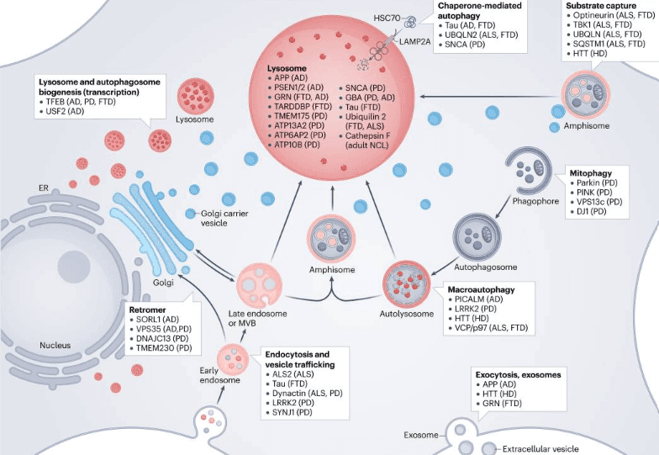
Causal genes for adult-onset neurodegenerative disease commonly disrupt autophagic–lysosomal function ( PMID: 39107446)
Featured Neurodegeneration Research Panels
—Integrated Antibody Solutions for Mapping Neurodegenerative Pathways, Neuroimmune Regulation, and Disease Mechanism Discovery
Neurodegenerative disorders arise from complex interactions between protein misfolding, neuronal dysfunction, synaptic degeneration, mitochondrial impairment, neuroinflammation, and epigenetic dysregulation.
Comprehensive molecular profiling across these interconnected pathways is essential for understanding disease initiation, progression, and therapeutic response.
n Alzheimer’s Disease Molecular Pathology Panel—Profiling Amyloid Deposition, Tau Dysfunction, and Neuroimmune Activation
Key Markers
APP | Aβ40 | Aβ42 | BACE1 | PSEN1/2 |
Total Tau | p-Tau181 | p-Tau217 | p-Tau (Ser202/Thr205) | p-Tau (Thr231) |
TREM2 | IBA1 | GFAP | CD68 | NLRP3 |
n Parkinson’s Disease & Synucleinopathy Panel—Decoding Dopaminergic Degeneration, Protein Aggregation, and Mitochondrial Dysfunction
Key Markers
TH | DAT/SLC6A3 | VMAT2 | NeuN | α-Synuclein | p-α-Synuclein |
LRRK2 | PINK1 | Parkin | GBA1 | Rab8 | Rab10 |
n ALS & Frontotemporal Dementia Panel—Investigating RNA Dysfunction, Protein Aggregation, and Motor Neuron Degeneration
Key Markers
TDP-43 | p-TDP-43 | STMN2 | UNC13A | C9orf72 |
SOD1 | NeuN | MAP2 | Synaptophysin |
|
n Neuroimmune Remodeling Panel—Mapping Microglial Activation and Inflammation-Driven Neurodegeneration
Key Markers
IBA1 | TMEM119 | P2RY12 | TREM2 | CSF1R | CD33 |
NLRP3 | ASC | Caspase-1 | IL-1β | PLCG2 |
|
Why Researchers Choose Our Neurodegenerative Disease Antibody Solutions
Validated Disease Targets. Comprehensive Pathway Coverage. Reliable Neuroscience Insights.
Our antibody portfolio supports integrated neurodegeneration research workflows:
Research Challenge | Our Solution |
How can I analyze Alzheimer’s disease pathology? | APP, Aβ, Tau, p-Tau, PSEN pathway antibody solutions |
How can I characterize neuroimmune activation? | TREM2, IBA1, CD68, NLRP3, complement pathway panels |
How can I study Parkinson’s disease mechanisms? | α-Synuclein, LRRK2, PINK1/Parkin, dopamine pathway antibodies |
How can I investigate neuronal loss and synaptic dysfunction? | NeuN, MAP2, PSD95, Synaptophysin-based neuronal profiling |
How can I study disease-associated signaling pathways? | Validated antibodies for WB, IHC, IF, and multiplex imaging |
How can I perform spatial analysis of brain pathology? | IF/IHC-compatible neurodegeneration marker panels |
Key reference
1. Yi Jin, Qiaofei Du (2024). Amyloid-β-targeting immunotherapies for Alzheimer's disease. J Control Release. 2024 Nov:375:346-365.
2. Céline Bellenguez, Fahri Küçükali (2022). New insights into the genetic etiology of Alzheimer's disease and related dementias. Nat Genet. 2022 Apr;54(4):412-436.
3. Kathryn M Monroe, Soyon Hong (2026). Therapeutic targeting of neuroimmune mechanisms in neurodegeneration. Nat Rev Drug Discov. 2026 May;25(5):390-405.
4. Yulan Xiong, Jianzhong Yu (2024). LRRK2 in Parkinson's disease: upstream regulation and therapeutic targeting. Trends Mol Med. 2024 Oct;30(10):982-996.
5. Yan-Zhe Liao, Jing Ma (2022). The Role of TDP-43 in Neurodegenerative Disease. Mol Neurobiol. 2022 Jul;59(7):4223-4241.
6. Anqi Zhao, Wenhong Xu (2024). Role of histone modifications in neurogenesis and neurodegenerative disease development. Ageing Res Rev. 2024 Jul:98:102324.