
info@mail.ucallm.com
From Model Establishment to Functional Assessment and Molecular Mechanism
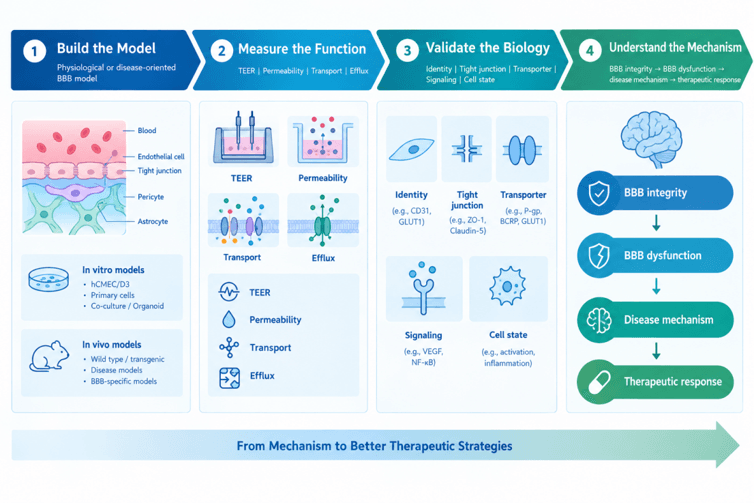
An integrated research solution designed to support comprehensive blood–brain barrier (BBB) investigation—from establishing physiologically relevant BBB models and assessing barrier function to characterizing molecular changes, neurovascular interactions, and disease-associated mechanisms.
Build the Barrier → Measure Function → Validate Molecular Features → Characterize the NVU → Decode BBB Dysfunction
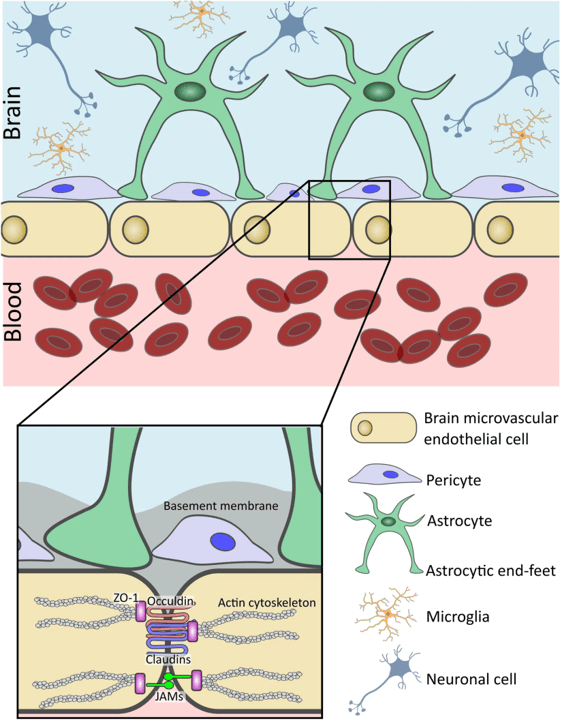
Structure and cellular components of the human blood-brain barrier (BBB)
(PMID: 41126959)
Integrated blood–brain barrier research solution
One Integrated Workflow for Comprehensive BBB Research
The BBB is a dynamic neurovascular interface that selectively regulates molecular transport between the circulation and the central nervous system.
Our integrated solution connects BBB model systems, functional assays, antibody-based molecular validation, neurovascular unit characterization, and disease-mechanism profiling to support research from basic barrier biology to therapeutic evaluation.
n BBB physiology
Characterize endothelial identity, tight junction organization and barrier integrity.
n Neuroinflammation
Investigate inflammatory signaling and inflammation-associated barrier disruption.
n Neurodegeneration
Study Aβ/Tau-associated vascular dysfunction and neurovascular alterations.
n Stroke and ischemia
Evaluate ischemia-associated endothelial injury and BBB breakdown.
n Brain tumor
Characterize tumor-associated vascular remodeling and BBB dysfunction.
n Drug delivery
Investigate BBB permeability, transporter expression and efflux mechanisms.
n Therapeutic evaluation
Monitor molecular and functional recovery following therapeutic intervention.
01 | BBB Model
Establish a relevant and reproducible BBB research model
Select the appropriate BBB model to address specific biological questions, from endothelial barrier biology to neurovascular unit function and disease-associated BBB dysfunction.
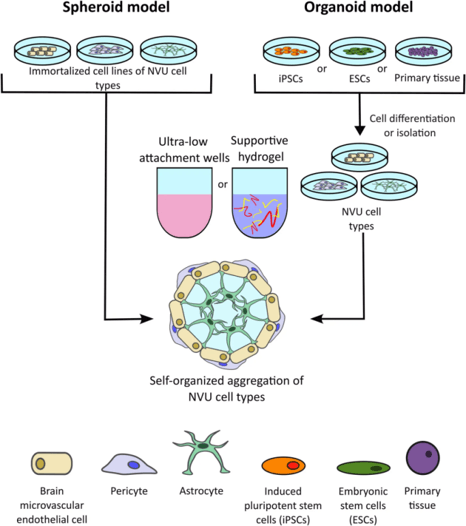
Representation of spheroid and organoid three-dimensional (3D) in vitro models of the blood-brain barrier (BBB) (PMID: 41126959).
Model systems
Endothelial models
Brain microvascular endothelial cells | Primary brain endothelial cells
Co-culture models
Endothelial–pericyte | Endothelial–astrocyte | Multicellular neurovascular unit
Advanced models
Transwell BBB | BBB-on-a-chip | Microfluidic BBB
Disease models
Neuroinflammation | Neurodegeneration | Ischemia | Brain tumor | Other BBB dysfunction models
Representative Ready-to-Use BBB Model Platform
PharmaCo-Cell BBB Kit™
Multicellular BBB models designed for barrier function, permeability, drug transport, and disease-modeling research.
Model | Cellular composition | Primary research application |
MBT-24 | Monkey brain endothelial cells + rat pericytes + rat astrocytes | BBB permeability · Drug transport |
RBT-24 | Rat brain endothelial cells + rat pericytes + rat astrocytes | BBB permeability · Large-molecule / cell transport |
RBE-12 | Rat brain endothelial cells + rat pericytes + rat astrocytes | BBB physiology · Disease modeling · Permeability |
https://www.pharmacocell.co.jp/en/
Research focus
BBB development | Barrier integrity | Neurovascular unit | Disease modeling | Therapeutic evaluation
02 | Molecular Validation
Validate BBB Identity, Integrity and Function
A focused antibody portfolio for molecular characterization of the blood–brain barrier (BBB)—from endothelial identity and junctional organization to transporter expression and barrier function.
n Endothelial Identity
Define BBB endothelial cell identity and characterize the vascular phenotype of in vitro and in vivo BBB models.
Marker | Research application |
CD31 | Endothelial identification |
VWF | Endothelial characterization |
VE-cadherin | Endothelial junction integrity |
EMCN | Microvascular endothelial characterization |
n Junctional Integrity
Assess tight-junction organization, continuity and localization—key molecular features underlying BBB paracellular barrier function.
Marker | Research application |
Claudin-5 | BBB tight junction integrity |
Occludin | Tight junction organization |
ZO-1 | Junctional structure and localization |
JAM-A | Endothelial junction regulation |
n Transporter & Efflux
Characterize the selective transport and drug-efflux properties that distinguish the BBB from peripheral vascular barriers.
Marker | Research application |
P-gp / ABCB1 | ATP-dependent drug efflux |
BCRP / ABCG2 | Drug and xenobiotic efflux |
MRP1 / ABCC1 | Multidrug efflux and barrier protection |
GLUT1 / SLC2A1 | Glucose transport |
LAT1 / SLC7A5 | Large neutral amino acid transport |
MCT1 / SLC16A1 | Monocarboxylate transport |
03 | Neurovascular Unit Characterization
Define the cellular architecture and microenvironment of the BBB
BBB function is governed not only by brain endothelial cells, but by coordinated interactions within the neurovascular unit (NVU).
A comprehensive marker panel enables characterization of pericytes, astrocytes, microglia, neurons and vascular basement membrane, providing a multidimensional view of BBB structure, cellular crosstalk and pathological remodeling.
Multicellular BBB models provide a functional context for studying endothelial–pericyte–astrocyte interactions within the neurovascular unit. (https://www.pharmacocell.co.jp/en/)
Key NVU Components
NVU Component | Core Markers | Research Focus |
Endothelial Cells | CD31 · VWF · CLDN5 | Barrier formation · Vascular identity |
Pericytes | PDGFRβ · NG2/CSPG4 · Desmin | Perivascular coverage · vascular stabilization · BBB integrity |
Astrocytes | GFAP · AQP4 · S100B | Astrocyte endfeet · water homeostasis · BBB support |
Microglia | Iba1 · TMEM119 · CD68 | Microglial identity · activation · neuroinflammation |
Neurons | NeuN · MAP2 · βIII-Tubulin | Neuronal identity · neuronal integrity · neurovascular signaling |
Basement Membrane | Laminin · Collagen IV · Fibronectin | ECM organization · vascular integrity · barrier remodeling |
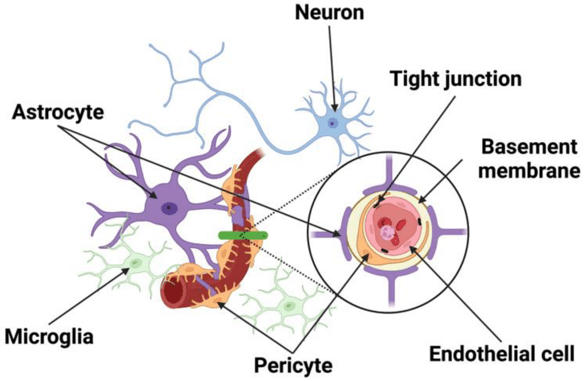
Schematic of the NVU. (PMID: 36139398)
From Cellular Architecture to BBB Pathology
From cellular identity and neurovascular unit (NVU) organization to cell–cell/ECM interactions, BBB structural integrity, neurovascular function, and disease-associated remodeling, a multidimensional approach enables comprehensive characterization of BBB architecture, function, and pathological changes. We provide validated antibodies and integrated research solutions covering BBB cell identity, NVU organization, junctional integrity, cellular interactions, transport function, and disease-associated remodeling—supporting BBB research from cellular architecture and molecular mechanisms to functional validation.
Research Applications
· BBB integrity & vascular remodeling
· Pericyte loss and vascular instability
· Astrocyte–endothelial interaction
· Microglia-mediated neuroinflammation
· Neurovascular coupling & neuronal–vascular communication
· Basement membrane remodeling
· Neurodegeneration-associated BBB dysfunction
· Stroke, neuroinflammation and cerebrovascular disease
04 | BBB Dysfunction Research
From Barrier Disruption to Molecular Mechanisms
BBB dysfunction is a central feature of numerous neurological and cerebrovascular disorders.
Systematic profiling of inflammatory signaling, oxidative stress, hypoxia/angiogenesis, cellular injury, junctional disruption, and extracellular matrix remodeling enables researchers to dissect the molecular mechanisms underlying BBB breakdown and neurovascular dysfunction.
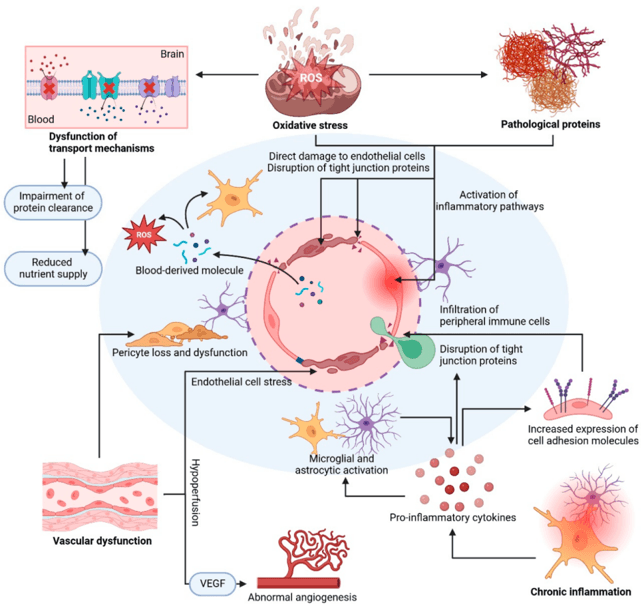
Mechanism of BBB disruption in the brain. ( PMID: 39860392)
Key Pathological Mechanisms
Mechanism | Core Markers | Research Focus |
Inflammation & Endothelial Activation | NF-κB · ICAM-1 · VCAM-1 · IL-6 · TNF-α | Endothelial activation · leukocyte adhesion · inflammatory signaling |
Oxidative Stress & Antioxidant Response | Nrf2 · HO-1 · 4-HNE | ROS accumulation · oxidative damage · cellular defense |
Hypoxia & Angiogenic Remodeling | HIF-1α · VEGF · VEGFR1 · VEGFR2 | Hypoxic response · angiogenic signaling · vascular remodeling |
Apoptosis & Cellular Injury | Cleaved Caspase-3 · Bax · Bcl-2 · γH2AX | Apoptosis · DNA damage · endothelial and NVU injury |
Barrier & Junctional Disruption | Claudin-5 · Occludin · ZO-1 · VE-Cadherin | Tight/adherens junction integrity · paracellular permeability |
ECM & Basement Membrane Remodeling | Laminin · Collagen IV · Fibronectin · MMP-2 · MMP-9 | Basement membrane degradation · vascular remodeling |
Mechanistic Research Framework
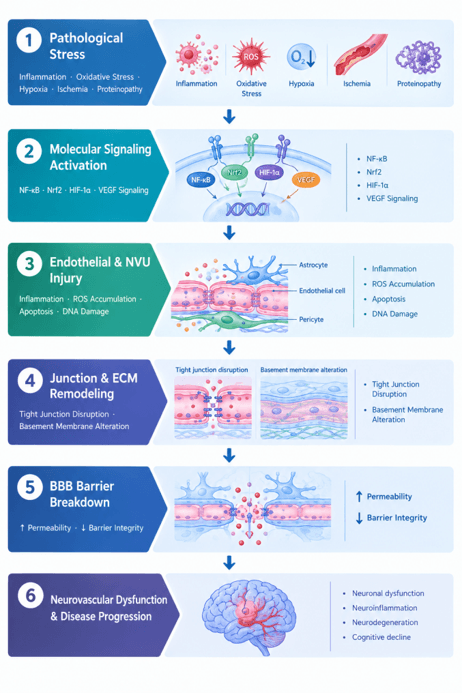
Pathological Stress → Molecular Signaling → NVU Injury → Junction/ECM Remodeling → BBB Breakdown → Disease Progression provides a mechanistic framework for understanding how pathological stimuli activate key pathways such as NF-κB, Nrf2, HIF-1α, and VEGF, drive endothelial and neurovascular unit injury, disrupt tight junctions and the extracellular matrix, and ultimately compromise BBB integrity and promote disease progression.
We provide validated antibodies and research solutions spanning BBB cell identity, barrier integrity, signaling pathways, cellular injury, and disease remodeling, enabling mechanistic investigation from molecular events to spatial and functional validation.
Disease-Relevant Research Areas
· Neuroinflammation
· Ischemic stroke & hypoxic injury
· Neurodegenerative disease
· Cerebrovascular disorders
· Brain tumor progression
· BBB-associated drug delivery
· Vascular aging & endothelial dysfunction
Multiparametric BBB Characterization
Connect Structure, Function and Molecular Mechanisms
A multiparametric characterization strategy integrates BBB identity, barrier structure, transport activity, pathological signaling and neurovascular unit composition to provide a comprehensive assessment of BBB phenotype and function.
Integrated Research Dimensions
Dimension | Core Research Question | Representative Markers / Readouts |
Identity | Is the BBB endothelial phenotype established? | CD31 · VWF · VE-Cadherin |
Structure | Is the barrier structurally intact? | Claudin-5 · Occludin · ZO-1 |
Function | Is the barrier functionally competent? | TEER · Permeability |
Transport | Which molecules are transported across the BBB? | GLUT1 · LAT1 · MCT1 |
Efflux | Which molecules are actively excluded from the brain? | P-gp · BCRP · MRP1 |
Dysfunction | What molecular mechanisms drive barrier failure? | NF-κB · Nrf2 · HIF-1α · p16/p21 · Cleaved Caspase-3 |
NVU | How is the BBB microenvironment regulated? | PDGFRβ · GFAP · AQP4 · Iba1 |
Key References
1. Wu D, Chen Q, Chen X, Han F, Chen Z, Wang Y. The blood–brain barrier: Structure, regulation and drug delivery. Signal Transduct Target Ther. 2023;8:217.
2. O'Halloran L, Akinsete O, Kogan AL, Wrona M, Mahdi AF. 3D in vitro blood-brain barrier models: recent advances and their role in brain disease research and therapy. Front Pharmacol. 2025;16:1637602.
3. Sato Y, Falcone-Juengert J, Tominaga T, Su H, Liu J. Remodeling of the Neurovascular Unit Following Cerebral Ischemia and Hemorrhage. Cells. 2022;11(18):2823.
4. Obermeier B, Daneman R, Ransohoff RM. Development, maintenance and disruption of the blood-brain barrier. Nat Med. 2013;19(12):1584–1596.
5. Kim S, Jung UJ, Kim SR. The Crucial Role of the Blood–Brain Barrier in Neurodegenerative Diseases: Mechanisms of Disruption and Therapeutic Implications. J Clin Med. 2025;14(2):386.