
info@ucallmlabs.com
The incidence of various respiratory diseases, including chronic obstructive pulmonary disease, idiopathic pulmonary fibrosis, cystic fibrosis, and congenital pulmonary surfactant deficiency disorders, continues to rise, creating a significant unmet need for clinical treatment and new drug development. However, primary human lung tissue sources are extremely limited, and lung cells rapidly lose their functional characteristics during in vitro culture. In addition, significant species differences exist between human and rodent lung cell lineages and signaling pathways, making it difficult for animal models to accurately recapitulate human airway and alveolar physiological structures and pathological injury features. These limitations greatly restrict the development of in vitro respiratory disease models, high-throughput screening of respiratory toxic drugs, lung tissue engineering, and lung cell replacement therapies.
In 2014, Nature Biotechnology published a landmark standardized induction protocol in the field of lung differentiation, which fully recapitulated the embryonic developmental sequence from human foregut to lung bud formation. By precisely regulating multiple key developmental signaling pathways, including TGF-β, BMP, Wnt, and retinoic acid (RA), this study established a five-step serum-free, directed differentiation system with high standardization and scalability. The protocol first uses Activin to induce highly purified definitive endoderm, followed by a temporally controlled dual-pathway inhibition strategy to precisely specify foregut cell identity. Subsequently, a combination of Wnt agonist, BMP4, RA, and FGF, termed the “ventralization cocktail,” efficiently induces lung bud multipotent progenitors. FOXA2/NKX2.1 double-positive lung progenitor cells can reach up to 86%, demonstrating substantially higher purity compared with traditional approaches available at that time. Lung progenitor cells obtained at day 15 of differentiation possess the potential to generate multiple respiratory lineages. Continued culture to day 48 enables simultaneous generation of six major types of mature human respiratory epithelial cells, including airway basal cells, ciliated cells, club cells, goblet cells, alveolar type I gas-exchange cells, and functional alveolar type II cells. Among them, alveolar type II cells can specifically synthesize, uptake, and release surfactant proteins. Electron microscopy reveals characteristic lamellar bodies, showing high similarity to human fetal alveolar structures. In vivo transplantation studies further demonstrated that these lung progenitor cells can autonomously generate lung-like tissues containing pseudostratified airway structures, alveolar cyst-like structures, smooth muscle, and cartilage mesenchyme after implantation into immunodeficient mice, without generating ectopic organs such as thyroid or intestinal tissues. Meanwhile, this system is compatible with co-culture using decellularized human lung extracellular matrix, allowing seeded cells to stably engraft and mature while expressing alveolar functional markers. The entire differentiation process is compositionally defined and highly reproducible between batches. Based on this standardized human lung cell platform, it can be widely applied to patient-specific in vitro disease modeling of genetic disorders such as cystic fibrosis, high-throughput evaluation of pulmonary drug absorption and airway toxicity for inhaled/systemic drugs, fundamental studies of human lung embryonic development, artificial lung tissue engineering, and preclinical development of alveolar repair cell therapies. This platform provides a high-fidelity, traceable, standardized human lung cell solution for respiratory disease research and regenerative medicine translation.
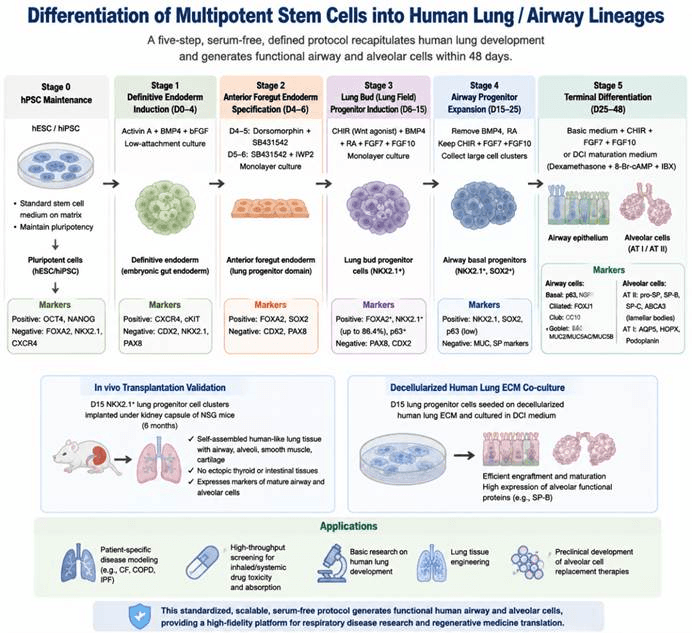
Differentiation process of pluripotent stem cells into lung/airway lineage. Through a five-stage serum-free directed induction system, cells sequentially undergo definitive endoderm, foregut endoderm, lung bud progenitor, and airway progenitor stages, ultimately generating human lung/airway cells including airway basal cells, ciliated cells, goblet cells, Clara cells, and alveolar type I/type II cells. This system can stably mimic human lung development and provides a high-fidelity cellular platform for respiratory disease modeling, drug screening, lung tissue engineering, and regenerative medicine research.
Differentiation Stage | Added Factors / Culture Conditions | Core Biological Function | Corresponding Cell Type / Developmental Stage | Stage-Specific Identification Markers |
Stage 0: hPSC Maintenance | Standard stem cell culture medium on matrix-coated plates; routine maintenance and passaging | Maintains pluripotent state and provides homogeneous starting materials for differentiation | Human embryonic stem cells / induced pluripotent stem cells (hES/hiPS) | Positive: OCT4, NANOG Negative: FOXA2, NKX2.1, CXCR4 |
Stage 1: Definitive Endoderm Induction (D0–4) | Serum-free SFD medium; Activin A + BMP4 + bFGF; low-attachment plates for embryoid aggregate formation | Activates gastrulation-related pathways, efficiently generates definitive endoderm, and eliminates ectodermal and mesodermal contaminants | Embryonic definitive endoderm (common upstream progenitor of endoderm-derived organs) | Positive: CXCR4, cKIT Negative: CDX2, NKX2.1, PAX8 |
Stage 2: Anterior Foregut Endoderm (AFE) Specification (D4–6, two-step temporal inhibition) | D4–5: Dorsomorphin (DSM) + SB431542 D5–6: SB431542 + IWP2; monolayer adherent culture | Sequential inhibition of BMP, TGF-β, and Wnt signaling to establish anterior foregut identity while suppressing hepatic, intestinal, and thyroid lineages | Embryonic anterior foregut endoderm (lung developmental precursor) | Positive: FOXA2, SOX2 Negative: CDX2 (hindgut), PAX8 (thyroid lineage) |
Stage 3: Lung Bud (Lung Field) Progenitor Induction (D6–15, Ventralization Cocktail) | SFD medium; CHIR (Wnt activator) + BMP4 + retinoic acid (RA) + FGF7 (KGF) + FGF10; continuous monolayer culture | Wnt/BMP/RA signaling synergistically induces lung-specific transcription factor NKX2.1 and efficiently enriches lung multipotent progenitors; removal of any key factor significantly reduces induction efficiency | Embryonic lung bud progenitors (lung field precursors capable of generating airway and alveolar lineages) | Core double-positive: FOXA2⁺NKX2.1⁺ (up to 86.4%) Low-level p63 expression Negative: thyroid marker PAX8, intestinal marker CDX2 |
Stage 4: Airway Progenitor Expansion (D15–25) | Remove BMP4 and RA; maintain CHIR + FGF7 + FGF10; only large cell clusters collected for reseeding (removing single-cell contaminants) | Expands airway basal progenitors and establishes proximal airway differentiation potential; mature airway/alveolar functional proteins are not yet expressed | Fetal airway basal progenitor cells | Broad markers: NKX2.1, SOX2 Local p63 positivity No mature airway/alveolar markers such as MUC or SP family |
Stage 5: Terminal Airway and Alveolar Maturation (D25–48, two maturation groups) | Basic group: CHIR + FGF7 + FGF10 DCI maturation group: basal medium + dexamethasone + 8-Br-cAMP + IBMX | DCI combination specifically promotes maturation of distal alveolar type II cells; simultaneously generates six major respiratory epithelial cell types and establishes surfactant protein synthesis, uptake, and secretion functions | Mature airway epithelium + alveolar type I/type II cells (human fetal lung-like) | Airway cells: Basal cells: p63, NGFR Ciliated cells: FOXJ1 Clara cells: CC10 Goblet cells: MUC2/MUC5AC/MUC5B Alveolar cells: AT2: pro-SP, SP-B, SP-C, ABCA3 (lamellar bodies) AT1: AQP5, HOPX, Podoplanin (PDN) |
In Vivo Transplantation Validation (D15 Lung Progenitor Implantation into NSG Mouse Kidney Capsule) | D15 NKX2.1⁺ cell clusters collected, combined with matrix, implanted under the kidney capsule of immunodeficient mice, maintained for 6 months | Validates multilineage differentiation capacity of lung progenitors and their ability to autonomously generate airway, alveolar, and lung stromal tissues | Mature human respiratory epithelium + lung smooth muscle / cartilage mesenchymal tissues in vivo | Expression of mature airway and alveolar markers; detection of smooth muscle and cartilage tissue markers; absence of ectopic thyroid or intestinal tissues |
Decellularized Human Lung Matrix Co-culture | D15 lung progenitors seeded onto decellularized human lung ECM and cultured under DCI maturation conditions | Validates cell attachment, expansion, and maturation within native lung extracellular matrix with expression of alveolar functional proteins | Lung epithelial cells integrated into extracellular matrix | NKX2.1, SP-B, and complete alveolar functional marker panel |