
info@mail.ucallm.com
Decoding Centrosome–Cilia Organization and Cellular Homeostasis with Validated Centriolar Satellite Antibody Solutions
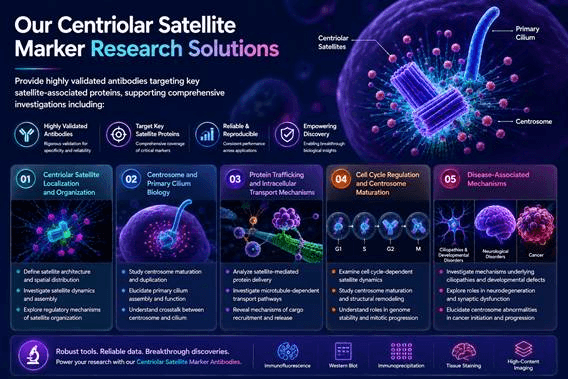
Centriolar satellites are dynamic, membrane-less organelles surrounding the centrosome that play essential roles in centrosome organization, primary ciliogenesis, intracellular trafficking, and cellular signaling regulation. As a critical component of the centrosome–cilium system, centriolar satellites coordinate the localization and assembly of centrosomal and ciliary proteins, thereby maintaining cell cycle progression, proliferation, migration, and tissue homeostasis.
Recent advances in proteomics, super-resolution microscopy, and interactome analysis have revealed extensive molecular diversity among centriolar satellite populations, uncovering their involvement in developmental disorders, neurodegeneration, ciliopathies, and cancer biology.
We support advanced centriolar satellite research by enabling high-resolution investigation of centrosome function, cilia biology, and intracellular organization. Centriolar satellite studies provide critical insights into centrosome maturation, primary cilium assembly, and organelle communication networks that regulate cellular homeostasis. By exploring microtubule-dependent transport and satellite-mediated protein trafficking, researchers can uncover mechanisms controlling subcellular organization and protein distribution. Furthermore, centriolar satellite dysfunction is increasingly linked to ciliopathies, neurodegenerative disorders, and cancer-associated centrosome abnormalities. Combined with super-resolution microscopy, multiplex imaging, and spatial proteomics, these approaches accelerate discovery in cell biology and disease mechanisms.
Centriolar Satellite Biomarker Antibody Portfolio
——Comprehensive Marker Solutions for Centrosome Biology, Ciliogenesis and Disease Research
Centriolar satellites consist of diverse protein complexes with distinct biological functions. Our antibody portfolio covers canonical scaffold proteins, centrosome-associated regulators, ciliary factors, trafficking proteins, and disease-related satellite components.
Biomarker Category | Representative Markers | Research Applications | Biological Significance |
Core Centriolar Satellite Scaffold Markers | PCM1 | Satellite identification, localization analysis | Gold-standard marker defining centriolar satellite structures |
Centrosome & Ciliogenesis Regulators | CEP131, PCNT, WDR60, WDR62, SASS6, PIBF1 | Centrosome maturation, centriole assembly, cilium formation | Control centrosome organization and developmental processes |
Intracellular Transport & Motor Protein Markers | KIF1A, KIF5B, MYO5A | Protein trafficking and satellite movement studies | Regulate microtubule-dependent transport pathways |
Cell Cycle & Centrosome Duplication Markers | NEK1, CEP97, CEP128, CNTRL | Cell division and centrosome replication research | Maintain genomic stability and mitotic progression |
Disease-Associated Satellite Markers | PLA2G6, CD2AP, DDHD2, WDR62 | Neurodegeneration and hereditary disease studies | Link satellite dysfunction to neurological disorders |
Cancer-Associated Satellite Markers | PCM1, LATS2, DMBT1, PRKCQ, G6PD | Tumor biology and pathway analysis | Investigate satellite-mediated tumor progression mechanisms |
Key Centriolar Satellite Biomarker Targets
——Molecular Functions and Research Applications
Marker | Biological Function | Research Value | Major Research Areas |
PCM1 | Core scaffold protein organizing centriolar satellites | Gold-standard marker for satellite visualization and validation | Centrosome biology, ciliogenesis, cancer research |
CEP131 | Centrosomal protein regulating satellite assembly and ciliogenesis | Study primary cilium formation and centrosome function | Ciliopathies |
PCNT | Pericentriolar matrix protein involved in centrosome organization | Analyze centrosome maturation defects | Developmental disorders |
WDR60 | Cilia-associated satellite protein | Investigate ciliary transport mechanisms | Ciliogenesis and genetic disease |
WDR62 | Centrosome-associated developmental regulator | Study centriole duplication and brain development | Primary microcephaly |
SASS6 | Essential centriole assembly protein | Analyze centriole biogenesis | Cell division and developmental biology |
NEK1 | Kinase regulating centrosome and DNA damage responses | Explore centrosome stability mechanisms | Neurodegeneration and ciliopathy |
KIF5B/KIF1A | Microtubule motor proteins involved in cargo transport | Study intracellular satellite trafficking | Neuronal transport and cancer biology |
PLA2G6 | Phospholipid metabolism regulator associated with satellite function | Investigate neuronal degeneration pathways | Parkinsonism and neurodegenerative disease |
LATS2 | Hippo pathway tumor suppressor | Study proliferation and tumor suppression mechanisms | Cancer biology |
G6PD | Metabolic enzyme involved in oxidative stress regulation | Explore metabolic adaptation mechanisms | Cancer metabolism |
Featured Centriolar Satellite Research Panels
—Integrated Biomarker Solutions for Comprehensive Satellite Characterization
Centriolar Satellite Localization Panel—Defining Satellite Architecture and Organization
Key Markers
PCM1
| CEP131
| CEP97
| PCNT | CEP128
|
Centrosome and Ciliogenesis Research Panel—Investigating Primary Cilium Formation and Centrosome Function
Key Markers
PCM1
| CEP131
| WDR60
| SASS6
| WDR62
| PIBF1
|
Neurodegeneration-Associated Satellite Panel—Exploring Satellite Dysfunction in Neurological Disorders
Key Markers
CD2AP
| PLA2G6
| DDHD2
| NEK1
| KIF1A
|
Cancer-Associated Satellite Panel—Investigating Satellite Regulation in Tumor Biology
Key Markers
PCM1
| LATS2
| DMBT1
| PRKCQ
| G6PD
|
Centriolar Satellite Research
——From Subcellular Localization to Disease Mechanism Discovery
Research Stage | Representative Markers | Scientific Objective |
Satellite Identification | PCM1, CEP131 | Visualize and validate centriolar satellite structures |
Centrosome Analysis | PCNT, CEP97, CEP128 | Study centrosome maturation and organization |
Ciliogenesis Research | WDR60, PIBF1, SASS6 | Investigate primary cilium formation |
Protein Transport Studies | KIF5B, KIF1A, MYO5A | Analyze intracellular cargo trafficking |
Disease Mechanism Research | PLA2G6, WDR62, NEK1 | Understand genetic disease pathways |
Cancer Biology Studies | PCM1, LATS2, G6PD | Explore tumor-associated satellite functions |
We provide comprehensive centriolar satellite research solutions enabling precise characterization of subcellular organization, centrosome function, and disease-associated mechanisms. Validated satellite and centrosome markers support visualization of centriolar satellite structures, centrosome maturation, and primary cilium formation. Integrated analysis of transport-related proteins enables investigation of intracellular trafficking networks, while disease-associated markers facilitate exploration of genetic disorders and cellular dysfunction. In cancer research, centriolar satellite profiling reveals emerging roles in tumor-associated signaling and cellular adaptation. These approaches advance understanding of organelle dynamics, developmental biology, neurological disease, and cancer mechanisms.
Why Researchers Choose Our Centriolar Satellite Marker Solutions
Validated Targets. Comprehensive Coverage. Reliable Subcellular Research.
Our antibody portfolio supports the complete centriolar satellite research workflow—from fundamental organelle characterization to disease mechanism investigation.
Research Challenge | Our Solution |
How can I accurately identify centriolar satellites? | Canonical PCM1-based marker panels combined with satellite-associated proteins for reliable localization analysis |
How can I study centrosome and cilium regulation? | Comprehensive CEP, PCNT, WDR, and SASS6 marker coverage for centrosome–cilium pathway research |
How can I analyze satellite heterogeneity? | Multiplex IF-compatible marker combinations enable identification of distinct satellite populations |
How can I investigate disease-associated mechanisms? | Disease-linked markers covering ciliopathy, neurodegeneration, and cancer pathways |
How can I improve experimental reproducibility? | Highly validated antibodies optimized for ICC/IF, IHC, and WB applications |
Key References
Begar E., Seyrek E., Firat-Karalar E.N. (2024).Navigating centriolar satellites: the role of PCM1 in cellular and organismal processes.The FEBS Journal. 292(4):688–708.
Hilgendorf K.I., Myers B.R., Reiter J.F. (2024).Emerging mechanistic understanding of cilia function in cellular signalling.Nature Reviews Molecular Cell Biology. 25:555–573.
Mill P., Christensen S.T., Pedersen L.B. (2023).Primary cilia as dynamic and diverse signalling hubs in development and disease.Nature Reviews Genetics. 24:421–441.
Hall E.A., Kumar D., Prosser S.L., et al. (2023).Centriolar satellites expedite mother centriole remodeling to promote ciliogenesis.eLife. 12:e79299.
Moran A.L., Louzao-Martinez L., Norris D.P., et al. (2024).Transport and barrier mechanisms that regulate ciliary compartmentalization and ciliopathies.Nature Reviews Nephrology. 20:83–100.
Wu J.Y., et al. (2023).Mapping of neuronal and glial primary cilia contactome and connectome in the human cerebral cortex.Neuron. 111:3579–3596.