
info@mail.ucallm.com
Decoding Molecular Drivers, EMT Programs, and Tumor Evolution — Empowering Precision Colorectal Oncology with Validated Antibody Solutions
Colorectal cancer (CRC) is one of the most prevalent malignancies worldwide and represents a major cause of cancer-related morbidity and mortality. Despite advances in screening, surgery, chemotherapy, targeted therapy, and immunotherapy, disease recurrence, metastatic progression, and therapeutic resistance remain significant clinical challenges.
Protein-level biomarker analysis using immunohistochemistry (IHC), immunofluorescence (IF), and Western blotting (WB) provides critical insight into CRC molecular characteristics, enabling researchers to investigate tumor initiation, epithelial–mesenchymal transition (EMT), cancer stemness, invasion, and therapeutic resistance.
Our Colorectal Cancer Biomarker Research Solutions provide highly validated antibodies targeting clinically relevant CRC markers, supporting comprehensive research applications including:
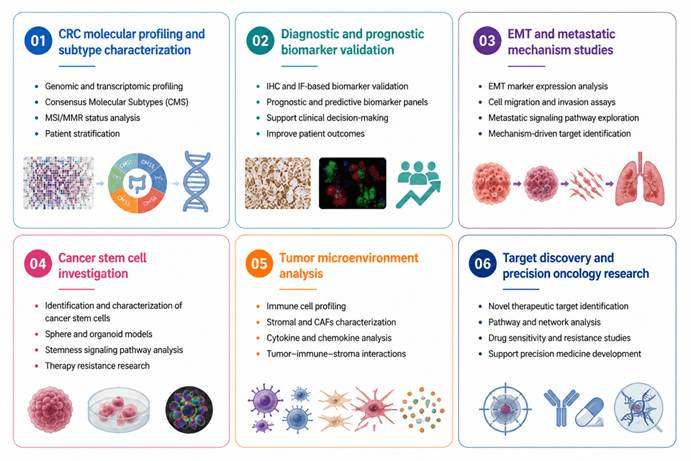
Colorectal Cancer Biomarker Antibody Portfolio
——Comprehensive Solutions for Tumor Classification, Prognosis Evaluation, and Mechanistic Research
Accurate CRC characterization requires integrated analysis of tumor-associated antigens, oncogenic signaling pathways, cell-cycle regulators, EMT-associated proteins, and metastatic biomarkers.
Biomarker Category | Representative Markers | Research Applications | Biological Significance |
Clinical Diagnostic Biomarkers | CEACAM5 (CEA), CA19-9, CA125, CA242, mSEPT9, CDX2 . MSH2/MSH6 | Tumor detection, monitoring, recurrence evaluation | Reflect tumor burden and disease progression |
Tumor Suppressor & Genomic Alteration Markers | TP53, RB pathway proteins | Molecular evolution and prognosis studies | Reveal genomic instability and malignant transformation |
Wnt/β-Catenin Signaling Markers | β-catenin, MYC, TCF4/TCF7L2 | Tumor initiation and proliferation studies | Define key oncogenic signaling events in CRC |
Cell Cycle Regulation Markers | CDK2, CDK4, Ki-67 | Proliferation and tumor grading analysis | Evaluate growth activity and malignant potential |
Cancer Stem Cell & Invasion Markers | CD44, PODXL | Stemness, metastasis, recurrence research | Associate with aggressive tumor phenotypes |
Lineage Identification Markers | SATB2 | Primary tumor origin identification | Distinguish colorectal origin from other adenocarcinomas |
EMT and Metastasis Markers | E-cadherin, N-cadherin, Vimentin, Fibronectin | EMT progression and metastatic mechanism studies | Reflect epithelial plasticity and invasive behavior |
EMT Transcription Regulators | SNAIL, SLUG, TWIST1/2, ZEB1/2, FOXM1 | EMT regulatory network analysis | Control epithelial-to-mesenchymal transition programs |
For Research Use Only. Not for use in diagnostic procedures
Key Colorectal Cancer Biomarker Targets
——Molecular Functions and Research Applications
Marker | Biological Function | Research Value | CRC Application |
CEACAM5 (CEA) | Tumor-associated glycoprotein highly expressed in colorectal tumors | Biomarker validation and tumor burden monitoring | Diagnosis and disease surveillance |
TP53 | Tumor suppressor regulating DNA damage response and apoptosis | Study genomic instability and therapy response | CRC progression studies |
β-catenin | Central mediator of Wnt signaling pathway | Investigate tumor initiation and pathway activation | APC/Wnt-driven CRC research |
MYC | Transcription factor controlling proliferation and metabolism | Study oncogenic transformation | Advanced CRC biology |
CD44 | Cancer stem cell-associated adhesion receptor | Investigate recurrence, invasion, and resistance | CRC stemness research |
SATB2 | Nuclear transcription factor defining colorectal lineage | Identify colorectal tumor origin | Differential diagnosis |
PODXL | Cell adhesion glycoprotein associated with aggressive phenotype | Evaluate metastatic potential and prognosis | Poor outcome-associated CRC |
Vimentin | Mesenchymal marker induced during EMT | Monitor invasive transition | Metastatic CRC research |
CA19-9 | Tumor-associated carbohydrate antigen | Auxiliary biomarker evaluation | Advanced CRC monitoring |
mSEPT9 | DNA methylation-associated biomarker | Epigenetic biomarker research | CRC detection and recurrence monitoring |
Featured CRC Research Panels
——Integrated Biomarker Solutions for Comprehensive Colorectal Cancer Profiling
CRC Molecular Characterization Panel—Defining Tumor Identity and Oncogenic Signaling
Key Markers
CEACAM5
| SATB2
| CDX2 | β-catenin
| TP53
| MYC
|
CRC EMT & Metastasis Panel—Investigating Tumor Invasion and Dissemination Mechanisms
Key Markers
E-cadherin | N-cadherin
| Vimentin
| Fibronectin
| ZEB1
| TWIST1 |
CRC Stemness & Recurrence Panel—Characterizing Therapy Resistance and Tumor Relapse
Key Markers
ALDH1A1 | PODXL | MYC
| Ki-67
| LGR5
| β-catenin | CD44 |
CRC Immuno-Oncology Panel—Supporting research into immune microenvironment remodeling
Key Markers
CD8 | PD-1 | LAG3 | FoxP3 | PD-L1 |
Colorectal Cancer Biomarker Research
——From Molecular Profiling to Translational Discovery
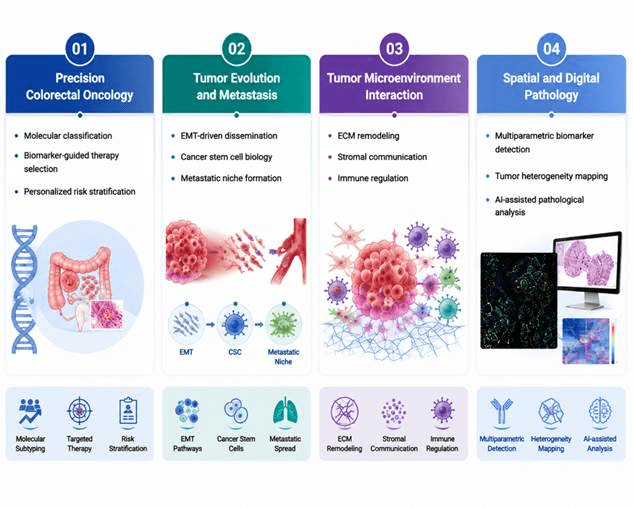
We provide comprehensive biomarker solutions enabling researchers to characterize CRC molecular subtypes, identify key oncogenic drivers, investigate tumor–immune interactions, and elucidate mechanisms underlying tumor progression, metastasis, and therapeutic resistance. By integrating highly validated antibodies with advanced molecular profiling, multiplex immunohistochemistry, immunofluorescence imaging, and spatial analysis technologies, researchers can evaluate clinically relevant biomarkers, dissect tumor heterogeneity, characterize the tumor microenvironment, and discover novel therapeutic opportunities.
These integrated solutions support comprehensive CRC research workflows—from early tumor identification and molecular classification to functional validation and translational application—accelerating biomarker discovery, precision medicine development, targeted therapy innovation, and next-generation colorectal cancer research.
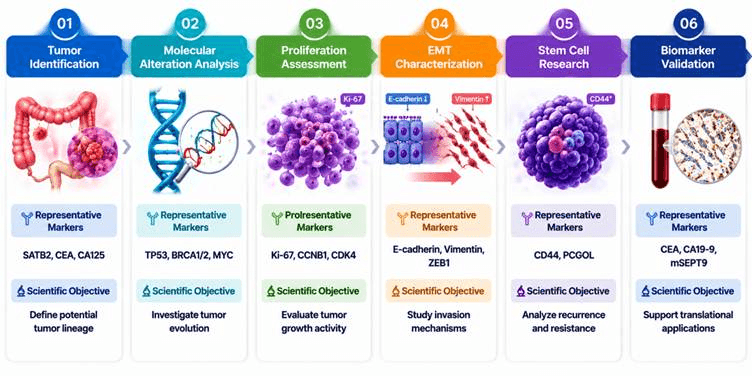
Research Frontiers Driving CRC Biomarker Discovery
Colorectal cancer (CRC) is a highly heterogeneous disease driven by complex molecular alterations, tumor evolution, and dynamic interactions within the tumor ecosystem. Emerging biomarker research integrates multi-omics profiling, spatial technologies, and functional validation approaches to enable precision diagnosis, patient stratification, therapeutic optimization, and discovery of novel treatment strategies.
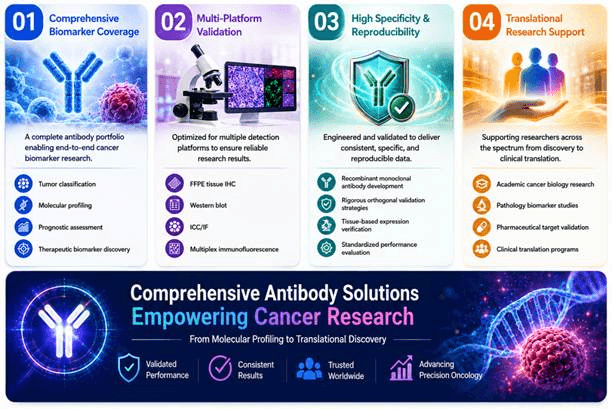
Why Researchers Choose Our Colorectal Cancer Biomarker Solutions?
Validated Targets. Comprehensive Panels. Reliable Translational Research.
Our antibody portfolio supports the complete CRC research workflow—from biomarker discovery and molecular characterization to translational oncology development.
Research Challenge | Solution |
How can I identify colorectal tumor origin? | SATB2 and CEACAM5 lineage identification panels |
How can I evaluate CRC progression? | TP53, β-catenin, MYC and proliferation marker panels |
How can I investigate metastasis? | EMT and invasion biomarker panels |
How can I study therapy resistance? | Stemness and signaling pathway markers |
How can I improve reproducibility? | Application-validated antibodies optimized for IHC, WB, IF and multiplex analysis |
Key References
Hlavca S, et al. Clusterin: a marker and mediator of chemoresistance in colorectal cancer. Cancer Metastasis Rev. 2024;43(1):379-391.
Lu P, et al. Methylated Septin 9 as a Promising Biomarker in the Diagnosis and Recurrence Monitoring of Colorectal Cancer. Dis Markers. 2022;2022:7087885.
Tan Y, et al. Construction and validation of artificial intelligence pathomics models for predicting pathological staging in colorectal cancer. Cancer Med. 2024;13(7):e6947.
Ghabra S, et al. Preoperative tumor marker elevations in colorectal cancer patients with peritoneal metastases. Eur J Surg Oncol. 2025;51(6):109720.
Kennel K.B., Greten F.R. (2025).The immune microenvironment of colorectal cancer.Nature Reviews Cancer. 25:945–964.
Jiang W., Yang K., Xiao C., et al. (2025).Multimodal tumor microenvironment signature of colorectal cancer for prediction prognosis and chemotherapy benefit. npj Precision Oncology. 9:270.