
info@mail.ucallm.com
Decoding Cellular Plasticity, Tumor Metastasis, and Tissue Remodeling with Validated EMT Biomarker Solutions
Epithelial-to-mesenchymal transition (EMT) is a fundamental biological process characterized by the loss of epithelial identity and acquisition of mesenchymal properties, enabling enhanced cellular migration, invasion, stem-like characteristics, and therapy resistance.EMT plays essential roles in embryonic development, tissue repair, fibrosis, immune regulation, and cancer progression. In solid tumors, aberrant activation of EMT programs promotes metastatic dissemination, tumor heterogeneity, immune evasion, and resistance to chemotherapy and targeted therapies.
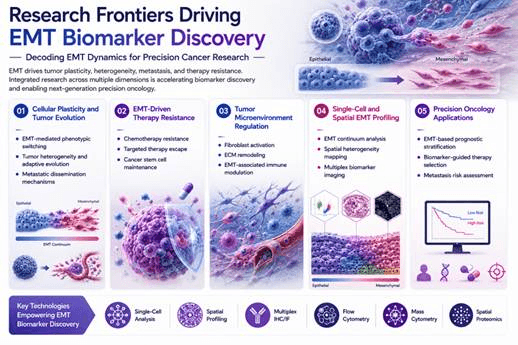
We support next-generation EMT biomarker research by enabling comprehensive characterization of epithelial–mesenchymal plasticity, tumor evolution, metastatic progression, and therapeutic resistance. Validated EMT biomarker solutions empower researchers to investigate phenotypic switching, tumor heterogeneity, cancer stem cell maintenance, and EMT-associated mechanisms underlying metastasis and therapy escape. Combined with single-cell analysis, spatial profiling, and multiplex biomarker imaging, EMT-based profiling reveals dynamic cellular states, tumor–microenvironment interactions, and molecular heterogeneity within complex tumor ecosystems. These integrated approaches accelerate discoveries in metastasis research, prognostic biomarker development, therapeutic resistance, and precision oncology, supporting biomarker-guided.
EMT Biomarker Antibody Portfolio
——Comprehensive Solutions for EMT Characterization, Metastatic Research, and Cellular Plasticity Analysis
EMT is a dynamic and heterogeneous process regulated by multiple molecular networks. Comprehensive EMT profiling requires simultaneous evaluation of epithelial identity loss, mesenchymal acquisition, transcriptional regulation, and extracellular matrix remodeling.Our antibody portfolio covers major EMT-associated biomarker categories to support standardized EMT research workflows.
Biomarker Category | Representative Markers | Research Applications | Biological Significance |
Epithelial Identity Markers | E-Cadherin (CDH1), EPCAM, Cytokeratin 8/18, Cytokeratin 19, ZO-1 | Monitor epithelial phenotype maintenance and EMT initiation | Reflect epithelial cell polarity, adhesion, and junction integrity |
Mesenchymal Transition Markers | Vimentin, N-Cadherin, Fibronectin, α-SMA | Evaluate acquisition of migratory and invasive characteristics | Indicate mesenchymal phenotype activation and cellular plasticity |
EMT Transcription Factors | SNAIL, SLUG, TWIST1, ZEB1, ZEB2 | Investigate EMT regulatory mechanisms | Master regulators controlling epithelial gene repression and mesenchymal activation |
Cell Adhesion & Migration Markers | CD44, Integrin β1, L1CAM | Study tumor invasion, metastasis, and stemness | Promote cell migration, extracellular matrix interaction, and metastatic potential |
Extracellular Matrix Remodeling Markers | MMP2, MMP9, MMP14, LOX | Analyze matrix degradation and tissue invasion | Mediate extracellular matrix remodeling during tumor progression |
Cancer Stem Cell-Associated EMT Markers | CD44, SOX2, OCT4, NANOG, ALDH1A1 | Study EMT-associated stemness and therapy resistance | Connect EMT activation with tumor initiating properties |
EMT Signaling Pathway Markers | β-Catenin, TGF-β pathway markers, SMAD proteins, AKT/mTOR pathway markers | Explore upstream EMT regulation | Reveal signaling networks driving EMT activation |
Key EMT Biomarker Targets
——Molecular Functions and Research Applications
Marker | Biological Function | Research Value | Major Research Applications |
E-Cadherin (CDH1) | Cell-cell adhesion molecule maintaining epithelial integrity | Gold-standard epithelial marker for EMT evaluation | EMT transition analysis, tumor progression studies |
EPCAM | Epithelial cell surface adhesion molecule | Identifies epithelial tumor populations and circulating tumor cells | Cancer diagnosis, tumor heterogeneity research |
Cytokeratin 8/18 | Intermediate filament proteins maintaining epithelial structure | Defines epithelial differentiation status | Carcinoma profiling, EMT monitoring |
Vimentin | Mesenchymal intermediate filament protein | Classical marker of mesenchymal phenotype acquisition | EMT activation, invasion, metastasis studies |
N-Cadherin (CDH2) | Mesenchymal adhesion molecule promoting migration | Indicates cadherin switching during EMT | Tumor dissemination and migration research |
Fibronectin | Extracellular matrix glycoprotein involved in adhesion and migration | Evaluates matrix remodeling and mesenchymal activation | EMT, fibrosis, tumor invasion |
SNAIL (SNAI1) | EMT transcription factor repressing epithelial genes | Key regulator initiating EMT programs | EMT induction mechanism studies |
SLUG (SNAI2) | EMT transcription factor regulating cell plasticity | Associated with invasion and therapy resistance | Cancer progression research |
TWIST1 | Developmental transcription factor activating EMT | Promotes metastasis and stem-like properties | Tumor metastasis and developmental biology |
ZEB1/ZEB2 | Transcriptional repressors targeting epithelial genes | Core regulators of stable EMT states | EMT maintenance and drug resistance studies |
β-Catenin | Cell adhesion and Wnt signaling regulator | Links EMT with pathway activation and stemness | Wnt pathway and tumor evolution research |
CD44 | Hyaluronic acid receptor associated with cancer stem cells | Marker of EMT-associated stemness and recurrence | Cancer stem cell biology |
MMP2/MMP9 | Matrix metalloproteinases degrading extracellular matrix | Evaluate invasive capacity | Metastatic mechanism studies |
MMP14 (MT1-MMP) | Membrane-associated matrix remodeling enzyme | Regulates tumor invasion through ECM degradation | Invasion and microenvironment research |
α-SMA (ACTA2) | Contractile mesenchymal marker | Characterizes fibroblast activation and EMT-like states | Fibrosis and tumor stroma studies |
Featured EMT Research Panels
——Integrated Biomarker Solutions for Comprehensive EMT Characterization
EMT Phenotype Transition Panel——Defining Epithelial Loss and Mesenchymal Acquisition
Key Markers
E-Cadherin | EPCAM | Cytokeratin 8/18 | Vimentin | N-Cadherin | Fibronectin |
EMT Transcription Regulation Panel—Deciphering Molecular Drivers of EMT Activation
Key Markers
SNAIL | SLUG | TWIST1 | ZEB1 | ZEB2 |
EMT-Mediated Metastasis Panel—Investigating Tumor Migration, Invasion, and Dissemination
Key Markers
Vimentin | N-Cadherin | CD44 | L1CAM | MMP2 | MMP9 |
MT-Driven Cancer Stemness Panel—Connecting Cellular Plasticity with Tumor Initiation and Resistance
Key Markers
CD44 | SOX2 | OCT4 | NANOG | ALDH1A1 |
EMT Biomarker Research
——From EMT Induction to Translational Metastasis Research
Research Stage | Representative Markers | Scientific Objective |
EMT Induction Validation | E-Cadherin, Vimentin, N-Cadherin | Confirm epithelial-to-mesenchymal phenotype conversion |
EMT Regulatory Analysis | SNAIL, TWIST1, ZEB1/ZEB2 | Identify molecular drivers controlling EMT activation |
Migration & Invasion Assessment | MMP2, MMP9, Fibronectin, Integrins | Evaluate metastatic potential and ECM remodeling |
Stemness Characterization | CD44, SOX2, OCT4, NANOG | Investigate EMT-associated cancer stem cell properties |
Microenvironment Analysis | α-SMA, Fibronectin, TGF-β pathway markers | Study stromal interaction and EMT regulation |
Therapeutic Response Research | EMT markers + pathway biomarkers | Explore mechanisms of drug resistance |
We provide comprehensive biomarker solutions enabling researchers to characterize epithelial–mesenchymal transition (EMT) states, define key regulatory pathways, investigate tumor plasticity and cancer stemness, and uncover mechanisms underlying invasion, metastasis, and therapeutic resistance. By integrating highly validated antibodies targeting key EMT biomarkers—including E-Cadherin, Vimentin, N-Cadherin, SNAIL, TWIST1, ZEB1/ZEB2, MMP2/MMP9, Integrins, CD44, SOX2, and TGF-β pathway markers—with advanced molecular profiling, multiplex imaging, and spatial analysis technologies, researchers can precisely evaluate EMT activation, dissect molecular drivers of tumor progression, and characterize dynamic interactions within the tumor microenvironment.
These integrated approaches support comprehensive investigation of EMT regulation, metastatic mechanisms, cancer stemness, tumor heterogeneity, and drug response, accelerating biomarker discovery, therapeutic target identification, precision oncology, and translational cancer research.
Why Researchers Choose Our EMT Biomarker Solutions?
Validated EMT Targets. Comprehensive Panels. Reliable Cellular Plasticity Research.
Our EMT antibody portfolio supports the complete EMT research workflow—from phenotype characterization and mechanism discovery to translational cancer studies.
Research Challenge | Our Solution |
How can I confirm EMT activation? | Integrated epithelial and mesenchymal marker panels including E-Cadherin, Vimentin, and N-Cadherin |
How can I study EMT regulation mechanisms? | Validated EMT transcription factor antibodies targeting SNAIL, TWIST1, and ZEB family proteins |
How can I evaluate metastatic potential? | Invasion-associated biomarkers including MMPs, CD44, L1CAM, and ECM regulators |
How can I investigate EMT-associated stemness? | Cancer stem cell marker panels covering CD44, SOX2, OCT4, and NANOG |
How can I improve experimental reproducibility? | Highly validated antibodies optimized for IHC, WB, ICC/IF, and multiplex imaging |

Key References
Dongre A., Weinberg R.A. (2021). New insights into the mechanisms of epithelial–mesenchymal transition and implications for cancer. Nature Reviews Molecular Cell Biology. 22:265–281.
Pastushenko I., Brisebarre A., Sifrim A., et al. (2021). Identification of the tumour transition states occurring during EMT. Nature. 589:184–191.
Yang J., Antin P., Berx G., et al. (2022). Guidelines and definitions for research on epithelial–mesenchymal transition. Nature Reviews Molecular Cell Biology. 23:341–357.
Lambert A.W., Weinberg R.A. (2021).Linking EMT programmes to normal and neoplastic epithelial stem cells. Nature Reviews Cancer.21, pages325–338.
Orozco-Ruiz S., Ruscone M. (2024). Mesenchymal to epithelial transition (MET) in cancer progression: insights from logical modeling. Scientific Reports.16:15032.