
info@mail.ucallm.com
From Molecular Classification to Precision Gastrointestinal Oncology — Empowering Comprehensive Gastric Cancer Profiling with Validated Antibody Solutions
Gastric cancer remains one of the most prevalent and deadly gastrointestinal malignancies worldwide, characterized by extensive molecular heterogeneity, diverse histological subtypes, complex tumor evolution, and variable therapeutic responses. Despite advances in screening programs and targeted therapies, challenges remain in early detection, molecular classification, prognostic assessment, and personalized treatment selection.
The integration of molecular biomarkers, immune-related signatures, oncogenic pathway regulators, and tumor microenvironment components has become essential for understanding gastric cancer initiation, progression, metastasis, and therapeutic resistance.
Our Gastric Cancer Biomarker Research Solutions provide highly validated antibodies targeting key gastric cancer-associated markers, supporting comprehensive research applications including:
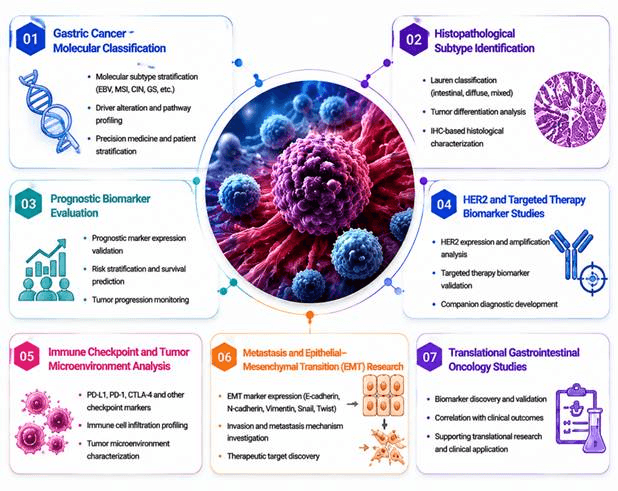
Gastric Cancer Biomarker Antibody Portfolio
——Comprehensive Solutions for Tumor Classification, Prognosis Evaluation, and Precision Therapy Research
Accurate gastric cancer characterization requires integrated evaluation of histological markers, molecular alterations, therapeutic targets, immune regulators, and metastatic signatures. Our antibody portfolio covers major gastric cancer biomarker categories to support standardized research workflows.
Biomarker Category | Representative Markers | Research Applications | Biological Significance |
Gastric Cancer Classification Markers | CDX2, MUC5AC, MUC2, MUC6, SOX2,CK7, CK20 | Molecular subtype and histological classification | Define intestinal, gastric, and mixed differentiation phenotypes |
HER2 & Targeted Therapy Biomarkers | HER2, EGFR, MET, FGFR2, CLDN18.2 | Target discovery and therapeutic response studies | Identify actionable oncogenic signaling pathways |
DNA Mismatch Repair (MMR) Biomarkers | MLH1, MSH2, MSH6, PMS2 | MSI status determination, Lynch syndrome screening, and immunotherapy response prediction studie | Underlie DNA mismatch repair deficiency |
Prognostic & Metastasis Markers | E-cadherin, Vimentin, Snail, MMP9, L1CAM | Tumor invasion, EMT, recurrence studies | Reflect metastatic potential and tumor aggressiveness |
Tumor Suppressor & Genomic Alteration Markers | TP53, CDH1, ARID1A, ATM | Mutation-associated tumor biology research | Reveal mechanisms of tumor initiation and genomic instability |
Immune Microenvironment Markers | PD-L1, PD-1, CD8, FOXP3, CD68,CD20, CD163 | Immunotherapy response and immune profiling | Characterize immune escape mechanisms and immune cell infiltration |
Stemness & Tumor Evolution Markers | CD44, ALDH1A1, SOX2, LGR5, CD133 (PROM1) | Cancer stem cell and resistance research | Investigate tumor plasticity and therapeutic resistance |
Proliferation & Cell Cycle Markers | Ki-67, Cyclin D1, p16 | Tumor growth assessment | Evaluate proliferation activity and cell cycle regulation |
For Research Use Only. Not for use in diagnostic procedures
Key Gastric Cancer Biomarker Targets
——Molecular Functions and Research Applications
Marker | Biological Function | Research Value | Associated Gastric Cancer Applications |
HER2 | Receptor tyrosine kinase regulating proliferation and survival signaling | Biomarker evaluation for targeted therapy studies | HER2-positive gastric and gastroesophageal junction cancer |
EGFR | Growth factor receptor activating MAPK and PI3K/AKT pathways | Oncogenic pathway analysis and therapeutic research | Advanced gastric cancer |
MET | Hepatocyte growth factor receptor promoting invasion and metastasis | MET amplification and resistance mechanism studies | Gastric cancer progression research |
FGFR2 | Fibroblast growth factor receptor involved in tumor growth | Targeted therapy biomarker investigation | FGFR2-amplified gastric cancer |
CDX2 | Intestinal differentiation transcription factor | Molecular classification and differentiation analysis | Intestinal-type gastric carcinoma |
MUC5AC / MUC6 | Gastric epithelial mucins regulating differentiation | Phenotypic classification studies | Gastric-type tumors |
E-cadherin (CDH1) | Cell adhesion molecule maintaining epithelial integrity | EMT and diffuse gastric cancer research | Diffuse gastric carcinoma and hereditary gastric cancer |
Vimentin | Mesenchymal intermediate filament protein | EMT and metastatic progression analysis | Invasive gastric cancer |
L1CAM | Cell adhesion molecule promoting migration and invasion | Prognostic and metastasis studies | Advanced gastric cancer |
TP53 | Tumor suppressor regulating genomic stability | Molecular subtype and mutation studies | Gastric cancer genomic profiling |
ARID1A | Chromatin remodeling regulator | Epigenetic alteration research | Gastric cancer molecular characterization |
PD-L1 | Immune checkpoint ligand mediating immune escape | Immunotherapy biomarker evaluation | Immune checkpoint inhibitor studies |
CD8 | Cytotoxic T-cell marker | Immune infiltration analysis | Tumor immune microenvironment research |
CD44 | Cancer stem cell-associated adhesion receptor | Recurrence and resistance studies | Gastric cancer stemness research |
Ki-67 | Nuclear proliferation marker | Tumor proliferation assessment | Prognostic evaluation |
Featured Gastric Cancer Research Panels
—Integrated Biomarker Solutions for Comprehensive Tumor Characterization
Gastric Cancer Molecular Classification Panel—Defining Histological Phenotypes and Molecular Identity
Key Markers
| CDX2 | MUC5AC | MUC2 | MUC6 | SOX2 | E-cadherin |
HER2-Positive Gastric Cancer Profiling Panel—Evaluating Therapeutic Targets and Oncogenic Signaling Networks
Key Markers
| HER2 | EGFR | MET | FGFR2 | Ki-67 |
Gastric Cancer EMT & Metastasis Research Panel—Investigating Tumor Invasion, Dissemination, and Resistance Mechanisms
Key Markers
| Vimentin | Snail | MMP9 | L1CAM | CD44 |
Diffuse Gastric Cancer & Genomic Alteration Panel—Understanding Genetic Drivers and Tumor Evolution
Key Markers
| CDH1 | TP53 | ARID1A | ATM | β-Catenin |
Gastric Cancer Immunotherapy Prediction and MMR Research Panel —— Defining MMR-deficient tumors with high mutational burden and immune infiltration
Key Markers
| MLH1 | MSH2 | MSH6 | PMS2 | PD-L1 | CD8 |
Gastric Cancer Biomarker Research
——From Molecular Profiling to Translational Discovery
Gastric cancer biomarker research integrates molecular profiling, therapeutic biomarker discovery, immune landscape characterization, and metastasis mechanism investigation to advance precision oncology. By leveraging validated biomarkers such as HER2, MET, FGFR2, PD-L1, EMT-related markers, and genomic alteration indicators, researchers can define tumor subtypes, evaluate disease progression, identify actionable targets, and uncover mechanisms driving tumor evolution. These biomarker-driven approaches enable reliable patient stratification, therapeutic response prediction, and translational development of personalized treatment strategies for gastric cancer.
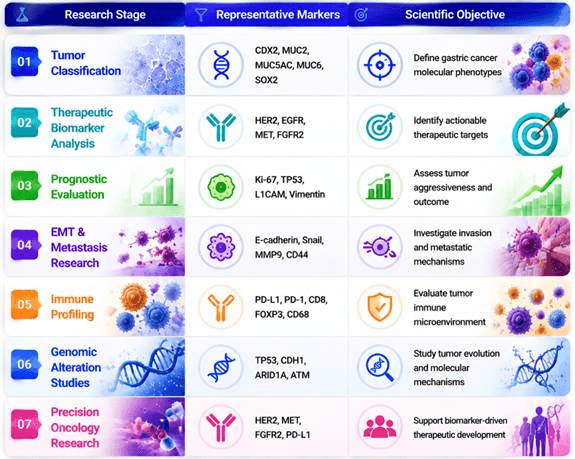
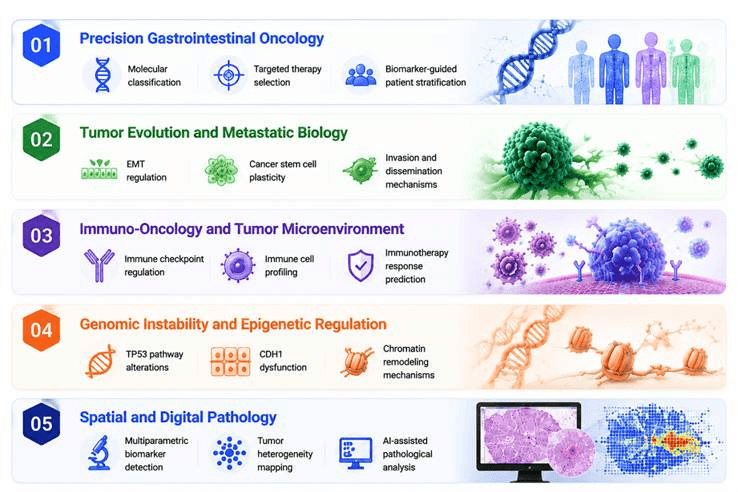
Research Frontiers Driving Gastric Cancer Biomarker Discovery
Gastric cancer biomarker research is rapidly evolving through the integration of precision gastrointestinal oncology, tumor evolution studies, immuno-oncology, genomic analysis, and advanced pathology technologies. These multidisciplinary advances, supported by validated antibody-based detection solutions, accelerate the translation of molecular discoveries into improved diagnostic, prognostic, and therapeutic applications in gastric cancer precision oncology.
Why Researchers Choose Our Gastric Cancer Biomarker Solutions?
Validated Targets. Comprehensive Panels. Reliable Translational Research.
Our antibody portfolio supports the complete gastric cancer research workflow — from molecular classification and biomarker discovery to translational oncology applications.
Research Challenge | Our Solution |
How can I classify gastric cancer subtypes? | Comprehensive differentiation panels including CDX2, mucins, SOX2, and E-cadherin |
How can I identify therapeutic targets? | Validated antibodies targeting HER2, EGFR, MET, and FGFR2 pathways |
How can I evaluate tumor aggressiveness? | Prognostic biomarkers covering EMT, invasion, and proliferation pathways |
How can I study immunotherapy response? | Immune profiling panels including PD-L1, PD-1, CD8, and immune markers |
How can I investigate genomic alterations? | Antibodies targeting TP53, CDH1, ARID1A, and DNA repair regulators |
How can I improve experimental reproducibility? | Highly validated antibodies optimized for IHC, IF, WB, and multiplex applications |

Key References
Nakayama I., Qi C., Chen Y., et al. (2024).Claudin 18.2 as a novel therapeutic target.
Nature Reviews Clinical Oncology.21:354–369.Mathias-Machado M.C., Fonseca de Jesus V.H., Jácome A., et al. (2024).Claudin 18.2 as a New Biomarker in Gastric Cancer—What Should We Know?Cancers.16(3):679.
Sun F., Gao X., Wang W., et al. (2025).Predictive biomarkers in the era of immunotherapy for gastric cancer: current achievements and future perspectives.Frontiers in Immunology.16:1599908.
Aquino de Moraes F.C., Sobreira L.E.R., Souza M.E.C., et al. (2024).The role of CLDN18.2 in gastric cancer prognosis: a systematic review and meta-analysis.Biomarkers.29(8):528–538.