
info@mail.ucallm.com
Decoding Receptor-Mediated Tumor Signaling and Microenvironment Regulation — Empowering Precision Oncology Research with Validated GPCR Biomarker Antibodies
G protein-coupled receptors (GPCRs) represent the largest family of cell-surface signaling receptors in the human genome, comprising more than 800 members that regulate diverse physiological processes including hormone sensing, immune regulation, neuronal communication, metabolism, and tissue homeostasis.In cancer biology, GPCRs function as critical signaling hubs that integrate extracellular signals from the tumor microenvironment and translate them into intracellular responses controlling tumor initiation, proliferation, angiogenesis, invasion, metastasis, cancer stem cell maintenance, immune evasion, and therapeutic resistance.
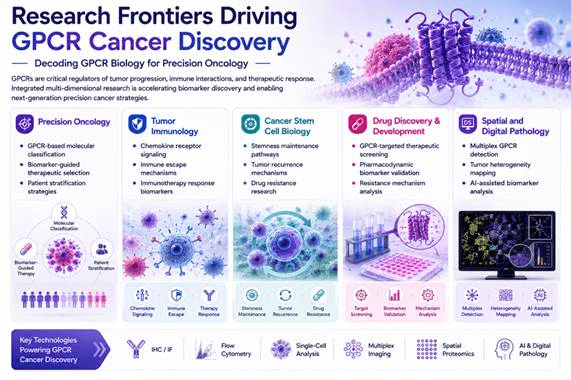
We support cutting-edge GPCR cancer research by enabling comprehensive investigation of receptor signaling, tumor progression, immune regulation, cancer stemness, and therapeutic response. Validated GPCR antibodies facilitate studies of molecular classification, chemokine receptor signaling, immune escape, stem cell–associated pathways, and mechanisms underlying tumor growth and therapy resistance. Combined with GPCR-targeted screening, pharmacodynamic biomarker validation, multiplex detection, and advanced spatial profiling, GPCR-based research reveals cellular heterogeneity, receptor-driven signaling networks, and complex tumor–microenvironment interactions. These integrated approaches accelerate discoveries in precision oncology, tumor immunology, cancer stem cell biology, drug discovery, biomarker development, and next-generation therapeutic research.
GPCR Biomarker Antibody Portfolio
——Comprehensive Solutions for Cancer Signaling, Tumor Classification and Therapeutic Discovery
Reliable GPCR research requires accurate detection of receptor abundance, localization, activation status, and biological function. Our antibody portfolio covers major cancer-associated GPCR classes, enabling researchers to establish standardized GPCR profiling workflows.
GPCR Category | Representative Markers | Research Applications | Biological Significance |
Neuroendocrine GPCRs | SSTR1, SSTR2, GRPR, NMBR, TACR1, NPY2R / NPY5R | Neuroendocrine tumor characterization, hormone signaling studies, targeted therapy research | Regulate endocrine signaling, tumor growth, and hormone-dependent proliferation |
Chemokine GPCRs | CXCR4, CCR2, CCR4, CCR7, CCR8, CCR10, CXCR7, CCR5, CXCR3 | Tumor immune microenvironment, metastasis, immune escape studies | Control immune cell recruitment, tumor migration, and metastatic dissemination |
Developmental Signaling GPCRs | LGR5, SMO, FZD receptors | Cancer stem cell biology, developmental signaling research | Regulate Wnt/β-catenin and Hedgehog pathways involved in tumor stemness |
Adhesion GPCRs | ADGRG1 (GPR56), ADGRL4 (ELTD1), ADGRE5 (CD97), ADGRB1 (BAI1) | Tumor invasion, extracellular matrix interaction, stromal signaling | Mediate cell adhesion, migration, and tumor–microenvironment communication |
Proton-Sensing GPCRs | GPR4, GPR65, GPR68, GPR132 | Tumor acidity adaptation, hypoxia response studies | Sense extracellular pH changes and regulate tumor survival mechanisms |
GPCRs Harboring Oncogenic Hotspot Mutations | MAS1L, CYSLTR2, CHRM1, TSHR, ADRA1B, GPR101 | Mutation-driven tumorigenesis studies | Constitutive receptor activation promotes oncogenic signaling |
For Research Use Only. Not for use in diagnostic procedures
Key GPCR Cancer Biomarker Targets
——Core Receptor Targets for Tumor Signaling, Microenvironment Regulation, and Precision Oncology Research
Marker | Biological Function | Research Value | Associated Cancer Applications |
CXCR4 | Chemokine receptor regulating tumor migration, invasion, angiogenesis, and metastatic homing | Key biomarker for tumor dissemination and immune microenvironment studies | Breast cancer, pancreatic cancer, gastric cancer, lung cancer, hematological malignancies |
CXCR7 (ACKR3) | Atypical chemokine receptor involved in CXCL12 signaling, survival, and angiogenesis | Investigate tumor progression, therapeutic resistance, and receptor crosstalk | Solid tumors, glioma, breast cancer, renal cancer |
CCR2 | Chemokine receptor controlling monocyte/macrophage recruitment and tumor-associated inflammation | Characterize tumor immune microenvironment and macrophage-mediated progression | Pancreatic cancer, colorectal cancer, breast cancer |
CCR7 | Chemokine receptor regulating lymphatic migration and metastatic dissemination | Study lymph node metastasis and immune cell trafficking | Gastric cancer, breast cancer, melanoma, head & neck cancer |
CCR8 | Tumor-associated chemokine receptor enriched in regulatory T cells (Tregs) | Identify immune suppressive mechanisms and immunotherapy biomarkers | Lung cancer, ovarian cancer, melanoma |
SSTR2 | Somatostatin receptor regulating hormone signaling and cellular proliferation | Biomarker for neuroendocrine tumor classification and targeted receptor therapy | Neuroendocrine tumors, pancreatic neuroendocrine tumors, gastric NETs |
LGR5 | Stem cell-associated GPCR regulating Wnt/β-catenin signaling | Identify cancer stem cell populations and recurrence mechanisms | Colorectal cancer, gastric cancer, liver cancer |
SMO | Hedgehog pathway receptor controlling developmental signaling and tumor stemness | Investigate Hedgehog-driven tumor initiation and therapeutic targeting | Basal cell carcinoma, pancreatic cancer, medulloblastoma |
FZD Receptors | Frizzled GPCR family activating Wnt signaling pathways | Study tumor stemness, proliferation, and differentiation programs | Colorectal cancer, breast cancer, liver cancer |
ADGRG1 (GPR56) | Adhesion GPCR regulating cell adhesion, migration, and extracellular matrix interaction | Analyze invasion, metastasis, and tumor microenvironment communication | Glioma, melanoma, pancreatic cancer |
ADGRE5 (CD97) | Adhesion GPCR involved in immune interaction, migration, and inflammatory signaling | Investigate tumor invasion and immune–tumor communication | Gastric cancer, colorectal cancer, breast cancer |
GPR4 | Proton-sensing GPCR responding to extracellular acidity | Study tumor acid adaptation and metabolic stress responses | Breast cancer, colorectal cancer, melanoma |
GPR65 | pH-sensitive GPCR regulating immune and metabolic adaptation | Explore tumor survival under acidic microenvironment conditions | Lymphoma, colorectal cancer, solid tumors |
CYSLTR2 | Cysteinyl leukotriene receptor involved in inflammatory signaling | Investigate oncogenic GPCR mutations and constitutive signaling | Melanoma and mutation-driven cancers |
CHRM1 | Muscarinic acetylcholine receptor regulating growth signaling pathways | Explore GPCR-driven proliferation and tumor-promoting signaling | Lung cancer, colorectal cancer, pancreatic cancer |
TSHR | Thyroid-stimulating hormone receptor controlling endocrine signaling | Study hormone-dependent tumor biology and receptor activation | Thyroid cancer |
Featured GPCR Research Panels
Neuroendocrine Tumor Profiling Panel——Characterizing Hormone-Responsive and Neuroendocrine Tumor Signaling
Key Markers
SSTR1 | SSTR2 | GRPR | NMBR | TACR1 | Chromogranin A | Synaptophysin |
Tumor Metastasis & Immune Microenvironment Panel——Decoding GPCR-Mediated Tumor Dissemination and Immune Escape
Key Markers
CXCR4 | CCR2 | CCR7 | CCR8 | CCR5 | ACKR3 | PD-L1 |
Cancer Stem Cell Signaling Panel——Investigating Tumor Initiation and Treatment Resistance
Key Markers
LGR5 | SMO | ADGRG1 | SOX2 | CD44 | ALDH1A1 |
Tumor Microenvironment Adaptation Panel——Understanding Hypoxia and Metabolic Stress Responses
Key Markers
GPR132 | GPR4 | GPR65 | GPR68 | HIF-1α | CA9 |
GPCR Cancer Research
——From Molecular Profiling to Therapeutic Validation
Research Stage | Representative Markers | Scientific Objective |
GPCR Expression Profiling | SSTR2, CXCR4, LGR5 | Identify tumor-associated receptor expression patterns |
Subcellular Localization | CCR7, ADGRG1, CYSLTR2 | Determine receptor distribution and trafficking |
Tumor Microenvironment Analysis | CCR2, CCR8, GPR132 | Investigate immune and metabolic regulation |
Cancer Stem Cell Characterization | LGR5, SMO | Evaluate tumor initiation capacity |
Drug Target Validation | SSTR, CXCR4, SMO | Assess therapeutic target expression |
Translational Biomarker Studies | GPCR panels | Support precision oncology research |
The GPCR Cancer Research Workflow integrates receptor profiling, subcellular localization analysis, tumor microenvironment investigation, cancer stem cell characterization, and therapeutic target validation to advance precision oncology research. By evaluating key GPCR biomarkers including SSTR2, CXCR4, LGR5, CCR7, ADGRG1, CCR2, CCR8, and SMO, researchers can characterize tumor-associated receptor expression, investigate signaling functions, and explore mechanisms involved in tumor initiation, immune regulation, and metabolic adaptation. This comprehensive workflow supports biomarker discovery, drug target validation, and translational cancer research through systematic GPCR profiling and therapeutic evaluation strategies.
Why Researchers Choose Our GPCR Cancer Research Solutions?
Validated Targets. Comprehensive Coverage. Reliable Cancer Biology Discovery.
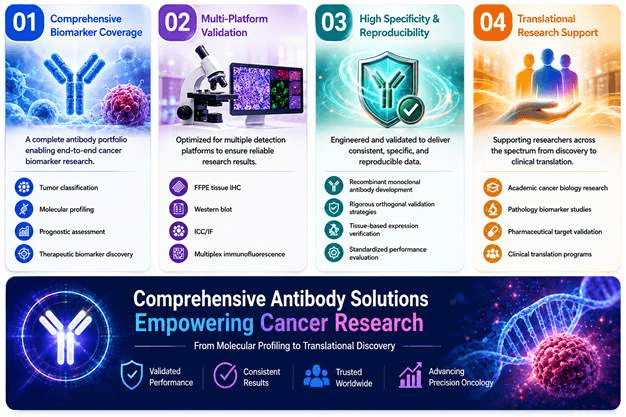
Our GPCR antibody portfolio supports the complete cancer research workflow—from receptor profiling and mechanism discovery to translational biomarker validation.
Research Challenge | Our Solution |
How can I profile oncogenic GPCR expression? | Comprehensive antibody coverage across major GPCR cancer-associated families |
How can I study GPCR-driven tumor progression? | Validated markers for proliferation, migration, invasion, and signaling studies |
How can I analyze tumor immune regulation? | Chemokine GPCR panels for immune microenvironment research |
How can I identify cancer stem cell populations? | LGR5 and developmental GPCR markers for stemness studies |
How can I improve reproducibility? | Application-validated antibodies optimized for IHC, IF, and WB platforms |
Key References
Conflitti P., Lyman E., Sansom M.S.P., et al. (2025).Functional dynamics of G protein-coupled receptors reveal new routes for drug discovery.Nature Reviews Drug Discovery. 24:251–275.
Sánchez Lorente J., Sokolov A.V., Ferguson G., et al. (2025).GPCR drug discovery: new agents, targets and indications.Nature Reviews Drug Discovery. 24:458–479.
Liu S., Anderson P.J., Rajagopal S. (2024).G Protein-Coupled Receptors: A Century of Research and Discovery.Circulation Research. 135(1):174–197.
Pearce A., Redfern-Nichols T., Wills E., et al. (2025).Quantitative approaches for studying G protein-coupled receptor signalling and pharmacology.Journal of Cell Science. 138(1):jcs263434.
Luo Y., Sun L., Peng Y., et al. (2025).The structural basis of the G protein–coupled receptor and ion channel axis.Cell Reports Structural Biology. 9:100165.
Dorsam R.T., Gutkind J.S. (2007).G-protein-coupled receptors and cancer.Nature Reviews Cancer. 7:79–94.