
info@mail.ucallm.com
From Molecular Profiling to Precision Oncology — Empowering Comprehensive Gynecological Cancer Research with Validated Antibody Solutions
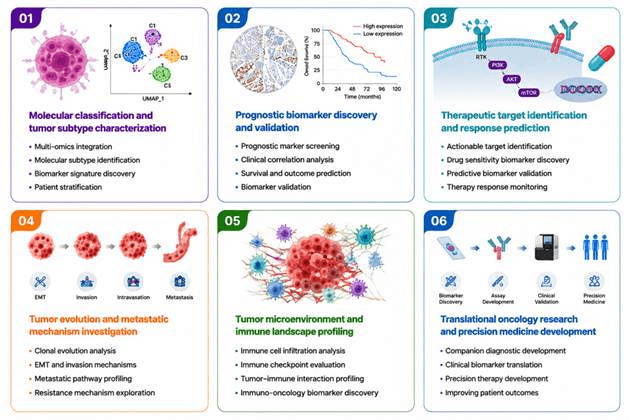
Gynecological cancers, including ovarian, endometrial, cervical, and other female reproductive system malignancies, represent a complex and rapidly evolving field in oncology research. Characterized by extensive molecular heterogeneity, diverse histopathological features, distinct tumor evolution patterns, and variable therapeutic responses, these cancers require advanced biomarker strategies to enable accurate classification, prognostic assessment, and precision treatment development.
Understanding the molecular drivers underlying gynecological cancer progression is essential for improving patient stratification and advancing targeted therapeutic approaches. Prognostic and predictive biomarkers provide critical insights into tumor biology by revealing key alterations associated with hormone receptor signaling, tumor suppressor dysfunction, genomic instability, cell cycle regulation, apoptosis resistance, epithelial–mesenchymal transition (EMT), immune modulation, and oncogenic pathway activation.
Our Gynecological Cancer Biomarker Research Solutions deliver a comprehensive portfolio of highly validated antibody reagents designed to support cutting-edge oncology studies, including:
Gynecological Cancer Prognostic Biomarker Portfolio
——Comprehensive Solutions for Tumor Classification, Prognostic Assessment and Translational Research
Accurate prognostic evaluation requires integrated analysis of tumor suppressive pathways, oncogenic signaling activation, hormone receptor status, and proliferation-associated markers. Our antibody portfolio covers key favorable and unfavorable prognostic biomarkers across major gynecological malignancies.
Biomarker Category | Representative Markers | Research Applications | Biological Significance |
Hormone Receptor Biomarkers | ER, PR | Endometrial and ovarian cancer classification, endocrine therapy studies | Regulate hormone-dependent tumor growth and differentiation |
Tumor Suppressor Markers | PTEN, p53, FOXO1, p27 | Molecular subtype analysis, tumor progression studies | Control genomic stability, apoptosis, and cell cycle regulation |
Cell Adhesion & EMT Markers | E-cadherin (CDH1), L1CAM, Vimentin | Tumor invasion, metastasis, epithelial plasticity studies | Regulate epithelial integrity and metastatic transformation |
Proliferation Biomarkers | Ki-67 (MKI67) | Tumor grading, proliferation assessment, prognosis evaluation | Reflect active cell cycle progression and tumor growth rate |
Growth Factor Signaling Markers | HER2/ERBB2, EGFR | Targeted therapy research, oncogenic pathway analysis | Promote malignant proliferation and survival signaling |
Apoptosis Resistance Markers | Survivin (BIRC5) | Therapy resistance and tumor survival studies | Inhibit apoptosis and promote cancer cell persistence |
Tumor Burden Markers | MUC16 (CA125) | Ovarian cancer monitoring and metastatic research | Associated with tumor burden and disease progression |
DNA Repair Biomarkers | MLH1, PMS2, MSH2, MSH6 | MMR deficiency analysis and immunotherapy research | Associated with mismatch repair (MMR) deficiency, microsatellite instability (MSI) status, and immune checkpoint inhibitor response |
For Research Use Only. Not for use in diagnostic procedures
Key Gynecological Cancer Biomarker Targets
Marker | Biological Function | Prognostic Value | Associated Cancer Types |
ER (Estrogen Receptor) | Hormone receptor regulating proliferation and differentiation | Favorable | Endometrial cancer, ovarian cancer |
PR (Progesterone Receptor) | Hormone-dependent regulator of tumor growth | Favorable | Endometrial cancer, ovarian cancer |
PTEN | Negative regulator of PI3K/AKT signaling | Favorable | Endometrial cancer |
E-cadherin (CDH1) | Maintains epithelial cell adhesion | Favorable | Endometrial, ovarian, cervical cancer |
p27 (CDKN1B) | G1 cell cycle checkpoint inhibitor | Favorable | Endometrial, ovarian cancer |
FOXO1 | Regulates apoptosis and cell cycle arrest | Favorable | Endometrial cancer |
L1CAM | Cell adhesion molecule regulating invasion | Unfavorable (high expression) | Endometrial cancer (also studied in ovarian cancer) |
Ki-67 (MKI67) | Marker of active proliferation | Unfavorable | Endometrial, ovarian, cervical cancer |
p53 (TP53) | p53 abnormal expression pattern reflects TP53 mutation status and is associated with aggressive molecular subtypes and poor prognosis. | Unfavorable | Ovarian, endometrial, cervical cancer |
HER2/ERBB2 | Receptor tyrosine kinase driving proliferation | Unfavorable | Endometrial cancer, ovarian cancer (rare) |
EGFR | Growth factor receptor activating oncogenic pathways | Unfavorable | Ovarian, cervical cancer |
Vimentin (VIM) | EMT-associated cytoskeletal protein | Unfavorable | Endometrial, ovarian, cervical cancer |
MUC16 (CA125) | Tumor-associated glycoprotein | Unfavorable | Ovarian cancer |
Survivin (BIRC5) | Anti-apoptotic regulator promoting survival | Unfavorable | Ovarian, endometrial, cervical cancer |
Featured Research Solutions
——Comprehensive Biomarker Panels for Gynecological Cancer Biology
Endometrial Cancer Prognostic Biomarker Panel——Defining Molecular Features and Clinical Risk Stratification
Favorable Prognostic Markers
ER | PR | PTEN | E-cadherin | p27 | Low L1CAM expression | FOXO1 |
Unfavorable Prognostic Markers
Ki-67 | TP53 mutation pattern | HER2 | Vimentin | High L1CAM expression |
Ovarian Cancer Prognostic Biomarker Panel——Investigating Tumor Progression and Therapeutic Response
Favorable Prognostic Markers
ER | PR | E-cadherin | p27 |
Unfavorable Prognostic Markers
TP53 mutation pattern | HER2 | EGFR | Ki-67 | Survivin | MUC16 | Vimentin |
Cervical Cancer Prognostic Biomarker Panel——Evaluating Tumor Aggressiveness and Disease Progression
Favorable Prognostic Markers
cadherin (CDH1)
Unfavorable Prognostic Markers
Ki-67 | TP53 mutation pattern | EGFR | Vimentin | Survivin |
Gynecological Cancer Biomarker Workflow
——Accelerating Discovery from Molecular Profiling to Prognostic Evaluation
Research Stage | Representative Markers | Scientific Objective |
Hormone Receptor Profiling | ER, PR | Determine hormone-dependent tumor characteristics |
Tumor Suppressor Evaluation | PTEN, TP53, FOXO1, p27 | Analyze genomic stability and tumor suppressive pathways |
Proliferation Assessment | Ki-67 | Evaluate tumor growth activity and aggressiveness |
EMT and Metastasis Analysis | E-cadherin, Vimentin, L1CAM | Investigate invasion and metastatic potential |
Oncogenic Pathway Profiling | HER2/ERBB2, EGFR | Study growth signaling activation and therapeutic targets |
Treatment Resistance Studies | Survivin, MUC16 | Explore apoptosis resistance and disease progression |
The Gynecological Cancer Biomarker Workflow provides a comprehensive research framework spanning molecular profiling, biomarker validation, and prognostic evaluation to advance precision oncology. By integrating hormone receptor analysis , tumor suppressor pathway assessment, and proliferation evaluation, researchers can define tumor characteristics and biological behavior. Further investigation of EMT and metastatic markers, oncogenic signaling pathways, and resistance-associated biomarkers enables deeper understanding of tumor progression, therapeutic response, and mechanisms of treatment resistance. This workflow supports reliable biomarker discovery and translational gynecological cancer research.
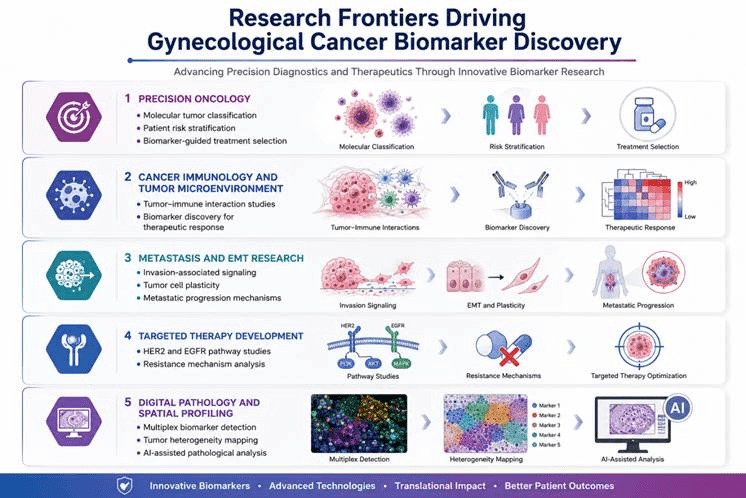
Research Frontiers Driving Gynecological Cancer Biomarker Discovery
Gynecological cancer biomarker research is advancing rapidly through integrated approaches in precision oncology, cancer immunology, metastasis biology, targeted therapy, and spatial profiling technologies. Molecular classification, patient risk stratification, and biomarker-guided treatment strategies enable more personalized cancer management, while tumor–immune interaction studies reveal new opportunities for therapeutic response prediction. Investigations into EMT, invasion signaling, and metastatic evolution provide critical insights into tumor progression and resistance mechanisms. Meanwhile, HER2/EGFR pathway analysis, multiplex biomarker detection, and AI-powered digital pathology are accelerating biomarker discovery and supporting next-generation precision oncology research.
Why Researchers Choose Our Gynecological Cancer Biomarker Solutions?
Validated Markers. Comprehensive Coverage. Confident Translational Research.
Our antibody portfolio supports the complete gynecological cancer biomarker workflow—from molecular characterization and prognostic evaluation to translational oncology research.
Research Challenge | Our Solution |
How can I evaluate tumor prognosis? | Comprehensive favorable and unfavorable prognostic marker panels covering major gynecological cancers |
How can I classify tumor molecular features? | Hormone receptor, tumor suppressor, and oncogenic pathway marker solutions |
How can I assess tumor aggressiveness? | Proliferation, EMT, invasion, and metastasis-associated biomarkers |
How can I support pathological research? | Highly validated antibodies optimized for IHC-based biomarker detection |
How can I improve experimental reproducibility? | Recombinant monoclonal antibodies with excellent specificity and lot-to-lot consistency |

Key References
Ghisoni E., Morotti M., Sarivalasis A., et al. (2024). Immunotherapy for ovarian cancer: towards a tailored immunophenotype-based approach.Nature Reviews Clinical Oncology. 21:801–817.
How J.A., Jazaeri A.A., Westin S.N., et al. (2024).Translating biological insights into improved management of endometrial cancer.Nature Reviews Clinical Oncology. 21:781–800.
Francoeur A.A., Monk B.J., Tewari K.S. (2025).Treatment advances across the cervical cancer spectrum.Nature Reviews Clinical Oncology. 22:182–199.
Yanaihara N. (2025).Immune checkpoint inhibitors in gynecologic oncology: Current status and perspectives.International Journal of Gynecology & Obstetrics. 171:166-188.
Koshkimbayeva G., Amirkhanova A., Orazymbetova A., et al. (2025). Recent therapeutic advances in gynecologic oncology: evolving roles of immunotherapy, antibody–drug conjugates, and clinical trial innovations. Frontiers in Oncology.15:166-188.
Wang Y.W., Allen I., Funingana G., et al. (2025). Predictive biomarkers for the efficacy of PARP inhibitors in ovarian cancer: an updated systematic review.BJC Rep. 11;3:14.
The Cancer Genome Atlas Research Network. (2013). Integrated genomic characterization of endometrial carcinoma. Nature. 497:67–73.
Cancer Genome Atlas Research Network. (2011). Integrated genomic analyses of ovarian carcinoma. Nature. 474:609–615.
How J.A., Jazaeri A.A., Westin S.N., et al. (2024). Translating biological insights into improved management of endometrial cancer. Nature Reviews Clinical Oncology. 21:781–800.