
info@mail.ucallm.com
Decoding Chromatin Dynamics and Epigenetic Regulation — Empowering Reliable Histone Profiling with Validated Antibody Solutions
Histones are fundamental chromatin-associated proteins that organize genomic DNA into nucleosomes and regulate genome accessibility, transcriptional activity, DNA repair, and epigenetic inheritance. Through dynamic post-translational modifications (PTMs) and histone variant exchange, histones serve as key regulators of cellular identity, development, differentiation, and disease progression.
Aberrant histone regulation, including altered histone modifications, variant redistribution, and chromatin remodeling defects, contributes to diverse biological processes and pathological conditions including cancer, developmental disorders, aging, and neurological diseases.
Our Histone & Chromatin Research Solutions provide highly validated antibodies targeting core histones, histone variants, and epigenetic regulatory states, supporting comprehensive applications including:
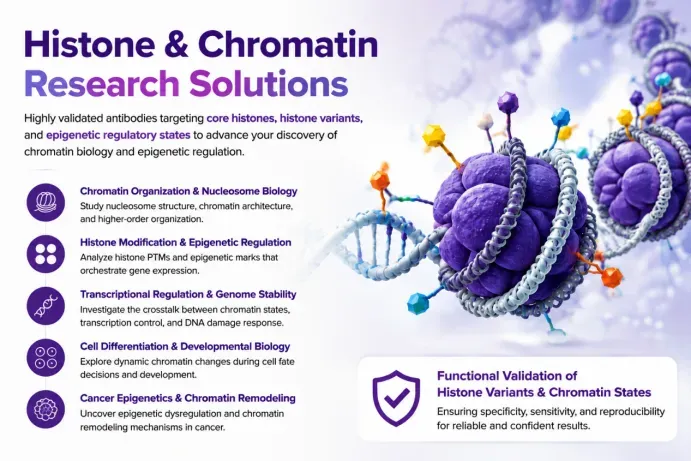
Compatible with ChIP-qPCR, ChIP-seq, IHC, WB, ICC/IF and multiplex imaging applications, our antibody solutions enable reliable characterization of histone expression, localization, and epigenetic regulation from basic discovery to translational research.
Histone Antibody Portfolio
——Comprehensive Solutions for Chromatin Structure, Epigenetic Regulation and Genome Function
Accurate chromatin profiling requires integrated analysis of core histones, histone variants, and modification-specific epigenetic states. Our antibody portfolio covers major histone research categories to support diverse chromatin biology workflows.
Research Category | Representative Targets | Research Applications | Biological Significance |
Core Histone Profiling | Histone H3, Histone H4, Histone H2A, Histone H2B | Chromatin composition analysis; nucleosome profiling; total histone quantification | Defines fundamental chromatin structure and nucleosome organization |
Histone Variant Characterization | H2A.Z, macroH2A.1 (H2AFY), macroH2A.2 (H2AFY2), CENPA, H3.3 | Variant deposition studies; developmental regulation; cell identity analysis | Reveals specialized chromatin states associated with transcription, differentiation, and chromosome stability |
DNA Damage & Genome Stability Markers | γH2AX (phospho-H2AX), H2AX | DNA damage response studies; replication stress analysis; genome integrity research | Monitors chromatin remodeling during DNA repair and genomic stress |
Histone Modification Research | Acetylated H3/H4, methylated H3/H4, phosphorylated histones | Epigenetic profiling; ChIP-seq; transcriptional regulation studies | Decodes histone PTM patterns controlling chromatin accessibility and gene expression |
Chromatin Remodeling & Epigenetic Regulation | Histone variant-associated regulators; chromatin-associated proteins | Epigenetic mechanism studies; transcription factor interaction analysis | Defines regulatory networks controlling cell fate and disease progression |
Disease-Associated Chromatin Research | H3 variants, H2AFY, CENPA, γH2AX | Cancer epigenomics; aging; developmental disorders; genome instability studies | Links altered chromatin states with pathological transcriptional programs |
Key Histone Biomarker Targets
——Molecular Functions and Research Applications
Marker | Biological Function | Major Research Areas |
Histone H3 | Core nucleosome component regulating DNA packaging and transcriptional accessibility | Chromatin biology, transcription regulation, cancer epigenetics |
Histone H4 | Highly conserved nucleosome structural protein essential for chromatin assembly | Genome organization, epigenetic regulation |
Histone H2A / H2B | Core histones controlling nucleosome stability and higher-order chromatin folding | Chromatin dynamics, transcriptional regulation |
Histone H2AX | DNA damage-responsive histone variant phosphorylated after double-strand breaks | Genome stability, cancer therapy response, radiation biology |
γH2AX (Ser139 Phosphorylated H2AX) | Activated DNA damage signaling marker forming repair-associated chromatin domains | DNA repair mechanisms, aging, cancer research |
Histone H3.3 | Replication-independent histone variant associated with active chromatin regions | Developmental biology, stem cell research, tumor evolution |
CENPA | Centromere-specific H3 variant directing kinetochore formation and chromosome segregation | Cell division, aneuploidy, cancer progression |
H2A.Z | Histone H2A variant regulating promoter accessibility and transcriptional balance | Transcription regulation, development, immune biology |
macroH2A.1 (H2AFY) | Large histone H2A variant enriched in stable repressive chromatin domains | X-chromosome regulation, differentiation, cancer epigenetics |
macroH2A.2 (H2AFY2) | Histone variant involved in chromatin compaction and transcriptional repression | Development, aging, tumor biology |
Histone H1 | Linker histone regulating nucleosome spacing and chromatin compaction | Genome organization, transcriptional control |
Featured Histone Research Panels
——Integrated Antibody Solutions for Comprehensive Chromatin Analysis
n Core Chromatin Structure Panel—Characterizing Nucleosome Organization and Histone Abundance
Key Markers
Histone H3 | Histone H2A | Histone H2B | Histone H4 |
n DNA Damage Response Histone Panel—Monitoring Genome Stability and Repair Activation
Key Markers
γH2AX | Histone H3 | Histone H2A |
n Histone Variant & Chromatin Remodeling Panel—Investigating Specialized Chromatin Domains
Key Markers
H3.3 | H2A.Z | CENPA | macroH2A.1 | macroH2A.2 |
n Epigenetic Modification Research Panel—Decoding Histone-Based Gene Regulation
Key Markers
H3K27ac | H3K9ac | H3K4me3 | H3K27me3 | H3K9me3 | γH2AX | H3S10ph |
Histone & Chromatin Epigenetic Research
——From Chromatin Profiling to Epigenetic Discovery
Research Stage | Representative Markers | Scientific Objective |
Chromatin Structure Analysis | H3, H2A, H2B, H4 | Define nucleosome organization and histone abundance |
DNA Damage Assessment | γH2AX, H2AFX | Monitor genome damage and repair responses |
Histone Variant Profiling | H3.3, CENPA, H2A.Z, macroH2A | Identify specialized chromatin states |
Epigenetic Regulation Studies | Modified histone antibodies | Analyze transcriptional regulation mechanisms |
Functional Chromatin Validation | Histone antibodies + ChIP-based assays | Connect histone states with gene regulation |
We provides comprehensive histone research solutions enabling systematic analysis of chromatin organization, genome stability, and epigenetic regulation. By leveraging validated antibodies against core histones, histone variants, and post-translationally modified histone marks, researchers can investigate nucleosome architecture, DNA damage responses, specialized chromatin states, and transcriptional control mechanisms. Integrated approaches combining histone profiling with ChIP-based technologies further connect chromatin dynamics with gene regulation and cellular function. These solutions support advanced studies in epigenetics, cancer biology, development, aging, and disease-associated chromatin remodeling.
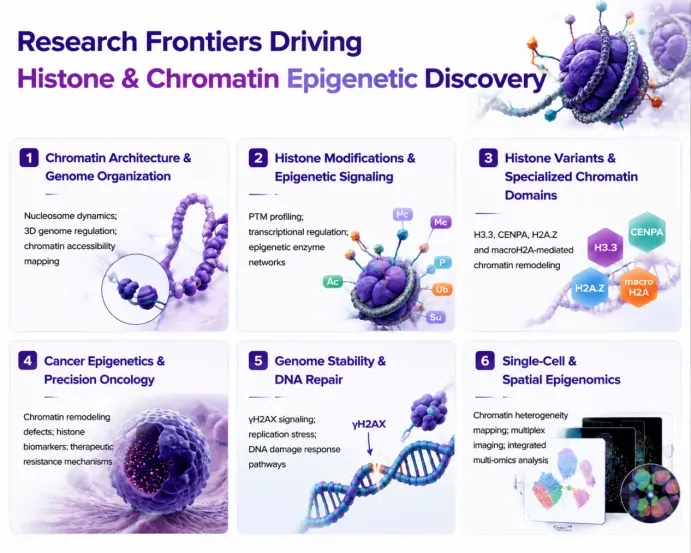
Research Frontiers Driving Histone & Chromatin Epigenetic Discovery
We support cutting-edge epigenetic research by enabling comprehensive investigation of chromatin organization, histone regulation, and genome function. Validated histone antibodies facilitate studies of nucleosome dynamics, chromatin accessibility, post-translational modifications, and specialized chromatin domains mediated by histone variants. These tools empower researchers to explore cancer-associated epigenetic alterations, DNA damage responses, genome stability mechanisms, and therapeutic resistance pathways. Combined with single-cell and spatial epigenomics approaches, our solutions enable high-resolution mapping of chromatin heterogeneity and multi-omics integration, accelerating discoveries in gene regulation, precision oncology, development, and disease biology.
Why Researchers Choose Our Histone Research Solutions?
Validated Targets. Comprehensive Coverage. Reliable Epigenetic Research.
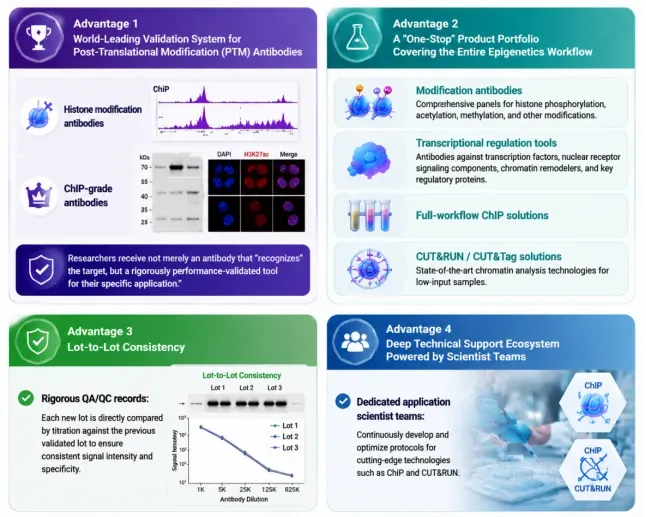
Our histone antibody portfolio supports complete chromatin research workflows, from basic nucleosome biology to advanced epigenomic analysis.
Research Challenge | Our Solution |
How can I characterize chromatin organization? | Core histone antibodies covering H3, H2A, H2B, and H4 for reliable nucleosome analysis |
How can I monitor DNA damage responses? | γH2AX antibodies validated for genome stability and repair studies |
How can I study histone variants? | Comprehensive variant panels covering H3.3, CENPA, H2A.Z, and macroH2A proteins |
How can I investigate epigenetic regulation? | Modification-specific antibodies for chromatin state profiling |
How can I improve experimental reproducibility? | Highly validated antibodies optimized for IHC, WB, ICC/IF, and ChIP applications |
Key References
1. Wong L.H., Tremethick D.J. (2025).Multifunctional histone variants in genome function.Nature Reviews Genetics. 26:82–104.
2. Hananya N., Koren S., Muir T.W. (2024).Interrogating epigenetic mechanisms with chemically customized chromatin.Nature Reviews Genetics. 25:255–271.
3. Policarpi C., et al. (2024).Systematic epigenome editing captures the context-dependent instructive function of chromatin modifications.Nature Genetics. 56:1168–1180.
4. Gourisankar S., et al. (2024).Context-specific functions of chromatin remodellers in development and disease.Nature Reviews Genetics. 25:340–361.