
info@mail.ucallm.com
From ECM Architecture to Cell–Matrix Signaling — Empowering Comprehensive Laminin Profiling with Validated Antibody Solutions
Laminin Biology Overview
——Decoding the Molecular Framework of Basement Membrane Organization
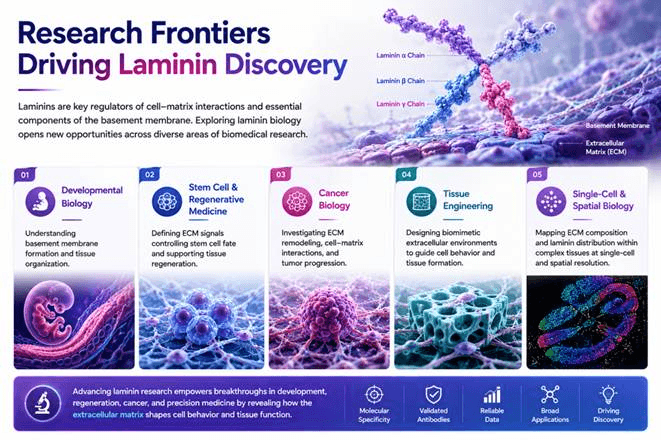
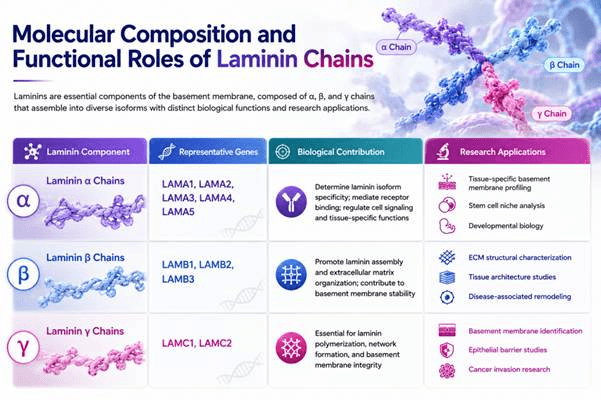
Laminins are essential extracellular matrix (ECM) glycoproteins that serve as core structural and signaling components of basement membranes. Through combinatorial assembly of α, β, and γ chain subunits, laminins generate diverse isoforms with distinct tissue distributions, receptor interactions, and biological functions.Disruption of laminin expression or assembly compromises basement membrane integrity and contributes to developmental defects, hereditary disorders, neurological diseases, muscular dystrophies, and cancer progression.
We support advanced laminin research by enabling precise investigation of extracellular matrix organization, basement membrane biology, and cell–matrix communication across diverse research fields. Laminin-based studies provide critical insights into developmental processes, stem cell niche regulation, tissue regeneration, and biomimetic tissue engineering. In cancer research, laminin profiling reveals ECM remodeling mechanisms that drive tumor invasion, metastasis, and microenvironment adaptation. Combined with single-cell and spatial biology approaches, laminin analysis enables high-resolution mapping of ECM composition and cellular interactions within complex tissues, accelerating discoveries in developmental biology, regenerative medicine, oncology, and precision tissue research.
Laminin Isoform Marker Portfolio Composition
————Comprehensive Tools for Tissue-Specific Basement Membrane Characterization
Our Laminin Marker Panel provides researchers with validated antibodies targeting major laminin subunits, enabling:
ECM composition → Cellular signaling → Biological function
Marker Category | Representative Targets | Applications | Research Focus |
Developmental Laminin Isoform Markers | Laminin-111 (LAMA1/LAMB1/LAMC1) | Developmental biology, embryogenesis, stem cell culture | Characterization of early basement membrane formation, tissue morphogenesis, and extracellular matrix regulation during development |
Muscle & Neural Basement Membrane Markers | Laminin-211 (LAMA2/LAMB1/LAMC1) | Muscle biology, neuromuscular development, nervous system research | Investigation of specialized basement membrane organization, neuronal support, and muscle integrity maintenance |
Epithelial & Cancer-Associated Laminin Markers | Laminin-332 (LAMA3/LAMB3/LAMC2) | Epithelial biology, wound healing, cancer invasion and metastasis studies | Analysis of epithelial adhesion, basement membrane remodeling, tumor cell migration, and invasive progression |
Vascular Basement Membrane Markers | Laminin-411 (LAMA4/LAMB1/LAMC1) | Angiogenesis, vascular biology, endothelial research | Characterization of vascular basement membrane composition, endothelial adhesion, and tissue barrier regulation |
Stem Cell Niche & Regeneration Markers | Laminin-511 (LAMA5/LAMB1/LAMC1) | Stem cell maintenance, organoid culture, regenerative medicine | Investigation of ECM-mediated stem cell self-renewal, lineage specification, and tissue regeneration mechanisms |
Featured Research Solutions
——Comprehensive Laminin Panels for ECM Biology
Our laminin marker solutions support researchers in investigating basement membrane function across development, regeneration, and disease.
Basement Membrane Mapping——Visualizing ECM Organization and Tissue Architecture
Key Markers
LAMA1 | LAMB1 | LAMC1 |
Stem Cell Niche Research——Understanding ECM Control of Stem Cell Behavior
Key Markers
LAMA1 | LAMA2 | LAMA5 | LAMC1 |
Neural and Muscle Development——Investigating Specialized Basement Membrane Functions
Key Markers
LAMA2 | LAMB2 | LAMC1 |
Tumor Microenvironment & Cancer Invasion——Investigating basement membrane remodeling, epithelial invasion and metastatic progression.
Key Markers
Laminin-332 (LAMA3/LAMB3/LAMC2) | Laminin-511 (LAMA5) | Integrin α6β4 | Integrin α3β1 | MMP2/MMP9 |
Laminin & Basement Membrane Research
From Target Selection to Functional ECM Analysis
Research Stage | Recommended Markers | Research Objective |
Tissue Model Selection | Tissue-specific laminin targets | Define appropriate laminin isoforms |
Basement Membrane Identification | LAMA/LAMB/LAMC markers | Characterize ECM architecture |
ECM Network Validation | Laminins + Collagen IV + Nidogen | Confirm basement membrane integrity |
Cell–Matrix Interaction Studies | Laminins + receptor markers | Investigate ECM signaling |
Disease Mechanism Studies | Altered laminin expression | Identify pathological remodeling |
We provide comprehensive laminin research solutions enabling systematic investigation of basement membrane composition, ECM organization, and cell–matrix communication. By selecting tissue-specific laminin markers, researchers can define laminin isoform distribution and characterize extracellular matrix architecture. Integrated analysis of laminins with complementary ECM components, such as collagen IV and nidogen, supports validation of basement membrane integrity and structural remodeling. Combined with receptor profiling, laminin studies reveal mechanisms underlying cell adhesion, signaling regulation, tissue development, and disease-associated ECM alterations, accelerating discoveries in cancer biology, developmental research, fibrosis, and regenerative medicine.
Why Researchers Choose Our Laminin Marker Solutions?
Validated Markers. Comprehensive ECM Coverage. Confident Discovery.
Our Laminin Marker Panel provides researchers with reliable tools to investigate ECM biology from molecular composition to tissue function.
Research Challenge | Our Solution |
"How can I identify basement membrane components?" | Comprehensive laminin α, β, and γ chain antibody coverage |
"How do I analyze tissue-specific ECM organization?" | Validated antibodies supporting IHC and imaging applications |
"How can I study ECM remodeling?" | Laminin markers compatible with integrated ECM profiling |
"How do I improve reproducibility?" | Our monoclonal antibodies with consistent performance |
"How can I connect ECM structure with cell behavior?" | Laminin solutions supporting cell–matrix signaling studies |
Key References
Nonnast E., Mira E., Mañes S. (2024).Biomechanical properties of laminins and their impact on cancer progression.Biochimica et Biophysica Acta (BBA) – Reviews on Cancer. 1879(6):189181.
Naba A. (2024).Mechanisms of assembly and remodelling of the extracellular matrix.Nature Reviews Molecular Cell Biology. 25:865–885.
Yurchenco P.D., Kulczyk A.W. (2024).Polymerizing laminins in development, health, and disease.Journal of Biological Chemistry. 300(7):107429.
Nonnast E., Mira E., Mañes S. (2025).The role of laminins in cancer pathobiology: a comprehensive review.Journal of Translational Medicine. 23:83.
Nasrollahi A., Yao Y. (2025).Laminins and the Blood-Brain Barrier.Matrix Biology. 137:33–41.
Miner J.H., Yurchenco P.D.(2004). Laminin functions in tissue morphogenesis. Annual Review of Cell and Developmental Biology.20:255-84.