
info@mail.ucallm.com
From MSC Identity to Regenerative Applications — Empowering Comprehensive Mesenchymal Stem Cell Characterization with Validated Biomarker Antibodies
Mesenchymal stem cells (MSCs) are multipotent adult stem cells with the unique ability to self-renew and differentiate into diverse mesenchymal lineages, including osteogenic, chondrogenic, adipogenic, and myogenic cell types. Through their regenerative capacity, immunomodulatory properties, and paracrine signaling functions, MSCs have emerged as key cellular platforms in regenerative medicine, tissue engineering, disease modeling, and advanced cell-based therapies.
Accurate identification and functional evaluation of MSC populations require precise molecular characterization of stem cell identity, surface phenotype, lineage commitment, and differentiation status. Reliable biomarkers enable researchers to define MSC properties, monitor expansion and quality, validate differentiation potential, and investigate mechanisms underlying tissue repair and therapeutic efficacy.
We support advanced mesenchymal stem cell (MSC) research by enabling comprehensive investigation of stem cell identity, regenerative potential, tissue repair, cellular aging, and microenvironmental regulation. Validated MSC marker solutions empower researchers to characterize MSC populations, investigate differentiation and lineage commitment, evaluate stem cell quality and therapeutic potential, and dissect mechanisms underlying bone, cartilage, and musculoskeletal regeneration.
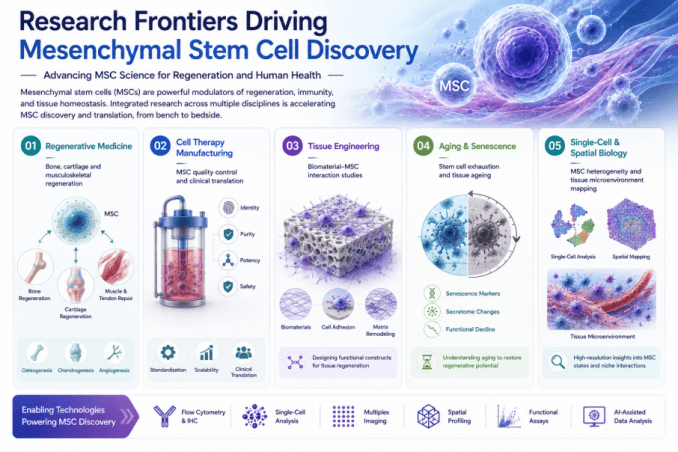
Mesenchymal Stem Cell Marker Portfolio
——Comprehensive Solutions for MSC Identification, Characterization and Differentiation
Reliable MSC research begins with precise marker selection. Our portfolio includes internationally recognized positive and negative MSC markers together with lineage-specific differentiation markers, supporting every stage of stem cell research.
Marker Category | Representative Markers | Research Applications | Biological Role |
Canonical Positive MSC Markers | CD73 (NT5E), CD90 (Thy-1), CD105 (ENG) | MSC identification, ISCT characterization, cell authentication | Standard positive markers defining MSC identity |
Cell Adhesion & Stromal Markers | CD29 (ITGB1), CD44, CD54 (ICAM1), CD106 (VCAM1), CD166 (ALCAM) | Cell adhesion, migration, stromal biology, immunomodulation | Cell–matrix interaction and tissue homeostasis |
Perivascular MSC Markers | CD146 (MCAM), CSPG4 (NG2), PDGFRβ | Pericyte biology, vascular regeneration, tissue-resident MSC studies | Perivascular niche maintenance and angiogenesis |
Osteogenic Differentiation | RUNX2, OSX (SP7), RUNX3 | Bone regeneration, skeletal biology, osteogenesis | Osteoblast differentiation and bone matrix formation |
Chondrogenic Differentiation | SOX9, SOX6, GDF-5 | Cartilage regeneration, musculoskeletal research | Chondrocyte commitment and extracellular matrix synthesis |
Adipogenic Differentiation | PPARγ, FABP4, Adiponectin, LPL | Adipose tissue engineering, metabolic disease research | Adipocyte maturation and lipid metabolism |
Myogenic Differentiation | MYOG | Skeletal muscle regeneration | Muscle lineage specification |
Negative MSC Markers (ISCT Criteria) | CD34, CD45, CD11b, CD14, CD31, CD79α, HLA-DR | Cell quality control, contamination exclusion, clinical manufacturing | Exclusion of hematopoietic, endothelial and immune cell populations |
Key Mesenchymal Stem Cell Biomarker Targets
——Comprehensive Solutions for MSC Identification, Differentiation, and Regenerative Medicine Research
Marker | Biological Function | Research Value | Associated MSC Applications |
CD73 (NT5E) | Ectonucleotidase involved in extracellular adenosine production and immunomodulation | Key positive MSC surface marker for MSC identification and immunophenotyping | Human MSC characterization, flow cytometry-based MSC validation |
CD90 (Thy-1) | Cell surface glycoprotein associated with MSC adhesion, migration, and stemness maintenance | Defines MSC populations and evaluates stem cell properties | Bone marrow MSCs, adipose-derived MSCs, tissue regeneration studies |
CD105 (Endoglin) | TGF-β co-receptor regulating angiogenesis and mesenchymal lineage development | Core MSC marker for confirming multipotent stromal cell identity | MSC isolation, expansion monitoring, regenerative medicine research |
CD44 | Hyaluronic acid receptor involved in cell adhesion, migration, and stemness regulation | Evaluates MSC self-renewal capacity and interaction with extracellular matrix | MSC biology, tissue repair, cancer stem cell comparison studies |
CD146 (MCAM) | Cell adhesion molecule associated with perivascular MSC identity and vascular niche regulation | Identifies highly regenerative MSC subpopulations | Perivascular MSC studies, angiogenesis, tissue engineering |
STRO-1 | Surface antigen enriched in early mesenchymal progenitor populations | Enables identification of primitive MSC populations | MSC isolation and progenitor cell characterization |
Vimentin | Intermediate filament protein maintaining mesenchymal cell architecture | Confirms mesenchymal phenotype and cellular transition status | MSC identification, EMT comparison, differentiation studies |
Nestin | Intermediate filament protein expressed in progenitor and immature stem cell populations | Characterizes multipotent progenitor states and regenerative potential | Neural MSC research, tissue regeneration models |
RUNX2 | Master transcription factor controlling osteogenic differentiation | Evaluates commitment toward osteoblast lineage | Osteogenic differentiation assays, bone regeneration research |
Osteocalcin (BGLAP) | Bone matrix protein produced by mature osteoblasts | Confirms terminal osteogenic differentiation and maturation | MSC-derived osteoblast formation, bone tissue engineering |
PPARγ | Nuclear receptor regulating adipocyte differentiation | Determines adipogenic lineage commitment of MSCs | MSC adipogenic differentiation studies |
FABP4 | Fatty acid-binding protein expressed during adipocyte maturation | Validates mature adipocyte differentiation | Adipose-derived MSC differentiation research |
SOX9 | Transcription factor controlling chondrogenic lineage development | Evaluates cartilage differentiation potential | MSC chondrogenesis and cartilage regeneration |
Aggrecan (ACAN) | Extracellular matrix proteoglycan essential for cartilage formation | Confirms mature chondrocyte differentiation | Cartilage tissue engineering and regenerative medicine |
α-SMA (ACTA2) | Actin isoform associated with contractile mesenchymal phenotypes | Studies MSC differentiation toward myofibroblast-like states | Fibrosis research, wound healing, stromal biology |
ALDH1A1 | Enzyme associated with cellular protection, metabolism, and stem-like properties | Evaluates MSC functional state and regenerative capacity | Stem cell quality assessment and therapeutic development |
Featured Research Solutions
——Comprehensive Marker Panels for MSC Biology
Our validated marker panels help researchers confidently characterize MSC identity, evaluate differentiation potential, and ensure high-quality stem cell preparations throughout regenerative medicine workflows.
n MSC Identification——Defining Authentic Mesenchymal Stem Cell Identity
Key Markers
CD73 | CD90 | CD105 | CD44 | CD29 | CD146 |
n Osteogenic Differentiation——Tracking Bone Lineage Commitment and Maturation
Key Markers
RUNX2 | SP7 | RUNX3 | ALP | Osteocalcin |
n Chondrogenic Differentiation——Monitoring Cartilage Lineage Specification
Key Markers
SOX9 | SOX6 | GDF5 | Aggrecan (ACAN) | Collagen II |
Mesenchymal Stem Cell Research
——Accelerating MSC Discovery from Isolation to Functional Characterization
Research Stage | Representative Markers | Scientific Objective |
MSC Isolation & Enrichment | CD73 (NT5E), CD90 (Thy-1), CD105 (ENG), CD146 (MCAM) | Identify and enrich authentic mesenchymal stem cell populations from tissue sources |
MSC Identity Validation | CD44, CD29 (ITGB1), CD166 (ALCAM), STRO-1 | Confirm MSC surface phenotype and establish cellular identity |
MSC Quality Control & Purity Assessment | CD45, CD34, CD14, CD31 | Exclude hematopoietic and endothelial contamination to ensure MSC preparation quality |
Self-Renewal & Functional State Analysis | Nestin, Vimentin, ALDH1A1, Ki-67 | Evaluate MSC maintenance, proliferative capacity, and regenerative potential |
Multilineage Differentiation Assessment | RUNX2, SP7 (Osterix), SOX9, PPARγ, MYOG | Characterize osteogenic, chondrogenic, adipogenic, and myogenic differentiation capacity |
Immunomodulation & Tissue Repair Research | CD146, VCAM1, ICAM1, α-SMA | Investigate MSC-mediated immune regulation, cell interaction, and tissue regeneration mechanisms |
The MSC Research Workflow provides a comprehensive framework for characterizing mesenchymal stem cells from initial isolation and identity confirmation to differentiation and functional assessment. By integrating key MSC biomarkers, researchers can accurately identify authentic MSC populations, evaluate cellular purity and quality, monitor self-renewal capacity, and validate multilineage differentiation potential. Comprehensive marker analysis, including MSC surface markers, lineage-specific regulators, and functional molecules, enables deeper understanding of MSC biology, immunomodulatory properties, and regenerative mechanisms. These solutions support advanced applications in cell therapy development, tissue engineering, regenerative medicine, and translational stem cell research.
Why Researchers Choose Our MSC Marker Solutions?
Validated Markers. Comprehensive Coverage. Confident Stem Cell Research.
Our recombinant antibody portfolio is designed to support the complete MSC research workflow—from stem cell isolation and identity verification to lineage differentiation and translational applications.
Research Challenge | Our Solutions |
"How do I identify authentic MSCs?" | ISCT-recommended positive marker panel (CD73, CD90, CD105) validated across multiple applications |
"How do I exclude contaminating cells?" | Complete negative marker panel including CD45, CD34, CD14, CD31 and HLA-DR for rigorous quality control |
"How can I monitor lineage differentiation?" | Differentiation marker antibodies covering osteogenic, chondrogenic and myogenic pathways |
"How do I improve experimental reproducibility?" | Recombinant monoclonal antibodies with exceptional specificity and lot-to-lot consistency |
"How can I study MSC function in disease?" | Functional markers supporting regeneration, immunomodulation, angiogenesis and tissue repair research |
Key References
1. Rauch A., Mandrup S. (2021).Transcriptional networks controlling stromal cell differentiation.Nature Reviews Molecular Cell Biology. 22:465–482.
2. Caplan A.I. (2017).Mesenchymal Stem Cells: Time to Change the Name! Stem Cells Translational Medicine. 6:1445-1451.
3. Wang Y., Chen X., Cao W., Shi Y. (2014).Plasticity of mesenchymal stem cells in immunomodulation: pathological and therapeutic implications.Nature Immunology. 15: 1009–1016.
4. Costa L.A., et al. (2024).Mesenchymal Stromal Cell-Based Products: Challenges and Clinical Therapeutic Options.International Journal of Molecular Sciences. 25:6063.
5. Settembre C., Perera R.M. (2024).Lysosomes as coordinators of cellular catabolism, metabolic signalling and organ physiology.Nature Reviews Molecular Cell Biology. 25:223–245.