
info@mail.ucallm.com
From Molecular Classification to Precision Gynecologic Oncology — Empowering Reliable Ovarian Cancer Profiling with Validated Antibody Solutions
Ovarian cancer represents the most lethal gynecologic malignancy, characterized by substantial molecular heterogeneity, complex histological diversity, late-stage diagnosis, and highly variable therapeutic responses. Despite the clinical application of serum biomarkers such as CA125, limitations in sensitivity and specificity remain major challenges for early detection, tumor classification, and personalized treatment strategies.
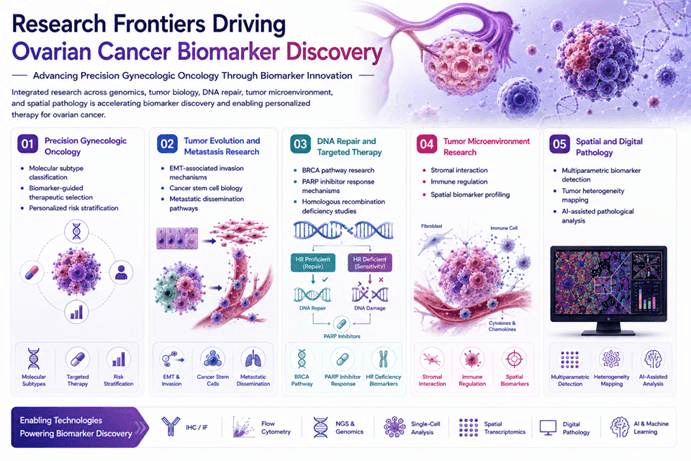
We support advanced ovarian cancer biomarker research by enabling comprehensive investigation of tumor heterogeneity, molecular classification, tumor evolution, DNA repair mechanisms, immune regulation, and spatial tumor biology. Validated biomarker solutions empower researchers to characterize molecular subtypes, evaluate disease risk, investigate EMT and cancer stemness, and uncover metastatic mechanisms underlying tumor progression and therapeutic response. Combined with BRCA pathway analysis, homologous recombination deficiency profiling, multiplex detection, spatial profiling, and AI-assisted digital pathology, ovarian cancer biomarker research enables high-resolution characterization of tumor heterogeneity, DNA repair status, tumor–microenvironment interactions, and clinically relevant molecular phenotypes. These integrated approaches accelerate discoveries in precision gynecologic oncology, biomarker-guided therapeutic development, targeted therapy, tumor evolution, and next-generation precision medicine.
Ovarian Cancer Biomarker Antibody Portfolio
——Comprehensive Solutions for Tumor Classification, Prognosis Evaluation and Translational Research
Accurate ovarian cancer characterization requires integrated analysis of tumor lineage markers, metastatic signatures, molecular alterations, and clinical biomarkers. Our antibody portfolio covers major ovarian cancer biomarker categories to support
standardized research workflows.
Biomarker Category | Representative Markers | Research Applications | Biological Significance |
Prognostic & Metastasis Markers | L1CAM, CD44, Claudin-3, Claudin-4, MRC2, Vimentin | Tumor invasion, recurrence, survival analysis | Reflect tumor aggressiveness, metastatic potential, and therapy resistance |
Differential Diagnosis (Primary vs. Metastasis) | PAX8, CK7, CK20, CDX2, GCDFP-15, WT1 | Primary vs. metastatic tumor discrimination; tissue-of-origin identification in secondary ovarian lesions | Discriminate ovarian primary from gastrointestinal, breast, or other metastases |
Ovarian Cancer Subtype Markers | WT1, PAX8, NAPSA, FOXL2, CALB2, HNF1B | Histological classification and tumor origin identification | Define molecular characteristics of distinct ovarian cancer subtypes |
Metastasis Differential Markers | CDX2, CK7, CK20, GCDFP-15, SMAD4 (DPC4) | Primary ovarian cancer versus metastatic tumor discrimination | Identify tissue origin of metastatic lesions |
Clinical & Molecular Markers | MUC16 (CA125), WFDC2 (HE4), ER, PR | Biomarker profiling and therapeutic research | Support diagnosis, monitoring, hormone response analysis, and pathway studies |
Genomic Alteration Markers | TP53, ARID1A, KRAS, BRCA1/2, PTEN | Mutation-associated tumor biology studies | Reveal mechanisms of tumor initiation and progression |
Neuroendocrine & Specialized Markers | NCAM1, GSPT1 | Rare ovarian tumor characterization | Support specialized pathological research |
For Research Use Only. Not for use in diagnostic procedures
Key Ovarian Cancer Biomarker Targets
——Molecular Functions and Research Applications
Marker | Biological Function | Research Value | Associated Ovarian Cancer Types |
L1CAM | Cell adhesion molecule promoting migration and invasion | Prognostic evaluation and metastatic mechanism studies | High-grade serous ovarian carcinoma |
CD44 | Cancer stem cell-associated adhesion receptor | Recurrence and treatment resistance research | Endometrioid and serous ovarian cancer |
CLDN3 / CLDN4 | Tight junction proteins involved in epithelial tumor progression | Tumor classification and prognosis studies | High-grade serous, low-grade serous, endometrioid carcinoma |
MRC2 | Extracellular matrix remodeling receptor | Invasion and poor outcome analysis | Serous ovarian cancer |
WT1 | Nuclear transcription factor defining serous lineage | Histological subtype identification | High-grade and low-grade serous carcinoma |
NAPSA | Lung/renal-associated differentiation marker | Clear cell carcinoma identification | Ovarian clear cell carcinoma |
FOXL2 | Granulosa cell lineage transcription factor | Sex cord-stromal tumor diagnosis | Granulosa cell tumor |
CALB2 | Calcium-binding protein marker | Sex cord-stromal tumor characterization | Granulosa cell tumor |
WFDC2 (HE4) | Secreted glycoprotein biomarker | Diagnostic and monitoring studies | Serous and endometrioid ovarian cancer |
MUC16 (CA125) | Tumor-associated glycoprotein | Disease monitoring and tumor burden assessment | Epithelial ovarian cancer |
CDX2 | Intestinal differentiation transcription factor | Identification of colorectal metastasis to ovary | Metastatic colorectal carcinoma |
CK7 / CK20 | Cytokeratin expression pattern markers | Primary versus metastatic tumor discrimination | Epithelial ovarian tumors |
HNF1B | Transcription factor associated with clear cell phenotype | Clear cell carcinoma classification | Ovarian clear cell carcinoma |
ER / PR | Hormone receptors regulating proliferation | Hormonal pathway and prognosis studies | Serous and endometrioid ovarian cancer |
TP53 | Tumor suppressor controlling genomic stability | Molecular subtype characterization | High-grade serous carcinoma |
ARID1A | Chromatin remodeling regulator | Epigenetic alteration studies | Clear cell and endometrioid carcinoma |
BRCA1/2 | DNA repair regulators | Homologous recombination deficiency research | High-grade serous carcinoma |
PTEN | PI3K/AKT pathway inhibitor | Tumor suppressor pathway analysis | Endometrioid and clear cell carcinoma |
PAX8 | Müllerian lineage transcription factor | Essential for identifying primary ovarian | Serous, endometrioid, clear cell carcinoma |
Vimentin | Type III intermediate filament, marker of EMT | Type III intermediate filament, marker of EMT | Type III intermediate filament, marker of EMT |
Featured Ovarian Cancer Research Panels
—Integrated Biomarker Solutions for Comprehensive Tumor Characterization
High-Grade Serous Ovarian Cancer (HGSC) Profiling Panel—Defining Molecular Identity and Aggressive Tumor Biology
Key Markers
WT1 | TP53 | PAX8 | CK7 | BRCA1/2 | Ki-67 |
Ovarian Clear Cell Carcinoma Panel—Characterizing Distinct Molecular Features of Clear Cell Tumors
Key Markers
NAPSA | HNF1B | ARID1A | PTEN | MUC16 |
Ovarian Cancer Metastasis & Invasion Panel—Investigating Tumor Dissemination and Recurrence Mechanisms
Key Markers
L1CAM | CD44 | CLDN3 | MRC2 | Vimentin |
Primary Ovarian vs. Metastatic Carcinoma Differential Panel—Resolving Diagnostic Challenges in Secondary Ovarian Lesions
Key Markers
PAX8 | WT1 | CK7 | CK20 | CDX2 | GCDFP-15 |
Ovarian Cancer Biomarker Research
——From Molecular Profiling to Translational Discovery
Research Stage | Representative Markers | Scientific Objective |
Tumor Classification | WT1, NAPSA, FOXL2, HNF1B | Define ovarian cancer molecular subtypes |
Prognostic Evaluation | L1CAM, CD44, CLDN3, MRC2 | Assess invasion potential and clinical outcome |
Hormone Signaling Analysis | ER, PR | Investigate endocrine regulation pathways |
Genomic Alteration Studies | TP53, BRCA1/2, ARID1A | Study tumor evolution and DNA repair mechanisms |
Metastasis Identification | CDX2, CK7, CK20 | Determine primary versus metastatic origin |
Therapeutic Biomarker Research | PTEN, HER pathway markers, BRCA pathway markers | Evaluate targeted treatment opportunities |
The Ovarian Cancer Biomarker Research Workflow integrates molecular classification, prognostic evaluation, genomic profiling, and therapeutic biomarker discovery to advance precision gynecologic oncology. By analyzing key markers including WT1, FOXL2, HNF1B, TP53, BRCA1/2, ARID1A, ER/PR, and pathway-related therapeutic targets, researchers can characterize ovarian cancer subtypes, investigate tumor evolution, and identify clinically relevant biomarkers. Evaluation of invasion-associated markers, metastatic signatures, DNA repair pathways, and targeted therapy indicators provides critical insights into disease progression, treatment response, and the development of personalized therapeutic strategies.
Why Researchers Choose Our Ovarian Cancer Biomarker Solutions?
Validated Targets. Comprehensive Panels. Reliable Translational Research.
Our antibody portfolio supports the complete ovarian cancer research workflow—from tumor classification and biomarker discovery to translational oncology applications.
Research Challenge | Our Solution |
How can I classify ovarian cancer subtypes? | Comprehensive subtype marker panels including WT1, NAPSA, FOXL2, and HNF1B |
How can I evaluate tumor aggressiveness? | Prognostic biomarkers covering invasion, metastasis, and recurrence pathways |
How can I distinguish primary ovarian tumors from metastases? | Integrated CK7/CK20/CDX2/SMAD4 differential diagnosis panels |
How can I study therapeutic biomarkers? | Antibodies targeting BRCA, PTEN, ER/PR, and pathway regulators |
How can I improve experimental reproducibility? | Highly validated antibodies optimized for IHC, IF, WB, and multiplex applications |

Key References
Lheureux S., Gourley C., Vergote I., Oza A.M. (2021). Epithelial ovarian cancer. The Lancet. 397:1240–1255.
Webb P.M., Jordan S.J. (2024). Global epidemiology of epithelial ovarian cancer. Nature Reviews Clinical Oncology. 21:389–400.
Ghisoni E., Morotti M., Sarivalasis A., et al. (2024). Immunotherapy for ovarian cancer: towards a tailored immunophenotype-based approach. Nature Reviews Clinical Oncology. 21:801–817.
Manda S.S., Espersen M.M., Mapagu C., et al. (2025). Overcoming intra-tumoral heterogeneity for biomarker discovery in the high-grade serous ovarian cancer proteome. npj Precision Oncology. 9:172.
Chen J., Larsson L., Swarbrick A., et al. (2024). Spatial landscapes of cancers: insights and opportunities. Nature Reviews Clinical Oncology. 21:660–674.
Gawełczyk W., Ovarian Tumor Biomarkers: Correlation Between Tumor Type and Marker Expression, and Their Role in Guiding Therapeutic Strategies. (2025). International Journal of Molecular Sciences. 26:11702.