
info@mail.ucallm.com
From Molecular Classification to Precision Renal Oncology — Empowering Comprehensive RCC Profiling with Validated Antibody Solutions
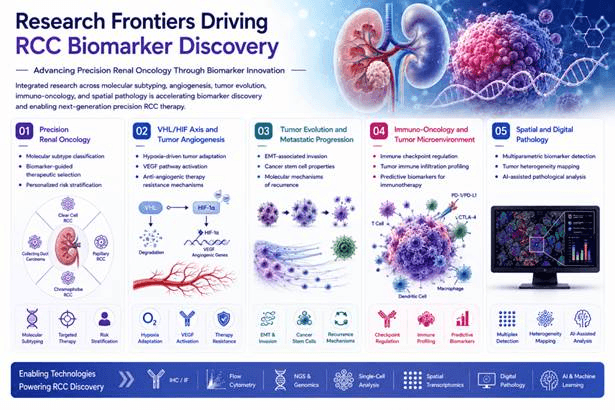
Renal cell carcinoma (RCC) represents the most common malignant tumor of the kidney and a highly heterogeneous group of cancers with distinct molecular alterations, histological subtypes, and therapeutic responses. Among RCC subtypes, clear cell renal cell carcinoma (ccRCC), papillary renal cell carcinoma (pRCC), and chromophobe renal cell carcinoma (chRCC) account for the majority of cases and exhibit unique genomic and biological characteristics.
Despite advances in targeted therapy and immune checkpoint blockade, challenges remain in early tumor classification, metastatic risk assessment, therapeutic resistance prediction, and biomarker-guided patient stratification. Molecular pathways involving VHL/HIF signaling, angiogenesis, metabolic reprogramming, epithelial–mesenchymal transition (EMT), immune regulation, and DNA repair mechanisms play essential roles in RCC initiation and progression.
We support advanced renal cell carcinoma (RCC) biomarker research by enabling comprehensive investigation of tumor heterogeneity, molecular classification, angiogenesis, tumor evolution, immune regulation, and spatial tumor biology. Validated biomarker solutions empower researchers to characterize molecular subtypes, investigate the VHL/HIF and VEGF signaling axes, and dissect EMT, cancer stemness, and metastatic mechanisms underlying tumor progression and therapeutic resistance.
Renal Cell Carcinoma Biomarker Antibody Portfolio
——Comprehensive Solutions for RCC Classification, Prognosis Evaluation, and Translational Research
Accurate RCC characterization requires integrated analysis of lineage markers, molecular alterations, angiogenic pathways, immune signatures, and therapeutic targets. Our antibody portfolio covers major RCC biomarker categories to support standardized research workflows.
Biomarker Category | Representative Markers | Research Applications | Biological Significance |
RCC Subtype Classification Markers | PAX8, CAIX, CD10, RCC Marker, CK7, KIT | Histological classification and tumor origin identification | Define molecular identity of major RCC subtypes |
Clear Cell RCC Biomarkers | VHL, CAIX, HIF-1α, HIF-2α, CD10 | ccRCC characterization and hypoxia pathway studies | Reflect VHL loss, hypoxia adaptation, and angiogenic activation |
Papillary RCC Biomarkers | CK7, AMACR, CD10, MET | Papillary subtype identification and pathway analysis | Characterize MET-driven tumor biology and epithelial differentiation |
Chromophobe RCC Biomarkers | KIT, CK7, FOXI1 | Chromophobe RCC classification | Identify distinct renal epithelial lineage features |
Angiogenesis & Hypoxia Markers | VEGFA, VEGFR2, HIF-1α, HIF-2α | Tumor vascularization and anti-angiogenic therapy studies | Reveal mechanisms driving RCC angiogenesis |
Prognostic & Metastasis Markers | Vimentin, MMP9, CD44, L1CAM | Invasion, recurrence, and metastatic research | Reflect tumor aggressiveness and metastatic potential |
Immune Oncology Markers | PD-L1, CD8, FOXP3, CD68, CD163 | Immune microenvironment profiling | Evaluate immune infiltration and immunotherapy response mechanisms |
Genomic Alteration Markers | VHL, PBRM1, BAP1, SETD2, TFE3 | Mutation-associated RCC biology studies | Investigate tumor evolution and epigenetic regulation |
Therapeutic Biomarkers | mTOR, PTEN, AKT, ERK, PARP | Targeted therapy response research | Support pathway-based therapeutic discovery |
For Research Use Only. Not for use in diagnostic procedures
Key Renal Cell Carcinoma Biomarker Targets
——Molecular Functions and Research Applications
Marker | Biological Function | Research Value | Associated RCC Types |
PAX8 | Renal lineage transcription factor regulating kidney epithelial identity | Renal tumor confirmation and lineage identification | Clear cell, papillary, chromophobe RCC |
CAIX | Hypoxia-inducible membrane protein regulated by HIF signaling | Diagnostic and molecular classification marker | Clear cell RCC |
CD10 | Cell surface metalloprotease involved in tumor progression | RCC identification and prognostic studies | Clear cell and papillary RCC |
RCC Marker | Renal epithelial differentiation marker | Confirmation of renal origin | RCC |
VHL | Tumor suppressor controlling HIF degradation | Study hypoxia signaling and tumor initiation mechanisms | Clear cell RCC |
HIF-1α / HIF-2α | Hypoxia-responsive transcription factors regulating angiogenesis | Investigate oxygen-sensing pathways and therapeutic resistance | Clear cell RCC |
VEGFA | Pro-angiogenic growth factor promoting vascular formation | Angiogenesis studies and anti-VEGF therapy research | Clear cell RCC |
VEGFR2 | VEGF receptor mediating endothelial activation | Targeted therapy pathway analysis | RCC |
CK7 | Cytokeratin associated with epithelial differentiation | Subtype classification and differential diagnosis | Papillary and chromophobe RCC |
AMACR | Enzyme involved in lipid metabolism | Papillary RCC identification | Papillary RCC |
KIT (CD117) | Receptor tyrosine kinase involved in cell signaling | Chromophobe RCC characterization | Chromophobe RCC |
MET | Receptor tyrosine kinase regulating proliferation and invasion | Target discovery and pathway studies | Papillary RCC |
Vimentin | Mesenchymal marker associated with EMT | Metastasis and invasion analysis | Advanced RCC |
CD44 | Cancer stem cell-associated adhesion receptor | Recurrence and therapy resistance research | RCC |
PD-L1 | Immune checkpoint ligand suppressing T-cell activity | Immunotherapy biomarker evaluation | RCC |
CD8 | Cytotoxic T-cell marker | Immune infiltration profiling | RCC tumor microenvironment |
CD68/CD163 | Macrophage-associated immune markers | Tumor-associated macrophage analysis | RCC |
PBRM1 | Chromatin remodeling regulator | Molecular evolution and immune response studies | Clear cell RCC |
BAP1 | Tumor suppressor regulating chromatin and DNA repair | Prognostic and genomic alteration studies | Clear cell RCC |
SETD2 | Histone methyltransferase controlling epigenetic regulation | Epigenomic alteration research | Clear cell RCC |
mTOR | Central regulator of growth and metabolism | Targeted therapy mechanism studies | RCC |
Featured Renal Cell Carcinoma Research Panels
——Integrated Biomarker Solutions for Comprehensive RCC Characterization
Clear Cell RCC (ccRCC) Profiling Panel——Defining VHL/HIF Signaling, Hypoxia Response, and Angiogenic Tumor Biology
Key Markers
PAX8 | CAIX | CD10 | VHL | HIF-2α | VEGFA | Ki-67 |
Papillary RCC Characterization Panel——Investigating MET Activation and Papillary Tumor Biology
Key Markers
PAX8 | CK7 | AMACR | CD10 | MET | CK20 |
Chromophobe RCC Identification Panel——Characterizing Distinct Renal Epithelial Lineage Features
Key Markers
KIT (CD117) | CK7 | PAX8 | FOXI1 | E-cadherin |
RCC Metastasis & Tumor Microenvironment Panel——Investigating Tumor Dissemination, EMT, and Immune Regulation
Key Markers
Vimentin | CD44 | MMP9 | PD-L1 | CD8 | CD68/CD163 |
Why Researchers Choose Our Renal Cell Carcinoma Biomarker Solutions?
Validated Targets. Comprehensive Panels. Reliable Translational Research.
Our antibody portfolio supports the complete RCC research workflow — from tumor classification and molecular profiling to therapeutic biomarker discovery.
Research Challenge | Our Solution |
How can I classify RCC subtypes? | Comprehensive subtype panels covering PAX8, CAIX, CD10, CK7, KIT, and lineage markers |
How can I study RCC progression? | Prognostic biomarkers targeting EMT, invasion, and metastatic pathways |
How can I investigate angiogenesis mechanisms? | Antibodies targeting VHL/HIF/VEGF signaling pathways |
How can I evaluate immunotherapy biomarkers? | Immune profiling solutions including PD-L1, CD8, CD68, and CD163 |
How can I study therapeutic resistance? | Biomarkers associated with mTOR, MET, DNA repair, and tumor evolution pathways |
How can I improve experimental reproducibility? | Highly validated antibodies optimized for IHC, IF, WB, and multiplex applications |
Key References
Choueiri T.K., Motzer R.J. (2022). Systemic therapy for metastatic renal-cell carcinoma. New England Journal of Medicine. 386:352–365.
Motzer R.J., Jonasch E., Agarwal N., et al. (2022). Kidney cancer, version 3.2022, NCCN Clinical Practice Guidelines in Oncology. Journal of the National Comprehensive Cancer Network. 20:71–90.
Braun D.A., Bakouny Z., Hirsch L., et al. (2021). Beyond conventional immune checkpoint blockade—new approaches to immunotherapy in renal cell carcinoma. Nature Reviews Clinical Oncology. 18:199–214.
Linehan W.M., Ricketts C.J. (2023). The metabolic basis of kidney cancer. Nature Reviews Urology. 20:127–142.
Sato Y., Yoshizato T., Shiraishi Y., et al. (2013). Integrated molecular analysis of clear cell renal cell carcinoma. Nature Genetics.45: 860–867.
Miao D., Margolis C.A., Gao W., et al. (2018). Genomic correlates of response to immune checkpoint blockade in clear cell renal cell carcinoma. Nature Genetics. 50:1271–1281 .