
info@mail.ucallm.com
Decoding Cell Fate Regulation — Empowering Stem Cell, Developmental Biology, and Disease Research with Validated SOX Family Antibodies
SOX Family
Master Regulators Connecting Stem Cell Identity, Development, and Differentiation
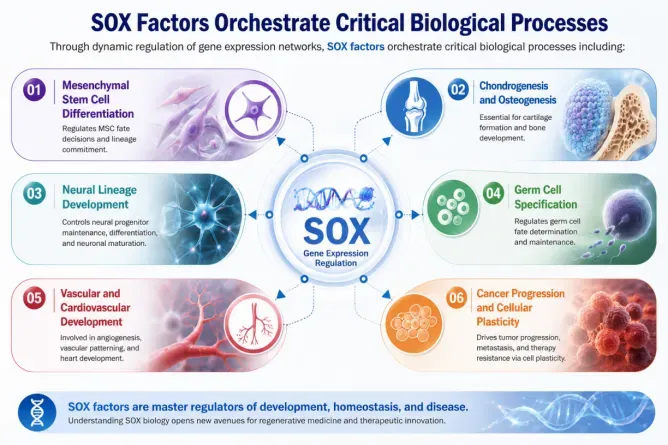
SOX Family represents a highly conserved group of transcription factors that serve as master regulators of cellular identity, developmental programs, and differentiation processes. Through their HMG-box DNA-binding domain, SOX proteins coordinate complex gene regulatory networks controlling stem cell maintenance, self-renewal, lineage commitment, tissue formation, and cellular transformation. With 20 human members classified into eight conserved groups, SOX factors play essential roles across diverse biological systems, including MSC differentiation, chondrogenesis, osteogenesis, neural development, vascular formation, germ cell specification, and cancer-associated cellular plasticity. Comprehensive SOX profiling provides powerful tools for understanding cell fate decisions and advancing regenerative medicine, developmental biology, and precision disease research.
Through dynamic regulation of gene expression networks, SOX factors orchestrate critical biological processes including:
Featured Research Solutions
——Comprehensive SOX Family Biomarker Panels for Cell Fate Regulation
Our validated SOX family antibody panels enable researchers to investigate transcriptional networks controlling stem cell identity, lineage specification, tissue development, and disease-associated cellular plasticity. These carefully curated marker panels support comprehensive studies from pluripotency maintenance and developmental biology to regenerative medicine and cancer research.
Research Category | Key Targets | Applications | Research Focus |
Pluripotency & Neural Stem Cell Biology | SOX2, SOX3 | IHC, WB, ICC/IF | Stemness maintenance, embryonic development, neural progenitor regulation |
Progenitor Cell Regulation | SOX4, SOX11, SOX12 | IHC, WB, ICC/IF | Developmental signaling, CNS formation, cellular differentiation |
Chondrogenesis & Skeletal Development | SOX5, SOX6, SOX9 | IHC, WB, ICC/IF | MSC differentiation, cartilage formation, ECM regulation |
Neural Crest & Glial Development | SOX8, SOX10 | IHC, ICC/IF | Neural lineage specification and glial differentiation |
Vascular Development | SOX7, SOX17, SOX18 | IHC, WB, ICC/IF | Endothelial differentiation and vascular biology |
Muscle Differentiation | SOX15 | IHC, ICC/IF | Myogenic lineage specification and maintenance |
Germ Cell Development | SOX30 | IHC, WB | Germ cell maturation and reproductive biology |
Key SOX Family Biomarker Targets
——Key Targets for Stem Cell Identity, Lineage Specification, and Developmental Biology
Marker | Biological Function | Research Value | Associated Research Applications |
SOX2 | Core transcription factor maintaining pluripotency, self-renewal, and neural progenitor identity | Essential marker for evaluating stemness status, cellular reprogramming, and progenitor maintenance | ESC/iPSC characterization, neural stem cell research, cancer stemness studies |
SOX3 | Developmental transcription factor involved in early neural specification and progenitor regulation | Enables analysis of neural lineage commitment and developmental programs | Neural development, embryonic biology, stem cell differentiation |
SOX4 | Transcription factor regulating cell fate decisions, differentiation, and cellular plasticity | Investigates developmental signaling and abnormal lineage regulation | Progenitor cell biology, EMT research, cancer progression studies |
SOX5 | Transcriptional regulator cooperating with SOX9 during cartilage development | Supports investigation of skeletal lineage commitment and chondrogenic differentiation | MSC differentiation, cartilage formation, skeletal biology |
SOX6 | Regulates terminal differentiation programs in cartilage and muscle lineages | Evaluates lineage maturation and tissue-specific developmental processes | Chondrogenesis, muscle development, regenerative medicine |
SOX7 | Endothelial-associated transcription factor controlling vascular lineage specification | Provides insights into endothelial differentiation and vascular development | Angiogenesis, vascular biology, developmental studies |
SOX8 | Regulator of neural crest and glial lineage development | Supports investigation of neural lineage specification mechanisms | Neural development, glial differentiation research |
SOX9 | Master transcription factor controlling chondrogenesis and maintaining progenitor states | Key biomarker for MSC differentiation potential and cartilage lineage commitment | MSC research, cartilage regeneration, skeletal tissue engineering |
SOX10 | Essential regulator of neural crest, melanocyte, and glial differentiation | Enables characterization of neural crest-derived cell populations | Neural development, glial biology, melanoma research |
SOX11 | Transcription factor promoting neuronal differentiation and developmental maturation | Evaluates neuronal lineage commitment and regeneration mechanisms | Neural stem cells, neurogenesis, CNS development |
SOX12 | Member of SOXC family regulating progenitor maintenance and differentiation | Helps define developmental signaling networks and cell fate transitions | Developmental biology, progenitor cell studies |
SOX15 | Transcription factor involved in muscle lineage specification and maintenance | Supports investigation of myogenic differentiation programs | Muscle development, regenerative medicine |
SOX17 | Regulates endothelial specification and vascular developmental pathways | Provides a marker for endothelial lineage formation and vascular identity | Vascular biology, angiogenesis, stem cell differentiation |
SOX18 | Controls vascular and lymphatic development programs | Enables analysis of vessel formation and endothelial maturation | Angiogenesis, lymphatic development, vascular regeneration |
SOX30 | Regulates germ cell differentiation and reproductive lineage development | Supports studies of germ cell maturation and reproductive biology | Germ cell research, developmental biology |
SOX Family Research
——From Transcription Factor Profiling to Functional Discovery
Research Stage | Representative Markers | Scientific Objective |
Stem Cell State Characterization | SOX2, SOX4 | Define stem/progenitor identity and self-renewal status |
MSC Lineage Commitment | SOX9, SOX6, SOX11 | Monitor differentiation trajectory and lineage specification |
Cartilage Differentiation Analysis | SOX9, SOX6 | Evaluate chondrogenic maturation and matrix formation |
Neural Lineage Specification | SOX2, SOX10, SOX11 | Investigate neural development and progenitor transition |
Disease Mechanism Investigation | SOX4, SOX9, SOX10 | Study abnormal cell fate regulation and pathological transformation |
SOX Research Workflow provides a comprehensive framework for investigating transcription factor networks that regulate stem cell identity, lineage specification, tissue development, and disease-associated cellular plasticity. By profiling key SOX family members, researchers can define stem/progenitor states, monitor MSC differentiation trajectories, and evaluate lineage-specific maturation processes such as chondrogenesis and neural development. SOX2, SOX4, SOX6, SOX9, SOX10, and SOX11 serve as critical molecular indicators for understanding cell fate decisions and developmental regulation. These validated SOX biomarker panels support mechanistic studies ranging from regenerative medicine and developmental biology to cancer progression and pathological transformation research.
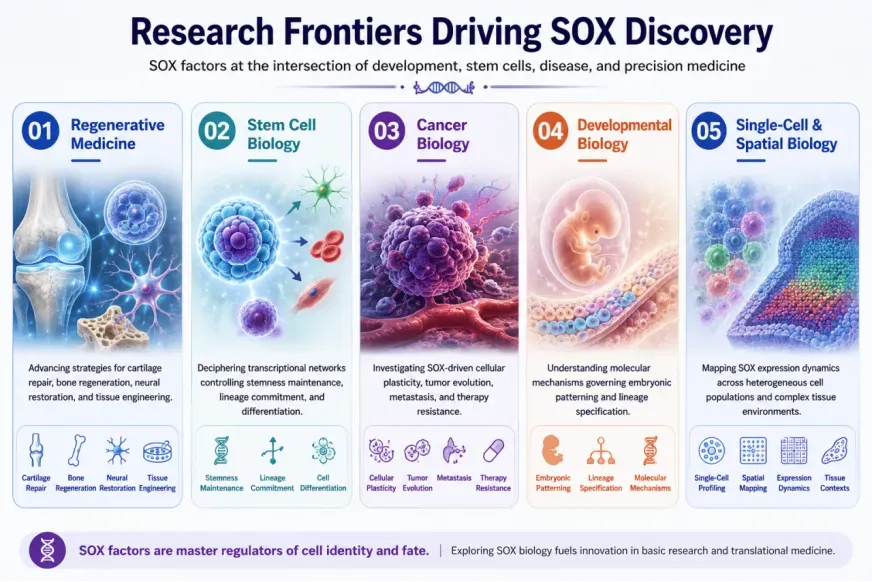
Research Frontiers Driving SOX Discovery
Research Frontiers Driving SOX Discovery highlight the central role of SOX transcription factors in regulating cell identity, developmental programs, and disease-associated cellular plasticity. In regenerative medicine, SOX networks provide critical insights into cartilage repair, bone regeneration, neural restoration, and tissue engineering strategies. Stem cell research focuses on deciphering SOX-mediated mechanisms controlling self-renewal, lineage commitment, and differentiation. In cancer biology, SOX-driven pathways contribute to tumor evolution, metastasis, stemness, and therapeutic resistance. Advanced technologies, including single-cell and spatial profiling, further enable precise mapping of SOX expression patterns across heterogeneous cell populations, accelerating discoveries in developmental biology, precision medicine, and translational research.
Why Researchers Choose Our SOX Family Antibody Solutions?
Validated Targets. Comprehensive Coverage. Confident Discovery.
Our recombinant SOX antibody portfolio enables researchers to confidently investigate transcriptional regulation from fundamental developmental biology to advanced disease research.
Research Challenge | Our Solution |
"How do I identify stem and progenitor states?" | Validated SOX2, SOX4, and SOX11 antibodies for stemness and progenitor characterization |
"How can I monitor MSC differentiation?" | SOX9 and SOX6 antibodies for cartilage lineage investigation |
"How do I study developmental pathways?" | Broad SOX family coverage across neural, skeletal, vascular and germ cell biology |
"How can I improve reproducibility?" | High-specificity recombinant antibodies with consistent lot-to-lot performance |
"How can I connect transcription factor expression with biological function?" | Integrated SOX marker solutions supporting mechanistic discovery |
Key References
1. Xu S., Huang W., Xia L. (2024).SOX on tumors, a comfort or a constraint? Cell Death Discovery. 2024.10:67.
2. Liu Y., Guo W. (2021).SOX factors as cell-state regulators in the mammary gland and breast cancer.Seminars in Cell & Developmental Biology. 2021;114:113–122.
3. Rauch A., Mandrup S. (2021).Transcriptional networks controlling stromal cell differentiation.Nature Reviews Molecular Cell Biology. 22:465–482.
4. Kim K.P., Han D.W., Schöler H.R. et al. (2021).Biological importance of OCT transcription factors in reprogramming and development.Experimental & Molecular Medicine. 53:1018–1028.
5. Xu S., Huang W., Xia L. (2025).SOXs: Master architects of development and versatile emulators of oncogenesis.Biochimica et Biophysica Acta (BBA) - Reviews on Cancer. 2025;1880(2):189295.