
info@mail.ucallm.com
From Stem Cell Identity to Cellular Fate — Empowering Precision Discovery with Validated Stem Cell Marker Antibodies
Stem cells represent the foundation of tissue development, regeneration, and cellular engineering, characterized by two defining properties: self-renewal capacity and multilineage differentiation potential. Through tightly regulated molecular programs, stem cells maintain tissue homeostasis, control developmental processes, and provide the foundation for regenerative medicine, disease modeling, and advanced cell-based therapies.Stem cell populations exist across a broad biological spectrum, ranging from totipotent cells with the potential to generate all embryonic and extraembryonic tissues, pluripotent stem cells capable of differentiating into diverse cell lineages, to adult tissue-resident stem cells responsible for tissue maintenance and repair. Understanding these distinct cellular states requires precise molecular identification and functional characterization.
We support advanced stem cell research by enabling comprehensive investigation of stem cell identity, self-renewal, lineage commitment, cellular fate determination, and regenerative potential. Validated stem cell marker solutions empower researchers to characterize cellular populations, investigate developmental mechanisms, establish patient-specific iPSC disease models, and evaluate the identity and quality of therapeutic cell products. Combined with iPSC technologies, single-cell analysis, spatial profiling, and high-resolution molecular characterization, stem cell research enables detailed mapping of cellular heterogeneity, developmental trajectories, and tissue-specific microenvironments. These integrated approaches accelerate discoveries in precision regenerative medicine, cell therapy development, developmental biology, disease modeling, and next-generation cellular engineering.
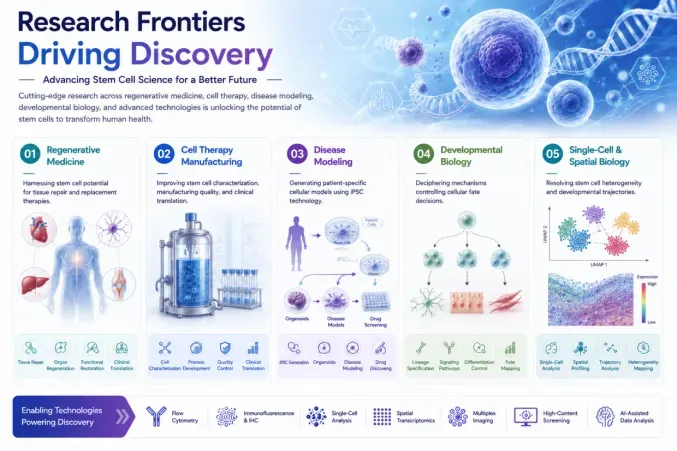
Stem Cell Marker Portfolio
——Precision Tools for Mapping Stem Cell Identity and Fate
Reliable stem cell research begins with accurate marker selection. Our comprehensive portfolio covers key molecular signatures associated with pluripotency, reprogramming, germ layer specification, and lineage differentiation.
Research Area | Representative Markers | Research Applications | Biological Significance |
Pluripotency Maintenance | OCT4/POU5F1, SOX2, NANOG, SALL4, KLF4, c-MYC | ESC/iPSC characterization, stemness validation | Core regulatory network maintaining self-renewal and undifferentiated state |
Cell Surface Pluripotency Markers | SSEA4/FUT4/CD15, NACC1, NES, TCL1 | Stem cell identification and enrichment | Surface signatures of pluripotent populations |
iPSC Reprogramming Validation | OCT4, NANOG, SSEA4, CD13/ANPEP | Reprogramming efficiency assessment | Confirmation of somatic cell conversion into pluripotent state |
Germ Cell Specification | KIT/CD117, DDX4/MVH, DAZL, GDF9, IFITM1 | Germ lineage development studies | Regulation of reproductive lineage commitment |
Ectoderm Differentiation | PAX6, TUBB3, NES, OTX2, P63 | Neural differentiation and development | Neural lineage specification and maturation |
Germ Layer Specification & Developmental Regulators | SOX17, FOXA2, GATA6, CER1, TBXT,MIXL1, PAX6, SOX1 | Early developmental biology | Germ layer patterning and tissue formation |
Stem Cell Quality Assessment | OCT4, SOX2, NANOG combined panels | Cell authentication and characterization | Ensuring experimental consistency and biological relevance |
Key Stem Cell Biomarker Targets
——Comprehensive Solutions for Pluripotency, Stem Cell Identity, Lineage Specification, and Functional Differentiation
Marker | Biological Function | Research Value | Associated Stem Cell Applications |
OCT4 (POU5F1) | Core pluripotency transcription factor maintaining embryonic stem cell identity | Essential marker for evaluating pluripotency status and reprogramming efficiency | Embryonic stem cells, iPSC generation, pluripotency validation |
SOX2 | Transcription factor regulating self-renewal and undifferentiated stem cell states | Monitor stemness maintenance and neural lineage potential | ESC/iPSC characterization, neural stem cell research |
NANOG | Master regulator of pluripotency and self-renewal networks | Assess maintenance of pluripotent states and reprogramming success | Pluripotent stem cell identification and quality control |
SSEA4 | Cell surface glycosphingolipid associated with pluripotent stem cells | Enable surface-based identification and enrichment of pluripotent populations | iPSC validation, flow cytometry-based stem cell analysis |
TRA-1-60 / TRA-1-81 | Human pluripotency-associated surface markers | Characterize undifferentiated human pluripotent stem cells | ESC/iPSC quality assessment |
KLF4 | Reprogramming transcription factor involved in induced pluripotency | Evaluate molecular mechanisms of cellular reprogramming | iPSC generation and stem cell engineering |
SALL4 | Zinc-finger transcription factor regulating embryonic stem cell identity | Study stem cell maintenance and developmental regulation | Embryonic development, pluripotency studies |
MYC (c-MYC) | Transcriptional regulator promoting proliferation and reprogramming efficiency | Investigate cell proliferation and induced pluripotency mechanisms | iPSC reprogramming and cellular transformation studies |
PAX6 | Developmental transcription factor controlling neural and ocular lineage specification | Track lineage commitment and differentiation programs | Neural progenitor differentiation, organoid research |
TUBB3 (βIII-Tubulin) | Neuronal cytoskeletal protein expressed during neural differentiation | Confirm neuronal lineage commitment and maturation | Neural stem cell differentiation, neurodevelopment research |
PAX2 | Transcription factor involved in kidney and developmental lineage specification | Evaluate organ-specific differentiation pathways | Renal progenitor and developmental biology research |
Nestin | Intermediate filament protein expressed in neural and progenitor cells | Identify immature stem/progenitor populations | Neural stem cells, tissue regeneration studies |
CD44 | Cell surface adhesion receptor associated with stemness and migration | Investigate cancer stem-like properties and regenerative cell populations | Cancer stem cell research, tissue repair studies |
LGR5 | Stem cell marker regulating Wnt signaling and tissue renewal | Identify actively cycling adult stem cell populations | Intestinal stem cells, organoid models, regenerative medicine |
ALDH1A1 | Enzyme associated with stem cell maintenance and metabolic protection | Evaluate stem cell properties and therapy-resistant populations | Cancer stem cells, tissue stem cell characterization |
Featured Research Solutions
——Mapping Stem Cell Identity and Differentiation Potential
Our validated marker panels support researchers throughout the stem cell discovery journey — from maintaining pluripotency to understanding developmental fate decisions.
n Pluripotent Stem Cells——Defining the Molecular Signature of Stemness
Key Markers
OCT4 / POU5F1 | SOX2 | NANOG | SALL4 | KLF4 | c-MYC |
n iPSC Reprogramming & Pluripotency Validation——Monitoring Cellular Reprogramming and Stem State Acquisition
Key Markers
OCT4 (POU5F1) | NANOG | SSEA4 | TRA-1-60 | ANPEP (CD13) |
n Adult Stem Cells & Tissue Renewal——Characterizing Tissue-Resident Stem Cell Populations
LGR5 | CD44 | Nestin | SOX2 | ALDH1A1 |
n Lineage Specification & Developmental Commitment——Tracking Stem Cell Differentiation Trajectories
PAX6 | βIII-Tubulin | PAX2 | Brachyury | SOX17 |
Stem Cell Research
——Accelerating Stem Cell Discovery from Identity to Functional Maturation
Research Stage | Representative Markers | Scientific Objective |
Pluripotency Identification | OCT4, SOX2, NANOG | Define core pluripotent states and confirm stem cell identity |
iPSC Reprogramming Validation | OCT4, NANOG, SSEA4, TRA-1-60 | Evaluate reprogramming efficiency and generation of induced pluripotent stem cells |
Stem Cell Self-Renewal & Expansion | SOX2, SALL4, KLF4 | Monitor maintenance of stemness, proliferation capacity, and undifferentiated states |
Lineage Specification & Commitment | PAX6, TUBB3, PAX2, Brachyury | Track developmental transitions and identify lineage-specific differentiation pathways |
Functional Differentiation Validation | Lineage-specific markers | Confirm mature cell identity and assess functional differentiation outcomes |
The Stem Cell Research Workflow provides a comprehensive strategy for characterizing stem cell identity, maintaining pluripotency, validating reprogramming, and evaluating lineage-specific differentiation. By analyzing key biomarkers including OCT4, SOX2, NANOG, SSEA4, SALL4, KLF4, PAX6, TUBB3, and PAX2, researchers can confirm stem cell states, monitor iPSC generation and expansion, and track developmental transitions toward mature cell identities. This integrated workflow supports reliable stem cell characterization across developmental biology, regenerative medicine, disease modeling, and cell therapy research, enabling precise evaluation of cellular fate decisions and functional maturation.
Why Researchers Choose Our Stem Cell Marker Solutions?
Validated Markers. Comprehensive Coverage. Accelerated Discovery.
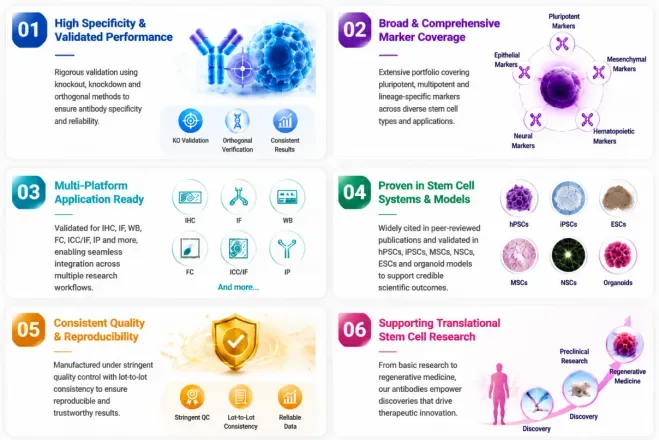
Our recombinant antibody portfolio delivers reliable tools for investigating stem cell biology with confidence — from fundamental mechanisms to translational applications.
Research Challenge | Our Solution |
"How do I confirm stem cell identity?" | Comprehensive pluripotency marker panels covering OCT4, SOX2, NANOG, and SALL4 |
"How can I validate iPSC generation?" | Dedicated reprogramming markers including OCT4, NANOG, SSEA4, and CD13 |
"How do I monitor differentiation?" | Germ layer and lineage-specific markers for developmental fate analysis |
"How can I improve reproducibility?" | Recombinant antibodies with high specificity and consistent lot-to-lot performance |
"How do I connect stem cell state with function?" | Integrated marker solutions supporting differentiation, development, and regenerative research |
Key References
1. Yang J., Antin P., Berx G., Blanpain C., Brabletz T., Bronner M., et al. (2022). Guidelines and definitions for research on epithelial–mesenchymal transition. Nature Reviews Molecular Cell Biology. 23:341–357.
2. Cerneckis J., Cai H., Shi Y. (2024). Induced pluripotent stem cells (iPSCs): molecular mechanisms of induction and applications. Signal Transduction and Targeted Therapy. 9:112.
3. Ricchetti M. (2024). When senescence generates pluripotent stem cells. Nature Reviews Molecular Cell Biology. 25:952.
4. Gulati G.S., D’Silva J.P., Newman A.M. (2025). Profiling cell identity and tissue architecture with single-cell and spatial transcriptomics. Nature Reviews Molecular Cell Biology.26: 11–31.
5. Andersson-Rolf A., Clevers h. (2026). New developments and applications of human organoids. Nature Reviews Molecular Cell Biology.27:543–558 .