
info@mail.ucallm.com
From Molecular Classification to Precision Endocrine Oncology — Empowering Comprehensive Thyroid Cancer Profiling with Validated Antibody Solutions
Thyroid cancer represents the most common endocrine malignancy, encompassing a broad spectrum of histological subtypes with distinct molecular characteristics, biological behaviors, and therapeutic responses. Although most differentiated thyroid cancers demonstrate favorable outcomes, challenges remain in accurate tumor classification, risk stratification, identification of aggressive variants, and management of advanced or recurrent disease.
Recent advances in molecular pathology have revealed critical roles for genetic alterations, lineage-specific transcription factors, MAPK and PI3K/AKT signaling pathways, immune regulation, and tumor microenvironment remodeling in thyroid tumor development and progression.
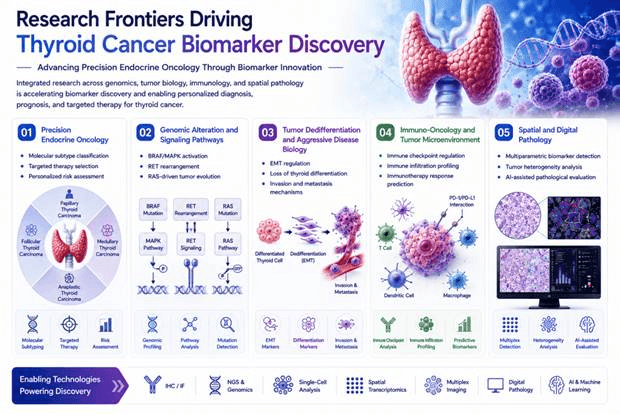
We support advanced thyroid cancer biomarker research by enabling comprehensive investigation of tumor heterogeneity, molecular classification, oncogenic signaling, tumor evolution, immune regulation, and spatial tumor biology. Validated biomarker solutions empower researchers to characterize molecular subtypes, investigate BRAF/MAPK activation, RET rearrangements, and RAS-driven pathways, and uncover mechanisms underlying tumor initiation, dedifferentiation, EMT, progression, and therapeutic response.
Thyroid Cancer Biomarker Antibody Portfolio
——Integrated Biomarker Solutions for Tumor Classification, Molecular Profiling, and Precision Therapy Research
Accurate thyroid cancer characterization requires integrated analysis of thyroid lineage markers, oncogenic pathway alterations, proliferation signatures, immune regulators, and metastatic-associated molecules. Our antibody portfolio covers major thyroid cancer biomarker categories to support standardized research workflows.
Biomarker Category | Representative Markers | Research Applications | Scientific Significance |
Thyroid Lineage Markers | PAX8, TTF-1, Thyroglobulin (TG), TPO, TSHR | Confirm thyroid origin and differentiation status | Define thyroid epithelial identity and functional differentiation |
Papillary Thyroid Cancer Markers | BRAF V600E, HBME-1, Galectin-3, CK19, RET | PTC diagnosis and molecular profiling | Identify MAPK-driven tumor characteristics |
Follicular Thyroid Cancer Markers | PAX8, TG, TTF-1, PTEN, Ki-67 | FTC classification and pathway studies | Characterize follicular differentiation and oncogenic signaling |
Medullary Thyroid Cancer Markers | Calcitonin, CEA, Chromogranin A, Synaptophysin, INSM1 | Neuroendocrine lineage analysis | Define C-cell derived tumor biology |
Aggressive Thyroid Cancer Markers | TP53, Ki-67, Vimentin, β-Catenin | Advanced disease progression studies | Reflect genomic instability and tumor dedifferentiation |
EMT & Metastasis Markers | E-cadherin, N-cadherin, Vimentin, Snail, MMP9 | Invasion and metastatic mechanism research | Reveal epithelial plasticity and dissemination pathways |
Immune Oncology Markers | PD-L1, PD-1, CD8, FOXP3, CD68, CD163, Granzyme B | Immunotherapy biomarker studies | Characterize immune escape and tumor immunity |
Cell Cycle & Proliferation Regulators | Ki-67, Cyclin D1, p21, p27 | Growth and prognosis evaluation | Assess tumor proliferation and disease aggressiveness |
For Research Use Only. Not for use in diagnostic procedures
Key Thyroid Cancer Biomarker Targets
——Molecular Function, Research Value, and Oncology Applications
Marker | Biological Function | Research Applications | Clinical Research Relevance |
PAX8 | Nuclear transcription factor regulating thyroid lineage specification | Thyroid origin confirmation and tumor classification | Differentiated thyroid carcinoma profiling |
TTF-1 (NKX2-1) | Thyroid-specific transcription regulator | Differentiation assessment | Thyroid lineage identification |
Thyroglobulin (TG) | Thyroid hormone precursor protein | Functional differentiation analysis | Differentiated thyroid tumor characterization |
TPO | Thyroid hormone biosynthesis enzyme | Thyroid differentiation studies | Follicular-derived tumor evaluation |
BRAF V600E | Activating MAPK pathway alteration | Mutation-associated signaling research | Papillary thyroid carcinoma studies |
RET | Receptor tyrosine kinase regulating proliferation | Fusion-driven oncogenesis studies | Targeted therapy biomarker research |
RAS | Small GTPase controlling MAPK/PI3K signaling | Tumor evolution studies | Follicular-pattern thyroid tumors |
HBME-1 | Cell surface-associated diagnostic marker | Thyroid lesion discrimination | Papillary carcinoma research |
Galectin-3 | Adhesion and invasion regulator | Malignancy and metastasis studies | Thyroid cancer progression analysis |
Calcitonin | C-cell secreted hormone | Neuroendocrine tumor characterization | Medullary thyroid carcinoma |
CEA | Tumor-associated glycoprotein | Tumor burden and progression research | Medullary thyroid cancer |
TP53 | Genome stability regulator | Aggressive tumor biology studies | Anaplastic thyroid carcinoma |
Ki-67 | Proliferation-associated nuclear antigen | Growth assessment | Prognostic evaluation |
PD-L1 | Immune checkpoint ligand | Immune escape research | Immunotherapy biomarker studies |
p27 (CDKN1B) | Cyclin-dependent kinase inhibitor; loss of nuclear expression linked to poor differentiation. | Prognostic marker for tumor progression; often downregulated in aggressive thyroid cancer. | Differentiated thyroid carcinoma progression |
CD163 | Scavenger receptor on M2-polarized tumor-associated macrophages | TAM immunophenotyping; correlates with immunosuppression. | Aggressive thyroid cancer microenvironment |
Featured Thyroid Cancer Research Panels
——Comprehensive Biomarker Panels for Translational Thyroid Oncology
Papillary Thyroid Carcinoma (PTC) Profiling Panel—Defining Molecular Identity and MAPK-Driven Tumor Biology
Key Markers
TTF-1 | PAX8 | Thyroglobulin | BRAF V600E | HBME-1 | Galectin-3 | CK19 |
Follicular Thyroid Tumor Research Panel——Characterizing Differentiation Status and Molecular Alterations
Key Markers
PAX8 | TTF-1 | Thyroglobulin | TPO | Ki-67 | p27 | PTEN |
Medullary Thyroid Carcinoma Panel—Investigating Neuroendocrine Differentiation and Tumor Biology
Key Markers
Calcitonin | CEA | Chromogranin A | Synaptophysin | INSM1 |
Advanced & Anaplastic Thyroid Cancer Progression Panel——Understanding Dedifferentiation, Invasion, and Therapeutic Resistance
Key Markers
TP53 | Ki-67 | Vimentin | N-cadherin | β-Catenin | BRAF V600E | E-cadherin |
Thyroid Cancer Biomarker Research Workflow
——From Molecular Classification to Translational Discovery
Research Stage | Representative Markers | Scientific Objective |
Thyroid Lineage Identification | TTF-1, PAX8, TG, TPO | Confirm thyroid origin and differentiation status |
Tumor Subtype Classification | BRAF, HBME-1, Calcitonin, CEA | Define papillary, follicular, and medullary tumor characteristics |
Molecular Alteration Studies | BRAF, RET, RAS, PTEN, TP53 | Investigate oncogenic signaling pathways |
Prognostic Evaluation | Ki-67, TP53, Cyclin D1 | Assess tumor aggressiveness and progression |
EMT & Metastasis Research | E-cadherin, Vimentin, Snail, MMP9 | Study invasion and metastatic mechanisms |
Immune Profiling | PD-L1, PD-1, CD8, FOXP3 | Evaluate tumor immune microenvironment |
Precision Therapy Research | BRAF, RET, PD-L1, pathway regulators | Support biomarker-guided therapeutic development |
The Thyroid Cancer Biomarker Research Workflow integrates molecular classification, tumor profiling, immune characterization, and precision therapy research to advance translational thyroid oncology. By analyzing key markers including TTF-1, PAX8, TG, TPO, BRAF, RET, RAS, TP53, PD-L1, and EMT-associated proteins, researchers can define tumor lineage, classify molecular subtypes, investigate oncogenic pathways, and evaluate disease progression. This comprehensive workflow supports the study of tumor differentiation, metastatic mechanisms, immune regulation, and therapeutic response, enabling biomarker validation and the development of personalized treatment strategies for thyroid cancer.
Why Researchers Choose Our Thyroid Cancer Biomarker Solutions?
Validated Targets. Comprehensive Panels. Reliable Translational Research.
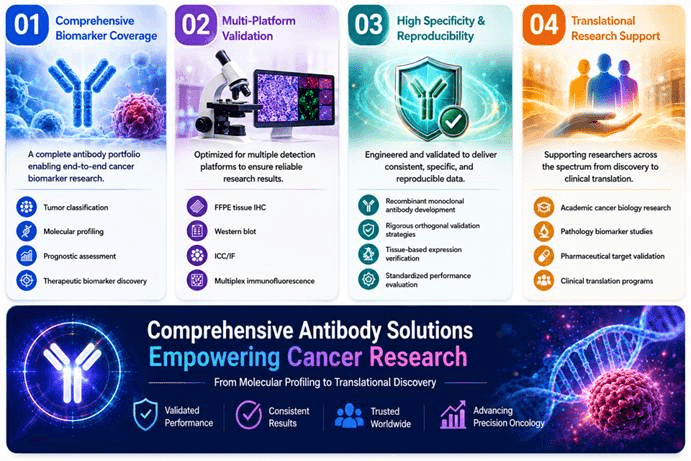
Our antibody portfolio supports the complete thyroid cancer research workflow — from tumor classification and molecular profiling to precision oncology applications.
Research Challenge | Our Solution |
How can I identify thyroid tumor origin? | Comprehensive lineage panels including TTF-1, PAX8, TG, and TPO |
How can I classify thyroid cancer subtypes? | Integrated panels covering papillary, follicular, medullary, and anaplastic markers |
How can I investigate oncogenic drivers? | Validated antibodies targeting BRAF, RET, RAS, PTEN, and TP53 pathways |
How can I evaluate aggressive tumor behavior? | Prognostic markers covering proliferation and EMT pathways |
How can I study immunotherapy biomarkers? | Immune profiling solutions including PD-L1, PD-1, and immune cell markers |
How can I improve experimental reproducibility? | Highly validated antibodies optimized for IHC, IF, WB, and multiplex applications |
Key References
Filetti S., Durante C., Hartl D.M., Leboulleux S., Locati L.D., Newbold K., Papotti M.G., Berruti A. (2022). Thyroid cancer: ESMO Clinical Practice Guidelines for diagnosis, treatment and follow-up. Annals of Oncology. 33:674–69.
Nikiforov Y.E., Nikiforova M.N. (2021). Molecular genetics and classification of thyroid cancer. Endocrine Pathology. 32:1–13.
Cabanillas M.E., McFadden D.G., Durante C. (2022). Thyroid cancer: recent advances in diagnosis and therapy. Nature Reviews Endocrinology. 18:725–742.
Xing M. (2022). Molecular pathogenesis and mechanisms of thyroid cancer. Nature Reviews Endocrinology. 18:529–543.
Cabanillas M.E., McFadden D.G., Durante C. (2023). Thyroid cancer. The Lancet. 401:1531–1545.
Nikiforov Y.E., Nikiforova M.N. (2021). Molecular genetics and classification of thyroid cancer. Endocrine Pathology. 32:1–13.