CHO Cell Protein Expression Industrial Application
1. Overview
CHO cells are epithelial cells derived from the ovary of the Chinese hamster (Cricetulus griseus). They were first isolated in the 1950s and have since been adapted for laboratory and industrial use as a mammalian cell host for recombinant protein production.
Unlike bacterial systems or yeast, CHO cells are mammalian cells. This means they have the cellular machinery to perform complex post‑translational modifications, that are critical for the biological activity and stability of many proteins.
2. Reasons why CHO dominates biopharmaceutical production
CHO cells represent the intersection of humanized protein quality, industrial scalability, and regulatory acceptance—a combination unmatched by other expression systems.
| Advantage Dimension |
Specific Explanation |
| Human‑compatible Glycosylation |
N‑glycosylation added by CHO cells closely resembles human glycosylation patterns, which is essential for maintaining antigenicity, protein stability, and antibody ADCC activity. |
| High Yield & Scalability |
Modern CHO cell lines achieve gram‑per‑liter expression levels in bioreactors. Suspension culture, chemically defined media, and fed‑batch/perfusion processes are fully mature. |
| Regulatory & Safety Track Record |
CHO cells have an extensive regulatory history with the FDA, EMA, and NMPA. Thousands of CHO‑derived biologics have been approved. |
| Stable Cell Line Development |
CHO cells can be engineered into stable, clonal cell lines with consistent expression maintained over hundreds of generations, ensuring long‑term production consistency and high‑throughput screening. |
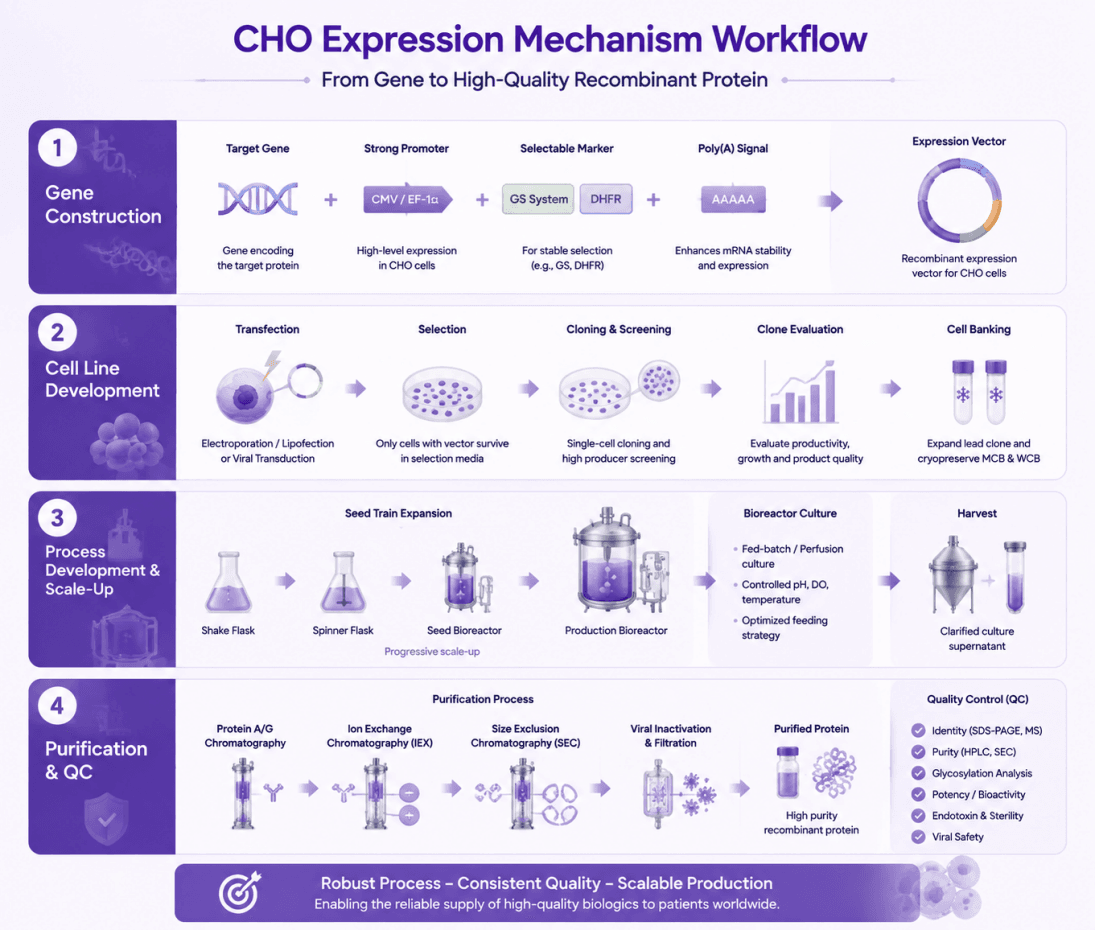
3. CHO Expression workflow
The general workflow for producing a recombinant protein in CHO cells involves several stages:
Step 1: Gene Construction
The gene encoding the target protein is cloned into an expression vector containing:
- A strong mammalian promoter (e.g., CMV, EF‑1α)
- Selectable marker genes (e.g., glutamine synthetase / GS system, DHFR)
- Polyadenylation signals for mRNA stability
Step 2: Cell Line Development
The expression vector is introduced into CHO cells via:
- Transfection: Electroporation, lipofection, or viral transduction
- Selection: Only cells that have taken up the vector survive in selection media
- Cloning: Single cells are isolated and screened for high producers
- Clone evaluation: Productivity, growth kinetics, and product quality are assessed.
- Cell banking: Lead clone is expanded and cryopreserved as Master and Working Cell Banks.
Step 3: Process Development & Scale‑Up
Once a high‑producing clone is selected, the process is scaled up through:
- Seed train: Progressive expansion from shake flasks to bioreactors
- Bioreactor culture: Fed‑batch or perfusion mode at controlled pH, temperature, and dissolved oxygen
- Harvest: Clarified culture supernatant containing the secreted protein
Step 4: Purification & QC
The recombinant protein is purified from the culture supernatant using a combination of:
- Protein A/G chromatography (for antibodies)
- Ion exchange chromatography (IEX)
- Size exclusion chromatography (SEC)
- Viral inactivation and filtration steps
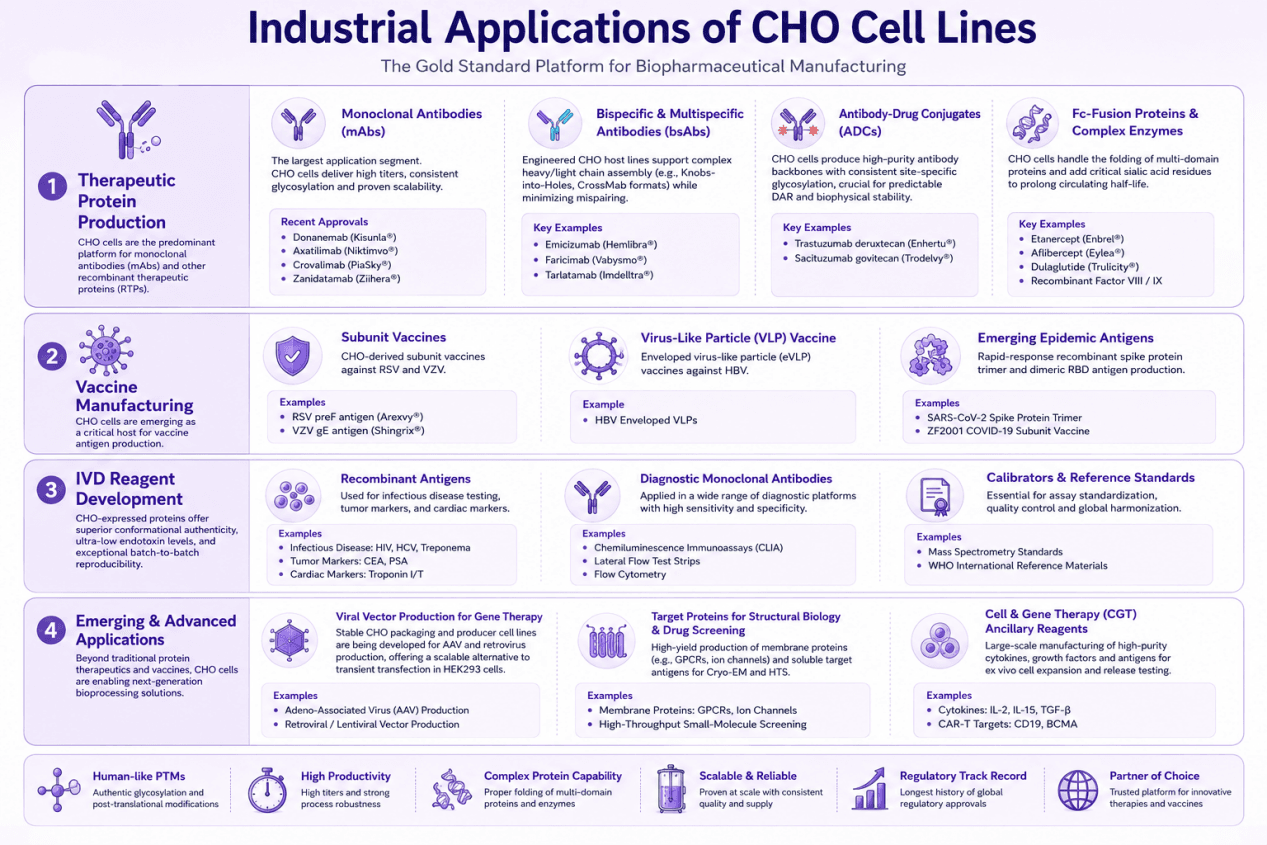
4. Industrial Applications of CHO Cell Lines
4.1 Therapeutic Protein Production
CHO cells are the predominant platform for monoclonal antibodies (mAbs) and other recombinant therapeutic proteins (RTPs).
- Monoclonal Antibodies (mAbs): The largest application segment. Recent Approvals: Donanemab (Kisunla®), Axatilimab (Niktimvo®), Crovalimab (PiaSky®), and Zanidatamab (Ziihera®).
- Bispecific & Multispecific Antibodies (bsAbs): Engineered CHO host lines support complex heavy/light chain assembly (e.g., Knobs‑into‑Holes, CrossMab formats) while minimizing mispairing. Key Examples: Emicizumab (Hemlibra®), Faricimab (Vabysmo®), and Tarlatamab (Imdelltra®).
- Antibody‑Drug Conjugates (ADCs): CHO cells produce high‑purity antibody backbones with consistent site‑specific glycosylation, which is crucial for predictable drug‑to‑antibody ratios (DAR) and biophysical stability. Key Examples: Trastuzumab deruxtecan (Enhertu®) and Sacituzumab govitecan (Trodelvy®).
- Fc‑Fusion Proteins & Complex Enzymes: CHO cells handle the folding of multi‑domain proteins and add critical sialic acid residues to prolong circulating half‑life. Key Examples: Etanercept (Enbrel®), Aflibercept (Eylea®), Dulaglutide (Trulicity®), and recombinant Factor VIII/IX replacement therapies.
4.2 Vaccine Manufacturing
CHO cells are emerging as a critical host for vaccine antigen production.
- Subunit Vaccines: CHO‑derived subunit vaccines against RSV and VZV.
- Virus‑Like Particle Vaccine: Enveloped virus‑like particle (eVLP) vaccines against HBV.
- Emerging Epidemic Antigens: Rapid‑response recombinant spike protein trimer and dimeric RBD antigen production (e.g., ZF2001 COVID‑19 subunit vaccine).
4.3 IVD Reagent Development
For In Vitro Diagnostics (IVD) manufacturers, CHO‑expressed proteins offer superior conformational authenticity, ultra‑low endotoxin levels, and exceptional batch‑to‑batch reproducibility.
- Recombinant Antigens: Used for infectious disease testing (HIV, HCV, Treponema), tumor markers (CEA, PSA), and cardiac markers (Troponin I/T).
- Diagnostic Monoclonal Antibodies: Applied in chemiluminescence immunoassays (CLIA), lateral flow test strips, and flow cytometry.
- Calibrators & Reference Standards: Essential for mass spectrometry standards and WHO international reference materials.
4.4 Emerging & Advanced Applications
Beyond traditional protein therapeutics and vaccines, CHO cells are finding new roles in cutting‑edge bioprocessing.
- Viral Vector Production for Gene Therapy: Emerging stable CHO packaging and producer cell lines are being developed for Adeno‑Associated Virus (AAV) and retrovirus production, offering a scalable alternative to transient transfection in HEK293 cells.
- Target Proteins for Structural Biology & Drug Screening: High‑yield production of membrane proteins (e.g., GPCRs, ion channels) and soluble target antigens for Cryo‑EM structure determination and high‑throughput small‑molecule screening (HTS).
- Cell & Gene Therapy (CGT) Ancillary Reagents: Large‑scale manufacturing of high‑purity growth factors, cytokines (e.g., IL‑2, IL‑15, TGF‑β), and CAR‑T target antigens (e.g., CD19, BCMA) used for ex vivo cell expansion and release testing.
| Application |
Sub‑category |
Examples |
| Therapeutic Proteins |
Monoclonal Antibodies |
- Donanemab (Kisunla®)
- Axatilimab (Niktimvo®)
- Crovalimab (PiaSky®)
- Zanidatamab (Ziihera®)
|
| Bispecific & Multispecific Antibodies |
- Emicizumab (Hemlibra®)
- Faricimab (Vabysmo®)
- Tarlatamab (Imdelltra®)
|
| Antibody‑Drug Conjugates |
- Trastuzumab deruxtecan (Enhertu®)
- Sacituzumab govitecan (Trodelvy®)
|
| Fc‑Fusion Proteins & Complex Enzymes |
- Etanercept (Enbrel®)
- Aflibercept (Eylea®)
- Dulaglutide (Trulicity®)
- Factor VIII/IX
|
| Vaccine Manufacturing |
Subunit Vaccines |
- RSV preF vaccine (Arexvy®)
- VZV gE vaccine (Shingrix®)
|
| Virus‑Like Particle Vaccine |
Enveloped virus‑like particle vaccines against HBV |
| Emerging Epidemic Antigens |
SARS‑CoV‑2 subunit vaccines (ZF2001) |
| IVD Reagent Development |
Recombinant Diagnostic Antigens |
- Infectious disease markers (HIV, HCV, Syphilis)
- Tumor markers (CEA, PSA)
- Cardiac Troponin
|
| Diagnostic mAbs |
- Chemiluminescence immunoassays
- Lateral flow test strips
- Flow cytometry
|
| Calibrators & Reference Standards |
- Mass spectrometry standards
- WHO international reference materials
|
| Emerging Applications |
Gene Therapy Viral Vectors |
AAV and retroviral/lentiviral vector biomanufacturing |
| Structural Biology & Drug Screening |
- Membrane proteins (e.g., GPCRs, ion channels)
- High‑throughput small‑molecule screening
|
| Cell & Gene Therapy Ancillary Reagents |
- Recombinant cytokines (IL‑2, IL‑15, TGF‑β)
- CAR‑T targets (CD19, BCMA)
|
5. Commonly Used CHO Expression Platforms
| Platform |
Selection System |
Key Features |
| CHO‑K1 |
Host cell line (untransfected) |
Original CHO lineage; widely available; high transfection efficiency |
| CHO‑S |
Suspension‑adapted CHO‑K1 |
Grown in suspension culture; ideal for scalable bioreactor production |
| CHO‑DG44 |
DHFR knockout (methotrexate amplification) |
Enables gene amplification; high‑yield production of complex proteins |
| CHO‑GS |
Glutamine synthetase knockout (MSX selection) |
Industry‑standard for stable, high‑yield monoclonal antibody production |
| ExpiCHO |
Transient + stable expression |
High‑density suspension culture; transient expression in 7–14 days |
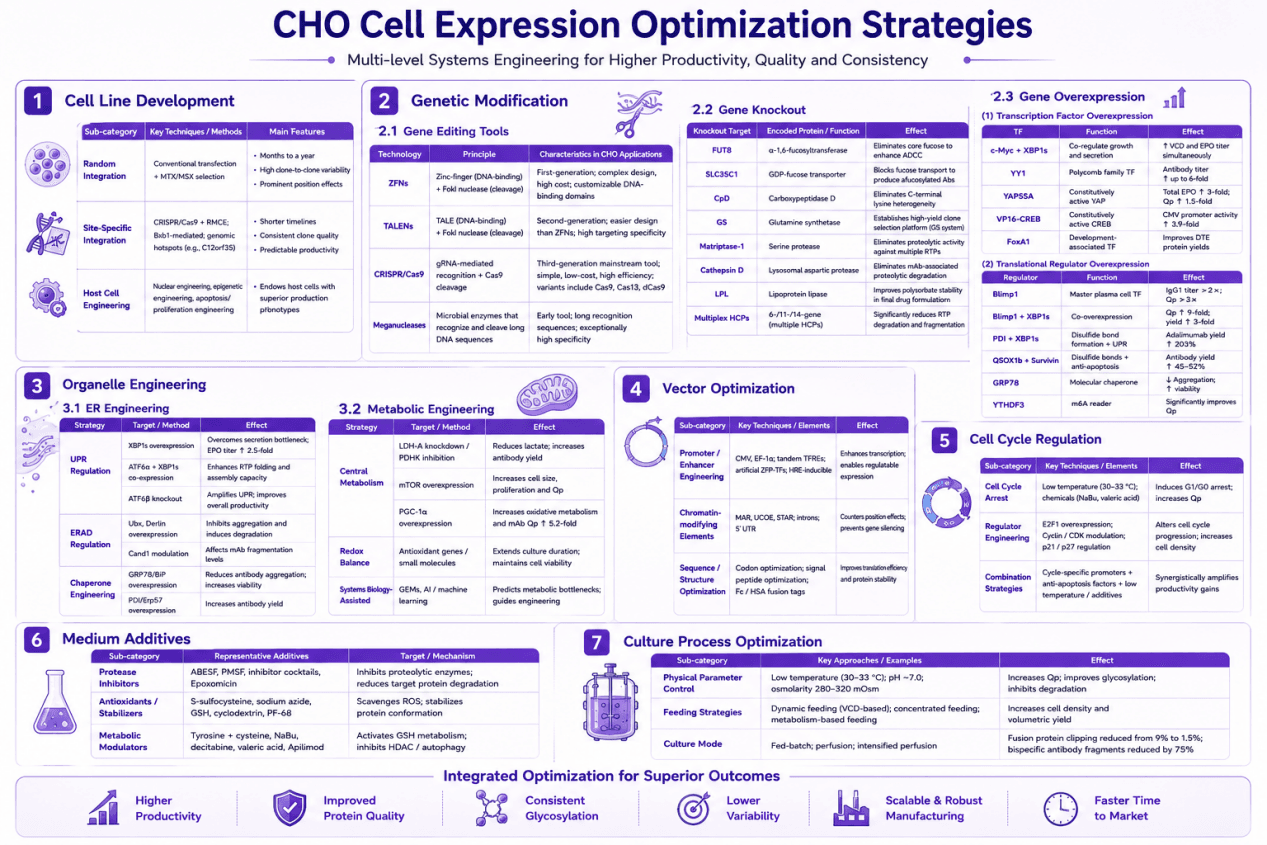
6. CHO Cell Expression Optimization Strategies
CHO cell expression optimization is a multi‑level systems‑engineering task. The field has evolved from simple overexpression to CRISPR‑mediated gene knockout, and combinatorial strategies targeting the nucleus, epigenetics, and apoptosis/proliferation have delivered the greatest gains.
6.1 Cell Line Development
| Sub‑category |
Key Techniques / Methods |
Main Features |
| Random Integration |
Conventional transfection + MTX/MSX selection |
Months to a year; high clone‑to‑clone variability; prominent position effects |
| Site‑Specific Integration |
CRISPR/Cas9 + RMCE; Bxb1‑mediated; genomic hotspots (e.g., C12orf35) |
Shorter timelines; consistent clone quality; predictable productivity |
| Host Cell Engineering |
Nuclear engineering, epigenetic engineering, apoptosis/proliferation engineering |
Endows host cells with superior production phenotypes |
6.2 Genetic Modification
6.2.1 Gene Editing Tools
| Technology |
Principle |
Characteristics in CHO Applications |
| ZFNs |
Zinc‑finger protein (DNA‑binding) + FokI nuclease (cleavage) |
First‑generation tool; complex design, high cost; customizable DNA‑binding domains |
| TALENs |
TALE protein (DNA‑binding) + FokI nuclease (cleavage) |
Second‑generation tool; easier design than ZFNs; high targeting specificity |
| CRISPR/Cas9 |
gRNA‑mediated recognition + Cas9 cleavage |
Third‑generation mainstream tool; simple, low‑cost, high efficiency; variants include Cas9, Cas13, dCas9 |
| Meganucleases |
Naturally occurring microbial enzymes that recognize and cleave long DNA sequences |
One of the earliest tools; long recognition sequences; exceptionally high specificity |
6.2.2 Gene Knockout
| Knockout Target |
Encoded Protein / Function |
Effect |
| FUT8 |
α‑1,6‑fucosyltransferase |
Eliminates core fucose to enhance ADCC |
| SLC35C1 |
GDP‑fucose transporter |
Blocks fucose transport to produce afucosylated antibodies |
| CpD |
Carboxypeptidase D |
Completely eliminates C‑terminal lysine heterogeneity |
| GS |
Glutamine synthetase |
Establishes high‑yield clone selection platform (GS system) |
| Matriptase‑1 |
Serine protease |
Eliminates proteolytic activity against multiple RTPs |
| Cathepsin D |
Lysosomal aspartic protease |
Eliminates mAb‑associated proteolytic degradation |
| LPL |
Lipoprotein lipase |
Improves polysorbate stability in final drug formulations |
| Multiplex HCPs |
6‑/11‑/14‑gene (multiple HCPs) |
Significantly reduces RTP degradation and fragmentation |
6.2.3 Gene Overexpression
(1) Transcription Factor Overexpression
| Transcription Factor |
Function |
Effect |
| c‑Myc + XBP1s |
Co‑regulate growth and secretion |
Increases both VCD and EPO titer simultaneously |
| YY1 |
Polycomb family transcription factor |
Antibody titer increased up to 6‑fold |
| YAP5SA |
Constitutively active YAP |
Total EPO increased 3‑fold; specific productivity increased 1.5‑fold |
| VP16‑CREB |
Constitutively active CREB |
CMV promoter activity increased 3.9‑fold |
| FoxA1 |
Development‑associated TF |
Improves DTE protein yields |
(2) Translational Regulator Overexpression
| Regulator |
Function |
Effect |
| Blimp1 |
Master plasma cell transcription factor |
IgG1 titer >2‑fold; specific productivity >3‑fold |
| Blimp1 + XBP1s |
Co‑overexpression |
Specific productivity 9‑fold higher; yield 3‑fold higher |
| PDI + XBP1s |
Disulfide bond formation + UPR |
Adalimumab volumetric yield increased 203% |
| QSOX1b + Survivin |
Disulfide bonds + anti‑apoptosis |
Antibody yield increased 45–52% |
| GRP78 |
Molecular chaperone |
Reduces antibody aggregation; increases cell viability |
| YTHDF3 |
m6A reader |
Significantly improves specific productivity |
6.3 Organelle Engineering
6.3.1 Endoplasmic Reticulum (ER) Engineering
| Strategy |
Target / Method |
Effect |
| UPR Regulation |
XBP1s overexpression |
Overcomes secretion bottleneck; EPO titer increased 2.5‑fold |
| ATF6α + XBP1s co‑expression |
Enhances RTP folding and assembly capacity |
|
ATF6β knockout |
Amplifies UPR; improves overall productivity |
| ERAD Regulation |
Ubx, Derlin overexpression |
Inhibits aggregation and induces degradation |
| Cand1 modulation |
Affects mAb fragmentation levels |
| Chaperone Engineering |
GRP78/BiP overexpression |
Reduces antibody aggregation; increases viability |
| PDI/Erp57 overexpression |
Increases antibody yield |
6.3.2 Metabolic Engineering
| Strategy |
Target / Method |
Effect |
| Central Metabolism |
LDH‑A knockdown/PDHK inhibition |
Reduces lactate accumulation; increases antibody yield |
| mTOR overexpression |
Increases cell size, proliferation, and specific productivity |
| PGC‑1α overexpression |
Increases oxidative metabolism and mAb specific productivity 5.2‑fold |
| Redox Balance |
Antioxidant genes/small molecules |
Extends culture duration; maintains cell viability |
| Systems Biology‑Assisted |
GEMs, AI/ machine learning |
Predicts metabolic bottlenecks; guides engineering |
6.4 Vector Optimization
| Sub‑category |
Key Techniques / Elements |
Effect |
| Promoter / Enhancer Engineering |
CMV, EF‑1α; tandem TFREs; artificial ZFP‑TFs; HRE‑inducible |
Enhances transcription; enables regulatable expression |
| Chromatin‑modifying Elements |
MAR, UCOE, STAR; introns; 5' UTR |
Counters position effects; prevents gene silencing |
| Sequence / Structure Optimization |
Codon optimization; signal peptide optimization; Fc/HSA fusion tags |
Improves translation efficiency and protein stability |
6.5 Cell Cycle Regulation
| Sub‑category |
Key Techniques / Elements |
Effect |
| Cell Cycle Arrest |
Low‑temperature culture (30–33°C); chemical additives (NaBu, valeric acid) |
Induces G1/G0 arrest; increases Qp |
| Regulator Engineering |
E2F1 overexpression; Cyclin/CDK modulation; p21/p27 regulation |
Alters cell cycle progression; increases cell density |
| Combination Strategies |
Cycle‑specific promoters + anti‑apoptosis factors + low temperature / additives |
Synergistically amplifies productivity gains |
6.6 Medium Additives
| Sub‑category |
Representative Additives |
Target / Mechanism |
| Protease Inhibitors |
ABESF, PMSF, inhibitor cocktails, Epoxomicin |
Inhibits proteolytic enzymes; reduces target protein degradation |
| Antioxidants / Stabilizers |
S‑sulfocysteine, sodium azide, GSH, cyclodextrin, PF‑68 |
Scavenges ROS; stabilizes protein conformation |
| Metabolic Modulators |
Tyrosine + cysteine, NaBu, decitabine, valeric acid, Apilimod |
Activates GSH metabolism; inhibits HDAC/autophagy |
6.7 Culture Process Optimization
| Sub‑category |
Representative Additives |
Target / Mechanism |
| Physical Parameter Control |
Low temperature (30–33°C); pH ~7.0; osmolarity 280–320 mOsm |
Increases Qp; improves glycosylation; inhibits degradation |
| Feeding Strategies |
Dynamic feeding (VCD‑based); concentrated feeding; metabolism‑based feeding |
Increases cell density and volumetric yield |
| Culture Mode |
Fed‑batch; perfusion; intensified perfusion |
Fusion protein clipping reduced from 9% to 1.5%; bispecific antibody fragments reduced by 75% |
7. Limitations and Considerations
While CHO cells are the gold standard, they are not without trade‑offs:
| Consideration |
Impact |
Mitigation |
| Higher cost vs. bacterial/yeast systems |
More expensive production; longer timelines (weeks vs. days) |
Reserve CHO for high‑value, quality‑critical proteins |
| Glycan variations & Immunogenicity |
CHO cells produce a mix of glycan structures and may synthesize non‑human immunogenic glycans (e.g., Neu5Gc and α‑Gal) |
Cell line engineering (e.g., knock‑out of fucosyltransferases) |
| Incomplete human‑like sialylation |
CHO cells naturally lack α‑2,6‑sialyltransferase (producing only α‑2,3 linkages), leading to reduced serum half‑life for some therapeutic applications |
Engineered cell lines with enhanced sialylation capacity |
| Risk of viral contamination |
CHO cells can harbor endogenous retroviruses |
Viral inactivation steps (low pH, solvent/detergent); regulatory testing required |