
info@ucallmlabs.com
Mitochondrial permeability transition (mPT)-mediated cell death is a mitochondria-dependent form of cell death driven by the abnormal opening of the mitochondrial permeability transition pore (mPTP).
```
```
Mitochondrial permeability transition (MPT)-mediated cell death
1 Mechanism Overview
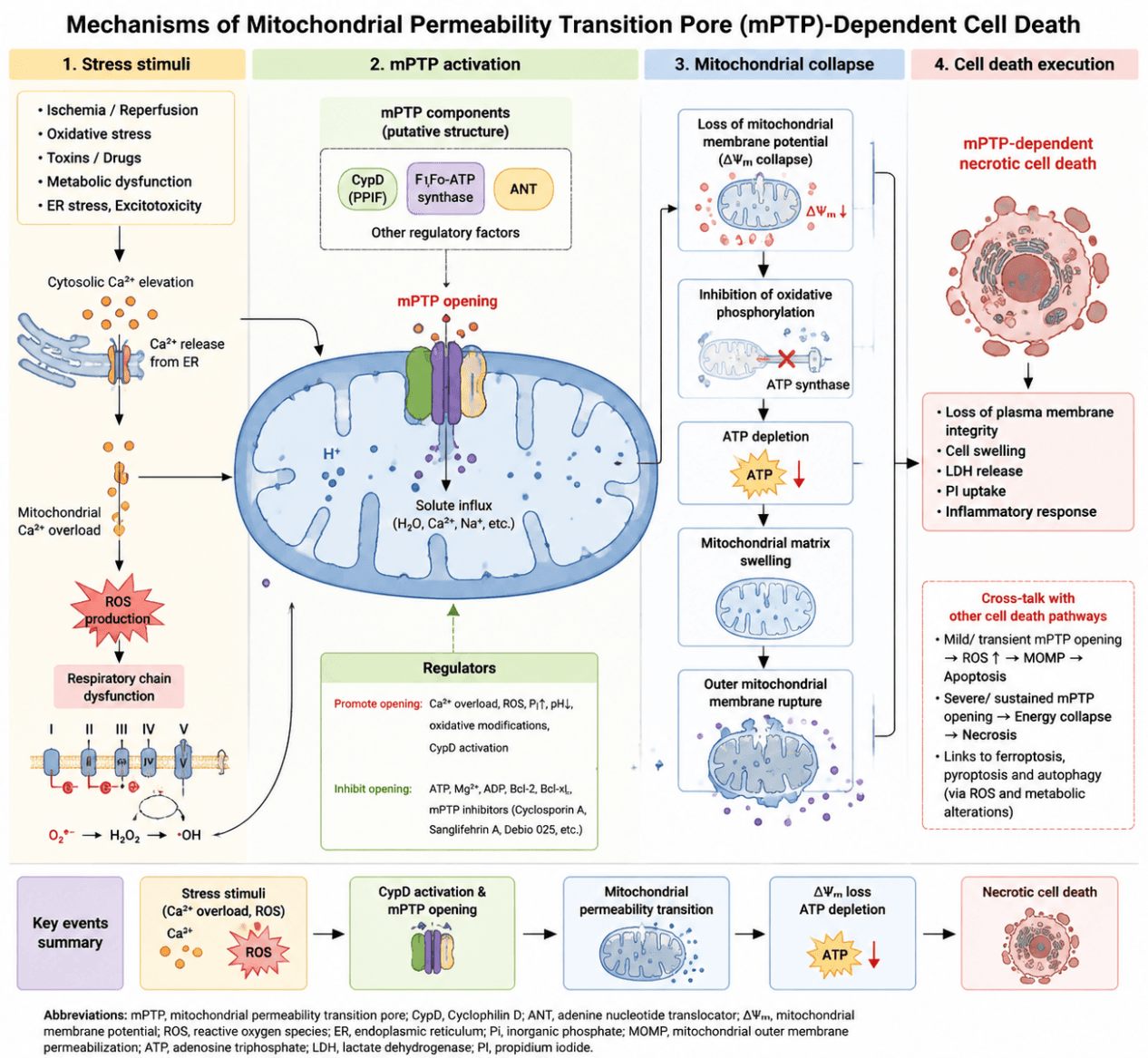
Mitochondrial permeability transition (mPT)-mediated cell death is a mitochondria‑dependent form of cell death driven by the abnormal opening of the mitochondrial permeability transition pore (mPTP). Under normal physiological conditions, the mPTP remains closed to maintain mitochondrial membrane potential, oxidative phosphorylation, and ATP production. When cells are exposed to ischemia, oxidative stress, toxic stimuli, or metabolic disturbances, intracellular Ca²⁺ overload and ROS accumulation induce mPTP opening, in which Cyclophilin D (CypD/PPIF) serves as a key regulatory factor. Persistent mPTP opening increases mitochondrial inner membrane permeability, resulting in loss of mitochondrial membrane potential (ΔΨm), impaired oxidative phosphorylation, ATP depletion, mitochondrial swelling, and outer membrane rupture, ultimately triggering a predominantly necrotic form of cell death. Meanwhile, ROS and Ca²⁺ establish a positive feedback loop, further promoting sustained mPTP opening and exacerbating mitochondrial damage. The core mechanism of mPTP‑mediated cell death can be summarized as: Cellular stress → Ca²⁺ overload / ROS accumulation → CypD activation → Persistent mPTP opening → ΔΨm collapse → ATP depletion → Mitochondrial structural disruption → Necrotic cell death.
In addition, mPTP‑mediated death exhibits extensive crosstalk with other cell death pathways, including apoptosis and ferroptosis. Under mild stress conditions, mPTP‑induced ROS elevation can promote mitochondrial outer membrane permeabilization (MOMP) and caspase‑dependent apoptosis. However, under severe damage conditions, sustained mPTP opening causes irreversible energy crisis and necrotic cell death. Therefore, the CypD–mPTP axis represents a critical regulatory hub linking mitochondrial metabolic dysfunction, oxidative damage, and cell death fate determination.
Mitochondrial permeability transition (mPT)-mediated cell death pathway schematic. External stimuli, such as ischemia/reperfusion injury, oxidative stress, toxic insults, and metabolic disturbances, initially induce intracellular Ca²⁺ accumulation and excessive production of mitochondrial ROS, resulting in mitochondrial dysfunction. Subsequently, activation of Cyclophilin D (CypD/PPIF) promotes mPTP opening, increasing mitochondrial inner membrane permeability. This allows excessive influx of water and ions into the mitochondrial matrix, leading to loss of mitochondrial membrane potential (ΔΨm), impaired oxidative phosphorylation, reduced ATP production, and mitochondrial swelling and rupture. Persistent mPTP opening ultimately causes irreversible mitochondrial damage, resulting in ATP depletion and disruption of plasma membrane integrity, thereby triggering mPTP‑dependent cell death characterized predominantly by necrotic features. Meanwhile, a positive feedback loop between ROS accumulation and mPTP opening further amplifies mitochondrial damage and accelerates the cell death process.
2 Target List
| Mechanism Module | Target / Detection Marker | Full Name | Molecular Function | Recommended Detection Method |
|---|---|---|---|---|
| mPTP Core Regulatory Axis | PPIF (Cyclophilin D, CypD) | Peptidyl‑prolyl cis‑trans isomerase F | Core regulator of mPTP opening and promotes pore activation | Western blot, qPCR, IF |
| F₁F₀‑ATP synthase (ATP5A/ATP5B) | ATP synthase F1 subunit alpha / ATP synthase F1 subunit beta | Participates in mPTP pore formation and regulation | Western blot | |
| ANT (SLC25A4/SLC25A5) | Adenine nucleotide translocator 1/2 | Regulates inner mitochondrial membrane permeability and sensitivity to mPTP opening | Western blot | |
| mPTP Opening Event Detection | Calcein‑AM/Co²⁺ assay | Calcein acetoxymethyl ester/cobalt quenching assay | Directly evaluates the extent of mPTP opening | Fluorescence assay |
| Mitochondrial permeability transition assay | Mitochondrial permeability transition assay | Evaluates mitochondrial permeability transition events | Flow cytometry / Fluorescence microscopy | |
| Ca²⁺‑Dependent mPTP Activation | Mitochondrial Ca²⁺ | Mitochondrial calcium | Critical trigger for mPTP opening | Rhod‑2 AM, mito‑GCaMP |
| MCU | Mitochondrial calcium uniporter | Mediates mitochondrial Ca²⁺ uptake | Western blot | |
| MICU1/MICU2 | Mitochondrial calcium uptake proteins 1/2 | Regulates mitochondrial Ca²⁺ entry threshold | Western blot | |
| ROS‑Induced mPTP Activation | MitoSOX | Mitochondrial superoxide indicator | Detects mitochondrial ROS production | Fluorescence assay |
| SOD2 (MnSOD) | Superoxide dismutase 2 | Mitochondrial antioxidant defense enzyme | Western blot | |
| GPX4, PRDX3 | Glutathione peroxidase 4 / Peroxiredoxin 3 | Evaluate mitochondrial ROS scavenging capacity | Western blot | |
| Mitochondrial Membrane Potential Collapse | JC‑1 | JC‑1 mitochondrial membrane potential probe | Detects reduction of mitochondrial membrane potential (ΔΨm) caused by mPTP opening | Fluorescence staining |
| TMRE/TMRM | Tetramethylrhodamine ethyl ester / Tetramethylrhodamine methyl ester | Measures mitochondrial membrane potential | Flow cytometry / IF | |
| Oxidative Phosphorylation Dysfunction | COX4 | Cytochrome c oxidase subunit IV | Marker of mitochondrial respiratory chain Complex IV | Western blot |
| NDUFS1/NDUFB8 | NADH dehydrogenase Fe‑S protein 1 / NADH dehydrogenase [ubiquinone] flavoprotein subunit | Indicators of mitochondrial Complex I function | Western blot | |
| SDHB | Succinate dehydrogenase iron‑sulfur subunit B | Indicator of mitochondrial Complex II function | Western blot | |
| ATP5A | ATP synthase F1 subunit alpha | Evaluates mitochondrial ATP synthesis capacity | Western blot | |
| Mitochondrial Energy Failure | ATP level | Cellular ATP level | Reflects mPTP opening‑induced ATP depletion | ATP assay |
| AMPK phosphorylation | AMP‑activated protein kinase phosphorylation | Marker of cellular energy stress response | Western blot | |
| Mitochondrial Structural Disruption | TOM20 | Translocase of outer mitochondrial membrane 20 | Marker of mitochondrial mass and quality control | IF, WB |
| TIM23 | Translocase of inner mitochondrial membrane 23 | Inner mitochondrial membrane protein | Western blot | |
| COX IV | Cytochrome c oxidase subunit IV | Indicator of mitochondrial structural integrity | Western blot | |
| Necrotic Cell Death Outcome | LDH release | Lactate dehydrogenase release assay | Indicates plasma membrane rupture | LDH assay |
| PI uptake | Propidium iodide uptake | Detects loss of plasma membrane integrity | Flow cytometry | |
| HMGB1 release | High mobility group box 1 release | Release of necrosis‑associated damage‑associated molecular patterns (DAMPs) | WB / ELISA | |
| Exclusion of Classical Apoptosis | Cleaved‑CASP3 | Cleaved caspase‑3 | Determines caspase‑dependent apoptotic activation | Western blot |
| Cleaved‑PARP | Cleaved poly(ADP‑ribose) polymerase | Execution marker of apoptosis | Western blot | |
| Cytochrome c release | Cytochrome c release | Indicator of mitochondria outer membrane permeabilization (MOMP)‑associated apoptosis | Western blot |
3 Application Scheme
| Mechanistic Stage | Markers |
|---|---|
| mPTP regulation | PPIF / Cyclophilin D |
| mPTP opening | Calcein‑Co²⁺ assay |
| Mitochondrial membrane potential | JC‑1, TMRE, TMRM |
| Ca²⁺ overload | Mitochondrial Ca²⁺ probes |
| ROS production | MitoSOX, DCFH‑DA |
| Mitochondrial damage | TOM20, COX IV |
| ATP depletion | ATP assay |
| Necrotic cell death occurrence | LDH release, PI staining |
| Exclusion of apoptosis | Cleaved‑CASP3, Cleaved‑PARP |
4 References
- Bernardi P, Gerle C, Halestrap AP, et al. Identity, structure, and function of the mitochondrial permeability transition pore: controversies, consensus, recent advances, and future directions. Cell Death Differ. 2023;30(8):1869‑1885. doi:10.1038/s41418‑023‑01187‑0.
- Bonora M, Giorgi C, Pinton P. Molecular mechanisms and consequences of the mitochondrial permeability transition. Nat Rev Mol Cell Biol. 2022;23:266‑285. doi:10.1038/s41580‑021‑00433‑y.
- Bock FJ, Tait SWG. Mitochondria as multifaceted regulators of cell death. Nat Rev Mol Cell Biol. 2020;21:85‑100. doi:10.1038/s41580‑019‑0173‑8.
- Halestrap AP. What is the mitochondrial permeability transition pore? J Mol Cell Cardiol. 2009;46:821‑831. doi:10.1016/j.yjmcc.2009.02.021.
- Kwong JQ, Molkentin JD. Physiological and pathological roles of the mitochondrial permeability transition pore in the heart. Cell Metab. 2015;21:206‑214. doi:10.1016/j.cmet.2014.12.001.