
info@mail.ucallm.com
```
```
PARP‑dependent cell death (Parthanatos)
1 Mechanism Overview
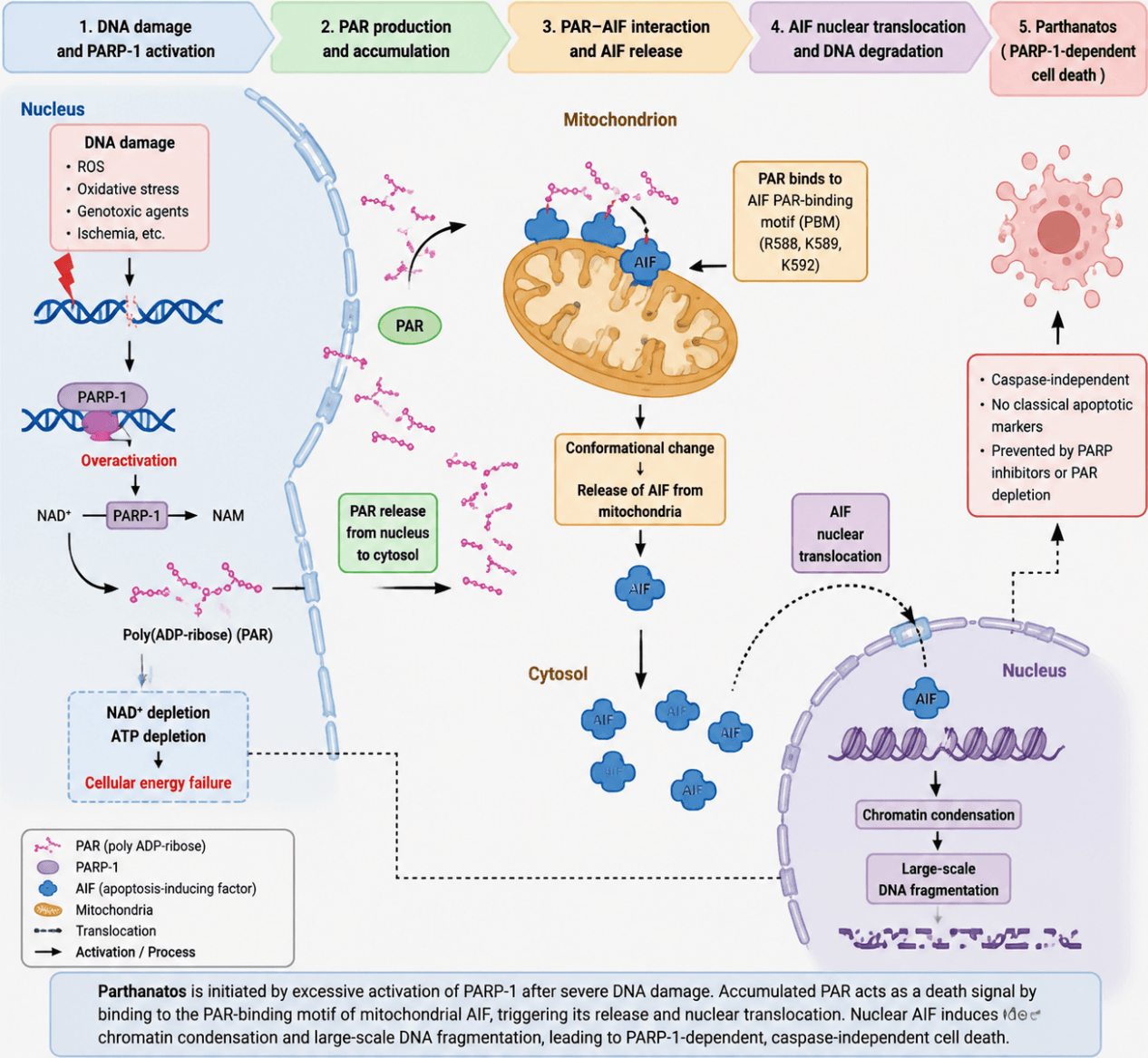
PARP‑dependent cell death (Parthanatos) is a form of caspase‑independent programmed cell death mediated by excessive activation of poly(ADP‑ribose) polymerase‑1 (PARP‑1). Unlike classical apoptosis, necrosis, and autophagic cell death, the defining feature of Parthanatos is the abnormal activation of PARP‑1, which leads to the excessive production of poly(ADP‑ribose) (PAR), followed by the release and nuclear translocation of apoptosis‑inducing factor (AIF) from mitochondria, ultimately resulting in extensive DNA degradation and cell death.
Under normal physiological conditions, PARP‑1 primarily functions in DNA damage repair. When cells experience severe oxidative stress, accumulation of reactive oxygen species (ROS), DNA strand breaks, or alkylation damage, DNA lesions activate PARP‑1. Moderate PARP‑1 activation facilitates DNA repair; however, persistent and excessive PARP‑1 activation causes massive consumption of NAD⁺, leading to disruption of cellular energy metabolism and promoting abnormal accumulation of PAR polymers. When PAR levels exceed cellular tolerance, PAR shifts from a DNA repair‑associated molecule to a death‑inducing signal, initiating the Parthanatos pathway.
PAR serves as a critical mediator in this pathway. Excessively generated PAR can translocate from the nucleus into the cytoplasm and specifically interact with the mitochondrial protein AIF. Studies have identified a PAR‑binding motif (PBM) within AIF, in which key amino acid residues including Arg588, Lys589, and Lys592 participate in PAR recognition and binding. Upon PAR–AIF interaction, the stability between AIF and the mitochondrial membrane is disrupted, promoting AIF release from mitochondria into the cytoplasm and subsequent translocation into the nucleus. Nuclear AIF exerts a nucleotoxic effect by inducing chromatin condensation and large‑scale DNA fragmentation, thereby triggering cell death.
Unlike apoptosis, in which DNA fragmentation is mediated by caspases, DNA degradation during Parthanatos primarily depends on an AIF‑mediated caspase‑independent mechanism. Therefore, inhibition of caspase activity cannot completely prevent this type of cell death, whereas inhibition of PARP activity or reduction of PAR accumulation can provide significant cellular protection.
Parthanatos is currently recognized as an important cell death mechanism involved in various pathological processes, including ischemia‑reperfusion injury, neurodegenerative diseases, inflammatory damage, and regulation of cancer therapeutic responses.
PARP‑dependent cell death (Parthanatos) pathway schematic. DNA damage induces PARP‑1 overactivation, leading to excessive PAR production and depletion of NAD⁺, resulting in cellular energy imbalance. Accumulated PAR acts as a death signal by interacting with mitochondrial AIF, inducing AIF release from mitochondria and its translocation into the nucleus. Nuclear AIF further promotes chromatin condensation and large‑scale DNA fragmentation, ultimately leading to a caspase‑independent, PARP‑1‑mediated form of cell death.
2 Target List
| Mechanism Module | Target / Detection Marker | Full Name | Detection Purpose | Expected Change |
|---|---|---|---|---|
| DNA Damage Initiation | γH2AX | Phosphorylated histone H2AX | Evaluation of DNA double‑strand break levels | ↑ |
| 8‑OHdG | 8‑Hydroxy‑2′‑deoxyguanosine | Marker of oxidative DNA damage | ↑ | |
| PARP1 Activation | PARP1 | Poly(ADP‑ribose) polymerase 1 | Core initiator protein of Parthanatos | ↑ / Activation |
| Cleaved‑PARP1 | Cleaved poly(ADP‑ribose) polymerase 1 | Determines PARP1 cleavage and distinguishes Parthanatos from apoptosis | Usually no significant increase | |
| PAR (poly(ADP‑ribose)) | Poly(ADP‑ribose) | Indicator of PARP1 enzymatic activity and accumulation of death signals | ↑↑ | |
| PAR Metabolism and Energy Depletion | NAD⁺ | Nicotinamide adenine dinucleotide | Assessment of substrate depletion caused by PARP1 overactivation | ↓ |
| ATP | Adenosine triphosphate | Evaluation of cellular energy status | ↓ | |
| NAM | Nicotinamide | Degradation product of NAD⁺ metabolism | ↑ | |
| PAR–AIF Core Axis | AIF (AIFM1) | Apoptosis‑inducing factor mitochondria‑associated 1 | Core execution factor of Parthanatos | Mitochondrial ↓, nuclear ↑ |
| AIF mitochondrial/cytoplasmic distribution | Subcellular distribution of AIF | Determines AIF release from mitochondria | Mitochondrial AIF ↓, cytoplasmic AIF ↑ | |
| AIF nuclear translocation | Nuclear translocation of apoptosis‑inducing factor | Determines occurrence of Parthanatos | ↑ | |
| AIF PAR‑binding motif | PAR‑binding motif of AIF | Validates PAR–AIF interaction mechanism | Cell death decreased after mutation | |
| Nuclear Death Execution | Chromatin condensation | Chromatin condensation | AIF‑mediated chromatin condensation | ↑ |
| TUNEL | Terminal deoxynucleotidyl transferase dUTP nick end labeling | Detection of DNA fragmentation | ↑ | |
| DNA fragmentation | Large‑scale DNA degradation | Detection of extensive genomic DNA degradation | ↑ | |
| Mitochondrial Damage‑Associated Markers | ΔΨm (JC‑1/TMRE) | Mitochondrial membrane potential | Evaluation of mitochondrial membrane potential changes | ↓ |
| ROS | Reactive oxygen species | Assessment of oxidative stress levels | ↑ |
3 Application Scheme
| Category | Recommended Markers |
|---|---|
| PARP activation | PARP1 + PAR |
| PAR accumulation | PAR staining / WB |
| AIF release | Mitochondrial AIF ↓ + Cytosolic AIF ↑ |
| AIF nuclear translocation | Nuclear AIF ↑ |
| DNA damage | γH2AX + TUNEL |
| Cell death validation | PARP inhibitor rescue |
4 References
- Wang Y, Kim NS, Haince JF, Kang HC, David KK, Andrabi SA, Poirier GG, Dawson VL, Dawson TM. Poly(ADP‑ribose) binding to apoptosis‑inducing factor is critical for PAR polymerase‑1‑dependent cell death (Parthanatos). Science Signaling. 2011;4(167):ra20. doi:10.1126/scisignal.2000902.
- Andrabi SA, Kim NS, Yu SW, et al. Poly(ADP‑ribose) (PAR) polymer is a death signal. Proceedings of the National Academy of Sciences of the United States of America. 2006;103(48):18308‑18313. doi:10.1073/pnas.0606526103.
- Yu SW, Wang H, Poitras MF, et al. Mediation of poly(ADP‑ribose) polymerase‑1‑dependent cell death by apoptosis‑inducing factor. Science. 2002;297(5579):259‑263.