
Organoid models recapitulate a wide range of biological characteristics associated with human development, disease initiation, tissue homeostasis and tissue repair, yielding abundant promising candidate therapeutic targets. We supply a full portfolio of organoid research reagents alongside standardized culture systems, empowering cell biologists to refine culture protocols and establish organoid models featuring high viability as well as uniform and stable phenotypes.
What is an organoid?
Stem cells feature distinctive capabilities of self-renewal and differentiation into various specialized cell populations. Leveraging these properties, researchers are able to generate three-dimensional multicellular structures in vitro that mimic native organs. These constructs need to meet three fundamental requirements: they comprise multiple organ-specific cell types, recapitulate relevant physiological functions, and form spatially organized tissue architectures Further information about organoids is available below.
Products for Organoid Culture
1 Core extracellular matrix hydrogels for organoid culture: Basement Membrane Extract (BME), Synthetic Hydrogel, Extracellular Matrix Proteins
2 Organoid harvesting and dissociation reagents: Organoid Harvesting & Dissociation Solution
3 Recombinant proteins dedicated to organoid culture
4 Small molecule compounds for organoid culture systems
Assay & Detection Tools
Deep gene expression profiling via microarray and quantitative real-time PCR (RT-qPCR).
Alterations in protein expression can be quantified by immunolabeling techniques, including immunohistochemistry (IHC), immunofluorescence (IF), flow cytometry and cytokine profiling analysis. (Supplement relevant product information, including TSA kits, antibody arrays and other related products.
WENR Culture Protocol
Hans Clevers and Toshiro Sato published a SnapShot article in Cell that outlined the WENR protocol. Their research emphasized that organoids derived from adult tissues require certain universal cytokines, such as EGF, Noggin and R-spondins, to support their growth and maintenance. In addition, they noted that Wnt-3a must be supplemented to the culture medium when culturing organoids that lack sufficient autocrine or paracrine Wnt ligands. Furthermore, additional factors including FGF10, HGF, TGF inhibitors and p38 inhibitors may be required to optimize culture conditions for different tissues and stem cells, depending on tissue type and specific requirements.
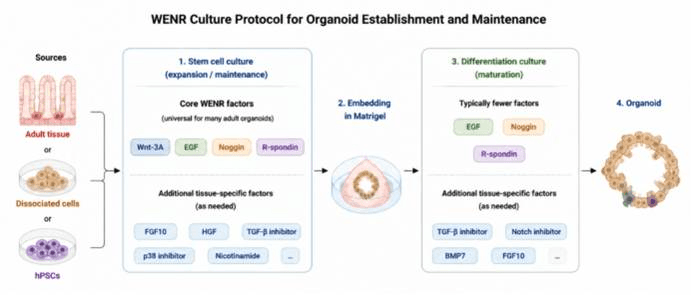
Organoid engineering: Mechanism overview. WENR establishes a "universal stem cell niche" to sustain organoid growth; tissue-specific factors deliver "organ identity cues" that determine the final organoid lineage.
| Type of tissue | Source | Stem cell culture condition (niche factors) | Differentiation culture condition |
| Stomach | Adult mouse | EGF, Noggin, R-spondin, Wnt-3A, FGF10 | EGF, R-spondin |
| Adult human | EGF, Noggin, R-spondin, Wnt-3A, FGF10 | EGF, R-spondin | |
| hPSC | EGF | EGF | |
| Small intestine | Adult mouse | EGF, Noggin, R-spondin | EGF, Noggin, R-spondin |
| Adult human | EGF, Noggin, R-spondin, Wnt-3A, TGF-β inhibitor, p38 inhibitor | EGF, Noggin, R-spondin, TGF-β inhibitor | |
| hPSC | EGF | EGF | |
| Colon | Adult mouse | EGF, Noggin, R-spondin, Wnt-3A | EGF, Noggin, R-spondin |
| Adult human | EGF, Noggin, R-spondin, Wnt-3A, TGF-β inhibitor, p38 inhibitor | EGF, Noggin, R-spondin, TGF-β inhibitor | |
| Pancreas | Adult mouse | EGF, Noggin, R-spondin, Wnt-3A, FGF10, Nicotinamide | EGF, Noggin, R-spondin, Wnt-3A |
| Adult human | EGF, Noggin, R-spondin, Wnt-3A, FGF10, TGF-β inhibition, Nicotinamide | / | |
| Liver | Adult mouse | EGF, Noggin, R-spondin, Wnt-3A, FGF10, HGF, Nicotinamide | EGF, Noggin, FGF10, TGF-β inhibition, Notch inhibition |
| Adult human | EGF, Noggin, R-spondin, Wnt-3A, FGF10, HGF, Nicotinamide, TGF-β inhibitor, Forskolin | EGF, Noggin, FGF10, TGF-β inhibition, Notch inhibition, BMP7 |
1. Organoid Models- physiological organoids
Click on the organoid type.
2. Organoid Models- pathological organoids
Tumor initiation and progression involve sustained, complex dynamic crosstalk between malignantly transformed cells and the tumor microenvironment (TME). Immunotherapies targeting the immune TME have been validated in numerous clinical trials; however, therapeutic responses vary drastically across different tumor histotypes, and are commonly hampered by transient efficacy, prominent inter-individual heterogeneity and widespread drug resistance. Accordingly, high-fidelity experimental models that faithfully reconstruct patient-specific tumor immune microenvironments and recapitulate tumor biological traits as well as immunotherapeutic responses can greatly streamline patient stratification, target discovery and mechanistic research on drug resistance for immuno-oncology agents. Tumor organoid models fully retain the core immune signatures of the TME, holding broad application prospects in tumor immunology research, new drug development and precision medicine.
Core Applications:
This system supports multiple research directions including tumor microenvironment simulation, drug screening & efficacy assessment, cell death mechanism study, drug resistance research and gene function exploration. Three-dimensional culture models such as cell spheroids accurately reconstruct the tumor microenvironment ex vivo, faithfully reproducing cell interactions, signaling pathway modulation and cellular responses to external stimuli.
In addition, tumor tissues exhibit prominent intratumoral cellular heterogeneity: subpopulations of tumor cells differ in differentiation status, metastatic capacity and drug resistance. Conducting drug screening targeting cells with low differentiation potential can achieve superior therapeutic outcomes. Cells isolated from primary tumor tissues can be used to establish clonal single-cell tumor lines. By assaying their migratory capacity, researchers can predict the target organs of tumor metastasis, enabling targeted drug screening against metastatic tumor cells.
Common Reagents for Cancer Organoid Culture:
Tumor organoid culture involves sophisticated culture systems. In addition to basal culture media, a variety of cytokines and small‑molecule compounds are essential supplements, and the demand for these additives varies significantly among different tumor organoid types. For instance, cytokines such as EGF and FGF stimulate epithelial cell proliferation and promote tumor growth. RSPO1, a potent activator of the Wnt signaling pathway, facilitates cell proliferation and differentiation, and supports the formation and maintenance of diverse cell populations within organoids.
Furthermore, the TGF‑β superfamily inhibitor A83‑01 and the ROCK inhibitor Y‑27632 enhance the structural stability and long‑term proliferative capacity of tumor organoids, preventing cell death caused by excessive cytoskeletal contraction. After culture completion, marker antibodies are used for organoid identification and phenotypic characterization to ensure consistency with in vivo tumor characteristics, providing a reliable model foundation for subsequent drug screening and translational research.
To support tumor organoid research, we have developed a comprehensive portfolio of high‑quality cytokines, small‑molecule compounds, and biomarker antibodies. Our cytokines undergo rigorous quality control to guarantee high biological activity and stability, effectively supporting the proliferation and differentiation of tumor organoids. The small‑molecule compounds feature high purity verified by NMR detection, delivering consistent and reliable performance for diverse tumor organoid culture applications. Our thoroughly validated biomarker antibodies are compatible with multiple detection platforms, including immunohistochemistry (IHC), immunofluorescence (IF), and H&E staining, enabling accurate identification and functional characterization of tumor organoids.
Cytokines & Small Molecules for Tumor Organoid Culture, Biomarker Antibodies for Organoid Characterization
Experimental result figures: tissue morphology, histopathology, gene expression profiling (genomic & transcriptomic analysis), drug susceptibility and tumorigenic capacity.
| Colorectal Cancer Organoids | Breast Cancer Organoids | Hepatocellular Carcinoma (HCC) Organoids | Pancreatic Cancer Organoids | Lung Cancer Organoids |
| Head and Neck Squamous Cell Carcinoma (HNSCC) Organoids | Gastric Cancer Organoids | Prostate Cancer Organoids | Ovarian Cancer Organoids | Glioblastoma (GBM) Organoids |
| Renal Cell Carcinoma Organoids | Cholangiocarcinoma Organoids | Melanoma Organoids | Bladder Cancer Organoids |